Showing posts with label wheelchairs. Show all posts

Wednesday, 22 November 2017

Athens

Five days in Athens in November - what an opportunity.  I was asked to go to a conference from the Sunday evening to the Tuesday afternoon and flight times meant the easiest solution was to fly out  on Saturday and back on Wednesday.  This meant I had Sunday for sightseeing.  I flew with Easyjet and all went well with arrangements.

First off I arrived at Athens Airport about 8:30 and debated whether I should get a taxi (€38) or the metro (€10) in to my hotel.  As usual I had used Google Maps to check out the route from the metro to the hotel as, despite good instructions from the conference organisers, I know all too well how a "gentle slope" can in fact be insurmountable in a wheelchair.  I had mixed feelings on whether I could easily get to the hotel as I was fairly well loaded down - with my carryon bag on the front, freewheel stowed on the back and my carry on bag on my lap.

The metro ticket office said there was no charge for me so I went with that.  What a pleasant surprise - it's a brand new metro so every single station is fully accessible and in all my travels I saw no more than a 3cm gap between train and platform.  The norm was a much, much smaller gap.  Don't mind the gap.  There isn't one.


When I got to the Megaro Mousikis station, near my hotel, I could see it was a gentle downhill slope to my hotel so opted to walk, which was fine apart from dodgy the branches of an orange tree (complete with oranges) and a few detours for dropped kerbs.  Hotel was lovely, room was nice and accessible, but the lift doors were only about 70cm wide - I had to remove the silicon grips from my push rims to fit in one!

Sunday morning I got up early and had the most ridiculously generous breakfast in my room - for a €3 surcharge over breakfast in the dining room. Conveniently this avoided dealing with the stairs to the dining room.  Each morning I would tick fewer boxes on the menu and still get more than I could eat.  By the time I left I had an impressively stocked fruit bowl in my room. Really all I wanted was a piece of fruit, some Greek yoghurt and honey and a couple of pastries.

I headed back to the metro station, feeling much more confident about using it, to discover the Athens Classic Marathon underway.  You know - the one that actually starts at Marathon and finishes in the ancient Panathenaic Stadium.  I managed to find a gap in the runners (who were going pretty slowly, it being the 40km mark) to cross to the metro station's lift and headed off.


First stop on my itinerary was the Acropolis museum - built to house the Elgin Marbles should they ever be returned.  It's an amazing museum, taking you up through the different periods of Athenian history with well chosen examples of each periods treasures.  Given the sheer quantity of archaeological treasures in Athens - they even have mini-museums in many of the metro stations - it could have ended up looking like your Granny's attic.  Instead it's light and airy and everything is well displayed.  The top floor is constructed to the exact dimensions of the Parthenon, which overlooks it.  There are spaces for each of the panels currently in the British Museum.  It really is where they should be.  No photos allowed, though.  Apart from of the Lego version.


Slight comedy moment at the entrance:

Me:  One adult please
Cashier:  Oh, you are free, do you have proof of the percentage of your disability?
Me:  Um, no.
Cashier, looking me up and down:  Can you walk?
Me: A little, a few metres at most.
Cashier, handing me a ticket:  I guess you must qualify, no charge.

Note to others:  Take your Blue Badge or similar to Greece with you!

Next up - I'd heard from friends that there is a lift up to the Acropolis itself.  Keen to add another site to my list of "World Heritage Sites I've been in a lift in", I started wheeling myself up.  It was a warm day, at least for someone who lives in Scotland.  The Athenians were in coats and hats.  I was in a summer dress and knee length leggings.  The first stage was a gentle hill with marble pavements.  I well recommend marble as an outdoor wheeling surface.  Effortless. 


Next up was a steeper hill with what were basically marble cobbles and poorly grouted.  Very hard work, with zig-zagging not really helping because it just made it more likely the wheels would get stuck.  I accepted a few offers for help on steeper bits, but only for a few minutes lest my helper expired.  Eventually reached the ticket area, over halfway up the Acropolis hill, to discover that whilst there is indeed a lift there is also a ramp (I think they mean one of those platform lifts) which was out of order.  So I didn't get my trip to the top.  I got pretty close though.


The climb was well worth it though as I went down the north side of the hill - much steeper but more interesting.  Including this view over the Ancient Agora.


After some detours when streets turned out to be staircases, I made it down to Monastiraki, which is very much tourist central of Athens.  Lots of little lanes with small shops, some of which I could even get into, interspersed with ruins from various periods. 


It's a fun place just to walk around, people watch and see what's around the next corner. 


Being Sunday there was a flea market on.  I worked my way down through the tiny streets to Thissiou station, where I wandered a wee way up the Apostolou Pavlou Avenue, a walking route through the centre of Athens which is a much more sensible route from the Acropolis Museum than the one I had taken. There was a great view here of the Temple of Hephaestus (which I'd seen from the Acropolis earlier) but by this time I was too tired to attempt to get closer to it - and it was time for me to head for the start of my conference.

Thursday, 30 June 2016

Almost but not quite...

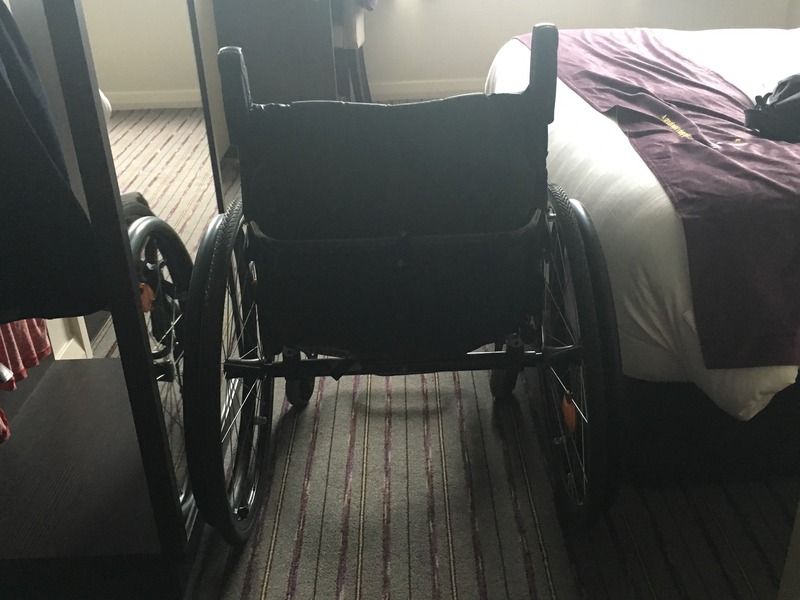
I'm at the Nottingham Human Rights Law Centre Summer School this week and we are staying in a Premier Inn in the centre of Nottingham.  I've been given an accessible room, which usually I don't bother with as I can walk the short distances in a hotel room.

The hotel is almost brand new and very comfortable.  It has a wet room with plenty of hand rails.  The basin is a decent size and there is counter space for toiletries and make up.  There's plenty of space to move around.  All in all the architect designed an accessible room that meets all the right standards but doesn't feel like a public toilet.

And then, I suspect, someone with a bit less knowledge came along to fit it out.


There's a shelf unit (with wheelchair height hanging rail) that sticks out into the room making it very difficult to squeeze a wheelchair through.  They should have put hooks on the wall.  


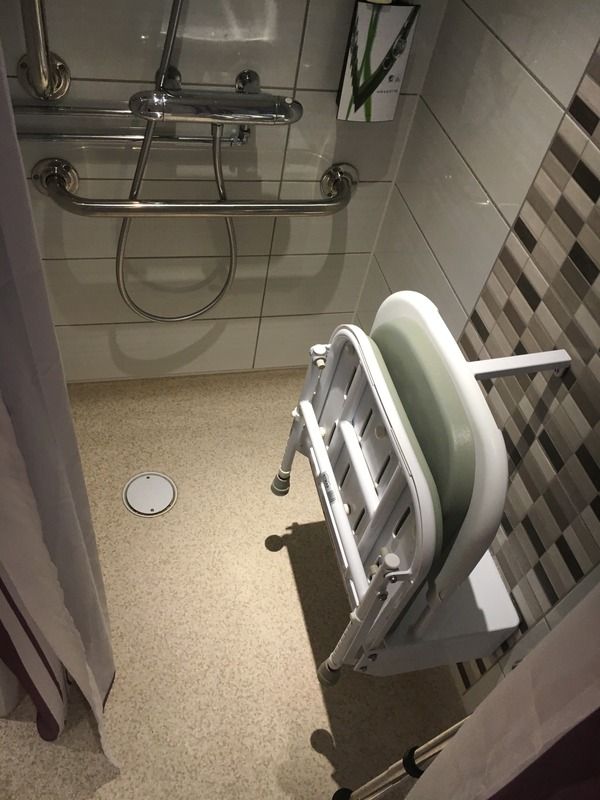
There's a very bulky shower seat in a small but otherwise workable shower area.  It makes it tricky to shower whether or not you're using it.  You can get much smaller ones than this, that take up less space or they could provided a freestanding chair or stool that could be moved out of the way.  

The phenomenon of a building being designed accessible but obstacles being added that reduce accessibility is not limited to hotels.  Shops are really goo at adding free standing displays that block aisles or even the tills!  

Friday, 3 June 2016

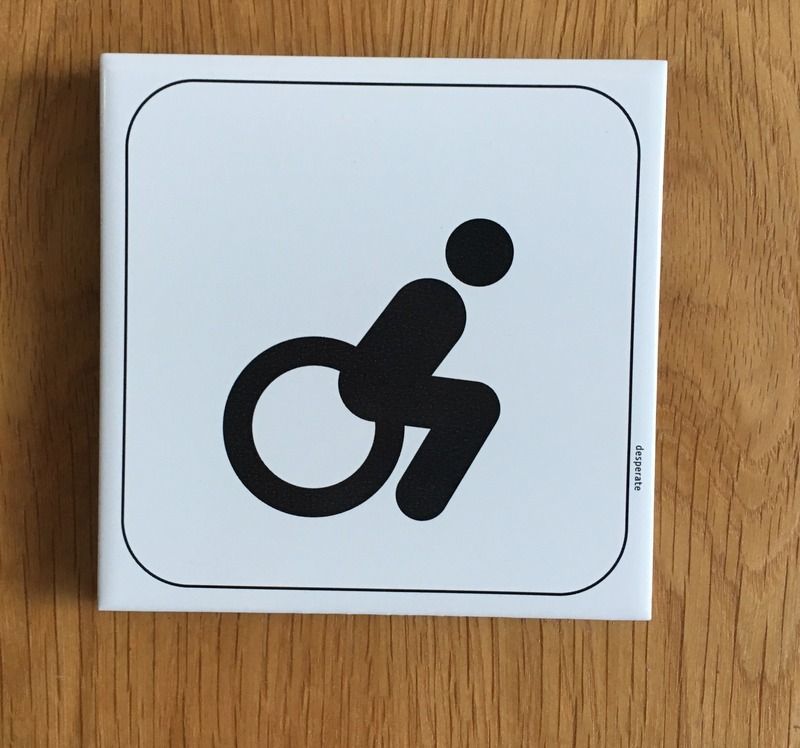
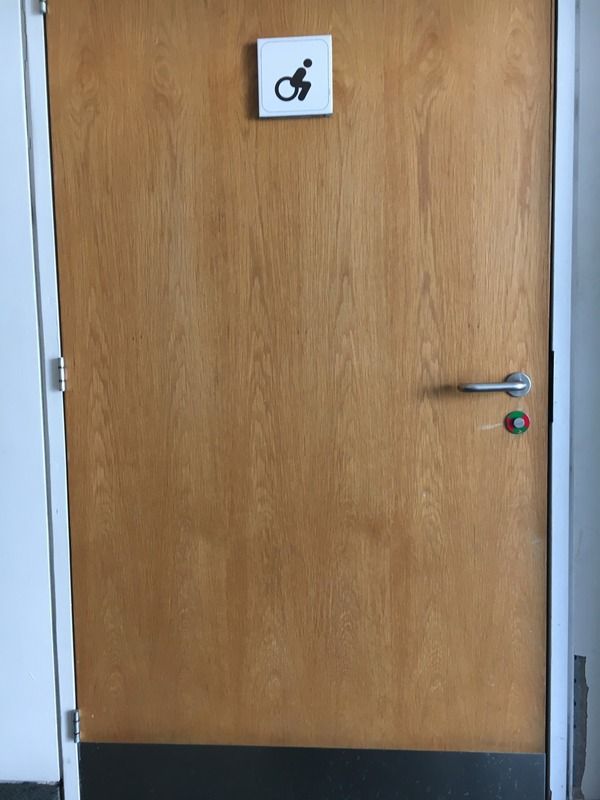
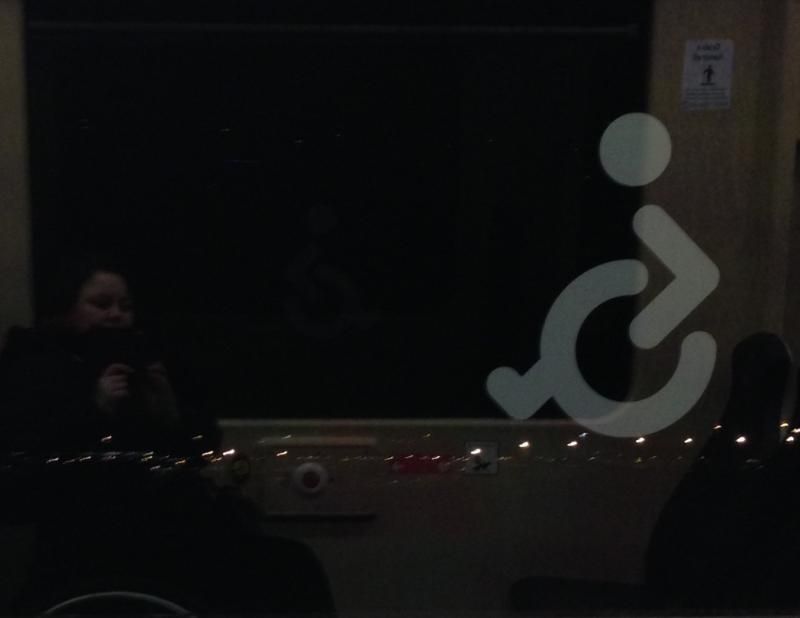
I'm at an event today at the Lighthouse in Glasgow and had to take a picture of this symbol they've used in all the signage for their disabled toilets.


I love active wheelchair logos, like the one on the Edinburgh trams I posted about a couple of years ago.  This person is clearly going up a very steep hill!

I'd suggest one small change - maybe it should be at the eye level of a wheelchair user.


Thursday, 31 March 2016

A good idea this, but first, toilets.

Disabled toilets are actually quite interesting in their variety.  And also in the ways that they can be done badly.  I'm lucky - I can stand and walk so transferring isn't a problem, so my interest is mostly theoretical, but for those who have to transfer horizontally (i.e. slide from wheelchair to toilet and then back again) it must be a nightmare. It doesn't surprise me at all that there is a whole blog on the subject.

The basics are pretty easy.  Lots of space, some handrails and a big door.  Easy?  That first criteria, it turns out, is the biggest problem.  Disabled toilets have loads of space.  And space is often at a premium in restaurants and shops.  You can see the thought process - lovely big space, we'll just store the high chairs/bulk pack of toilet roll/cleaning equipment in there.  The other thing is that they see the lovely space, realise they also need to provide a baby change area, so in goes a changing table and a really bulky bio-waste bin for nappies.   The problem is, if the toilet is the minimum size and you add those in, suddenly there's not enough room for a wheelchair user to get in, turn around, maneuver alongside the toilet (from either side) and then transfer across.  Add in a helper and it's pretty crowded in there.  Now I've nothing against baby change areas (I've used them enough myself) but if the disabled toilet is going to do double duty, it needs to be bigger.

Then there's the sinks.  Often they're tiny, probably because it's in some guideline somewhere and because the room is probably too small to start with.  But if the water pressure is too high, you end up with a very wet lap.  And the tiny ones don't feel like they're any easy to use than a bigger one, with clearance underneath would be.  They usually require a lot of leaning at an odd angle.

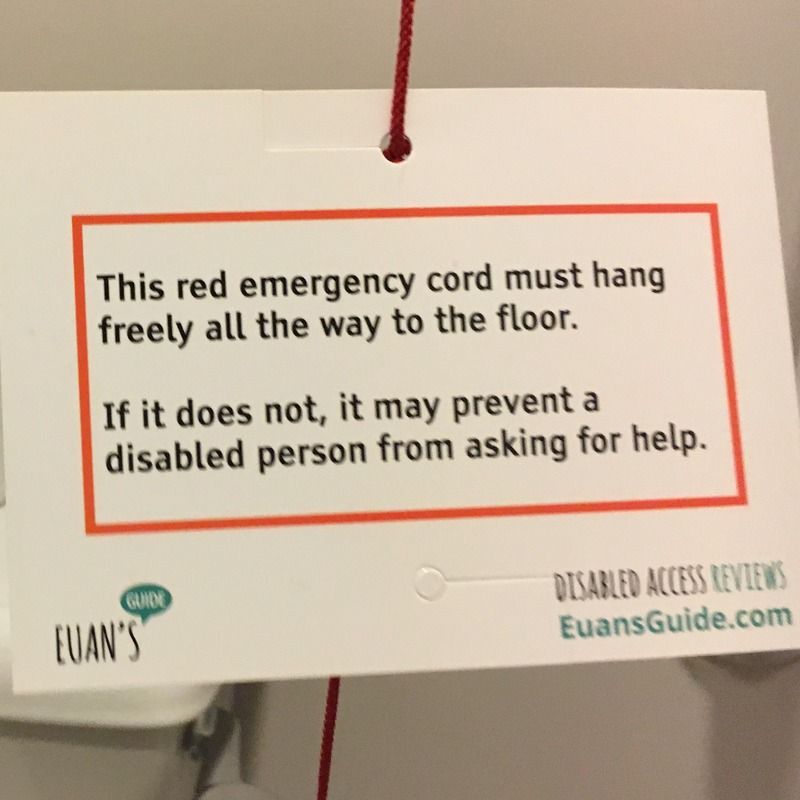
Finally, that red emergency pull cord.  It's not something I'm likely to use, but it's there for a reason.  A very good reason.  If a disabled person falls, for example because they're trying to transfer at a strange angle, they need to be able to grab it to get help.  Easily.  Without standing up (because perhaps they can't).  But cleaners clearly find the cord extremely annoying.  I've seen all sorts of efforts to tidy it "out of the way" - in one extreme case a hook had been installed, a foot below the ceiling, for it to be wound round!  One of the most annoying being to wrap it round the fold down handrails.  Thing is, they're there for a reason as well and it's pretty embarrassing to fold down the handrail (which I do need) and set it off.  Even if you can reach the reset button in a hurry (they're usually clear across the room), even if someone knocks rather than barging straight in while your knickers are down, you're going to do a walk (or wheel) of shame back to your table when that happens in a busy restaurant.

It seems like I'm not the only one who has been silently fuming about the safety cords.  The great Euan's Guide, who run a Scottish version of the J'accede app I used in France last year, have started a campaign and produced A5 cards to raise awareness of the cords.  Here's one I snapped at the Dovecot Studios in Edinburgh a couple of weeks ago.


I've ordered a supply and have already deployed my first - in an Asda store which had the cord very firmly wrapped around the hand rail (and yes, I did set it off when I untangled it!)

Saturday, 23 January 2016

Wheelchair fashion

A friend pointed me in the direction of IZ Collection, an American company who specialise in clothing for wheelchair users.  It hadn't occurred to me that such a thing existing but I can definitely see the point.

One of the things they don't tell you when you get a wheelchair is that you'll end up replacing most of your clothes.  All my trousers were too short because when you're sitting down the whole time, it pulls the hems up and your ankles get cold - I've gone from wearing a short to a regular length.  And you don't want a lot of bulk round your middle (and mine perhaps has enough built in!) so I'm afraid treggings and jeggings, much as I hate the words, are the answer.   Cardigans and jackets have to be fastened or they catch in the wheels (and get filthy!).  And the bits of you that feel the cold change. My lovely down jacket, bought last winter, is too warm on all but the coldest days, if I'm moving about much, but at the same time my legs are often freezing.  I have a couple of men's ski jackets, in dark colours because otherwise they'd be turned grey, quickly, by the muck from the wheels.  This hybrid jacket does a good job of not cooking my arms but keeping the bits that get cold warm.  They're far lighter than any coat I'd normally wear.  Finally, none of my tailored jackets fit anymore because I've developed arm muscles.  Just as well the dress code is fairly casual at my new job.

A lot of the clothes on the IZ website, particularly in the sale, are along the lines of things I've figured out already.  Tunics were already part of my wardrobe.  I've added cropped, fastening cardigans - some bought, some hand knitted.  I hate ironing, so jersey is a great fabric - it also doesn't crease when you're sitting all day.  The thing that interested me most - and what I am most likely to order - is their trousers.  I'd not anticipated the draughts down the back of my trousers, even when wearing a longer top and a vest (US - undershirt) tucked in underneath.  I've bought a couple of pairs of elastic waisted trousers from M&S which are comfortable and fit round the waist but IZ's look really interesting.  That slanted waistline looks like it could be very useful at stopping what my Grandma used to call "a chill in your kidneys".


The other conundrum I've been mulling over is how to cover my legs to keep them warm and dry without feeling like a granny.  I quite like a couple of the options on the IZ website, but I do wonder whether I couldn't make them myself.   On the other hand, a friend suggested one of these:


Thursday, 10 September 2015

Cobbles

This post has been lurking in drafts since our holidays - poor internet connection prevented me from adding pictures, so I'm posting it now.  Pretend I'm still in France, it's 40 degrees outside, the sun is shining and I have a glass of 3 quid AOC white wine in my hand!


Cobbles have always been a bit lost on me. They look very historic and picturesque but even walking they're hard work - as any number of turned ankles evidences. On wheels, they're a nightmare. However, there are good cobbles and bad cobbles. Good ones look as good, perhaps better, but are a smooth enough surface to wheel over without trapping a caster, which carries the threat of an undignified headfirst tumble out of the chair. Good cobbles also take a fraction of the effort to push across.

We got quite a lot of experience of different cobbles surfaces in Amiens, where the signage for the disabled entrance to the cathedral has disappeared due to building works. Here's some lovely cobbles from Amiens:

 photo FD3A4C20-E882-4AC7-B812-23029616EDE1.jpg

And here's some that aren't. Notice that the good ones look nicer and are free of cigarette ends. These were only a few metres up the same street.

 photo D49D0001-7AA1-4239-8A8E-4CCEA995CC85.jpg

This evening we had dinner in a family restaurant, Leon, on the outskirts of Amiens. The man at the next table had the same model of Quickie Helium as me, but larger casters. Maybe that was for the cobbles!

Here's a few shots from Amiens.   The Cathedral was wheelchair accessible (aside from dodgy cobbles and a slightly too steep ramp at one point) but the entrance was poorly signposted as there were building works.

 photo D8BC6F1B-0682-44B2-AC7D-D45F0FDC4641_1.jpg

 photo B734E38C-3501-4990-862C-E35BFB590D76.jpg

 photo 0D1F2B44-A563-4EFB-B30A-6AA1D698896D.jpg

 photo E8D07FDE-F05C-4D2F-B62F-532A14B03801.jpg

And we found a New Zealand memorial inside.

 photo 77BD5DA6-5278-44D3-AD37-EF22570CAACC_1.jpg


Sunday, 28 June 2015

Accessible France

We're on our way to France for our summer holidays, which are usual brings the challenge of figuring out which places are accessible and which aren't.  I found very little in English, but I have just discovered J'accede which looks to be very useful.  Not all of it is translated but the basic access information is (mostly) and the good news is that accessibility French is pretty close to English.  First up is Notre Dame d'Amiens, which the site tells me is fully wheelchair accessible.  We'll be there on Tuesday (we've a trip through the Channel Tunnel first!).

Tuesday, 5 May 2015

Zen and the art of wheelchair maintenance.

I've been a bit lax over the last couple of weeks about wheelchair maintenance - you need to pump up the tyres once a week or so and strip out the front casters about once a month as grit, fluff and hair builds up.  In particular you end up with lovely little circles of hair.  On Thursday I'd noticed the casters were no longer moving very well and there was a bolt that seemed to be coming loose on either side of back, so I decided it was time.  And for the first time I did a proper job of it.

The basic rule is to take the wheels off, squirt everything that should move with WD40, tighten everything that shouldn't move but is.

So I hauled the wheelchair in the house and started stripping it down with my trust set of US hex keys.  So far so good.  Cleaned everything up, squirted WD40 all over the bearings, etc, and in the socket the front fork goes into on the frame of the chair.  As instructed I did the casters one by one, so I didn't forget which of the three positions they needed to be in.  That's the trickiest part and I've never yet managed to do it without dropping the bolts or, particularly, the washers several times.

I also took the wheels off, pumped them up to their full 110psi (that raised eyebrows when I bought the pump in the bicycle sectionof Decathlon) and squirted a bit of WD40 on the axels.

Fully re-assembled, I put the chair back in my car.

I didn't use it  much on Friday, so Saturday was the first time I used it for any length of time and it just felt weird.  Heading out to Tesco, I skidded on some gravel in the carpark.  It seemed to wobble and, on very smooth laminate flooring of the SNP local campaign office, one of the rear wheels skidded instead of turned.

I finally figured it out late afternoon - I'd managed to put one of the casters at the wrong height and that was enough to through the whole chair off.  Luckily it's a quick fix, so my local parliamentary candidate was treated to a quick demonstration of wheelchair maintenance (I keep a small purse with the hex keys for the casters in a pocket on the chair) and I was good to go.


Wednesday, 29 April 2015

Scottish Sea Life Centre - Oban

I'm still playing catch-up on our trip away during the school holidays, so here's a belated post about another one of our outings.

On our second day at Ballachulish we decided to try and dodge the rain showers and visit the Scottish Sea Life Centre at Oban.  It was featured in Rough Guide to Accessible Travel in Britain as accessible so I thought it would be fine - and have plenty of shelter if it did rain.

This Sea Life Centre is situated in a wooded area, just north of Oban.  Unlike the other's we've been to, it wasn't all in one building, but spread across several buildings.  The car park is about 100m or so from the main buildings and when we visited the ticket office was closed, so you had to enter through a gate with an uneven path.  Once back on the main path, it was smooth enough, with a couple of uneven bits where tree roots had lifted the path.  It's down a slight hill and I was a bit nervous about getting back up.

When we arrived the staff gave me a map with details of disabled access.  The main aquarium was not built with disabled access in mind, so you have to enter each of three sections separately to see everything - this means doubling back against the flow of other visitors and then going round the side of the building to re-enter via a fire exit.  At one point I sent the boy down some steps, saying I'd meet him down there, only to find I ended up stranded at the top of some steps at the other side of the building and had to shout across to get his attention.

The tricky bit highlighted in the Rough Guide was the ramp down to the lower level of the seal enclosure, which you also needed to use (again, against the flow of traffic) to get access to the lower level of the aquarium.  It was, as warned, slightly too steep but was also uneven, which made navigating it myself even riskier.  I had to ask someone for help pushing me up (and I hate this so much, my chair doesn't have push handles).  Likewise the adjacent ramp up to the upper seal viewing area is very uneven as well as slightly too steep and again I felt very much at risk of tipping.

There was also a cafe, in a separate building, with disabled toilet and a lovely view over Loch Creran, and a gift shop, with a viewing platform giving views over the otter enclosure.  The entrance to the latter was a little challenging (non-automatic door, plus ramp, plus threshold strip, plus recessed door mat!)

The outdoor areas were not so accessible.  I couldn't get up the path to the children's play area - luckily the boy is old enough to send up on his own, but it would have been disappointing for a younger child.  Likewise the Terry Nutkin Memorial Nature Trail has a narrow and steep path with steps.  The boy went off exploring it on his own, as it was one of the items on the kids' quiz which earned them medals, and was gone long enough I'd started to worry about how to go find him.

All in all we had a good day and I managed to see everything and not permanently lose the boy. I wouldn't like to visit when they were busy, because of the difficulties doubling back and going against the flow of traffic.   Unfortunately, though, I don't think it's quite as accessible as the Rough Guide writers think.

My two pieces of advice to the management are:

  • Fix the ramp at the seal enclosure - I was at serious risk of flipping over and that probably means it's dangerous for mobility scooters and potentially buggies.  The combination of uneven surfaces and a steep incline are a real problem. 
  • Please, please, please, when you're doing a trail for kids, don't include any parts of your site which aren't accessible.  Had I had a younger child, or had my child been the one in the wheelchair, they wouldn't have completed it and there would have been tears. 
Oh and the hill to the car park?  I made it back up that unaided.  And very proudly so!

Apologies for the lack of pictures.  

Saturday, 18 April 2015

Culloden Battlefield Site

We're just back from 5 days in the Highlands, so I'll be posting a bit about that.

Yesterday, we went to visit the Culloden battlefield site.  It's somewhere I've always wanted to go but have been put off by the amount of walking.  This time, no walking needed!


I checked the accessibility information on the website before we went.  Like a number of sites, they have mobility scooters available, as well as wheelchairs (which were the typical heavyweight ones found at such sites - fine for someone being pushed).  I asked the very helpful member of staff at the desk about the accessibility and she said the paths should all be OK, so I decided to try it with my wheelchair.

First off was the indoor exhibition.  There are sloped areas inside the building, but they are fairly gentle and weren't difficult to negotiate.  The entrance and car park is below the level of the battlefield site, which has a positive effect when you're up on the battlefield itself, so the slopes seem justified and they're well done.

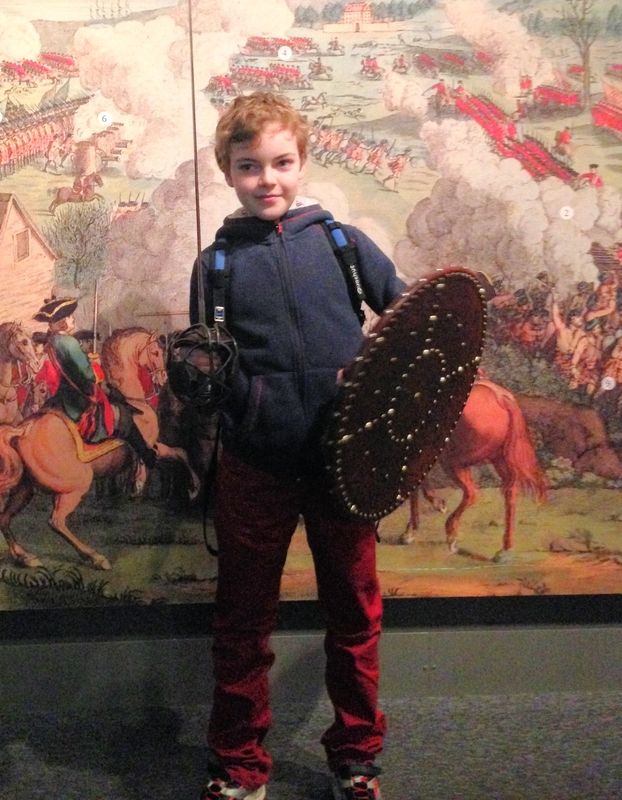
The displays are excellent and easy to see from wheelchair height.  There are interactive elements which the boy liked and an immersive cinema that puts you in the middle of the battle, which was a big hit with him.  At the end is a display of weapons from the battle and he spent about 20 minutes looking at them.  Thanks to some re-enactors from Canada and New York, he got to try a couple of them out.


And then it was out onto the battlefield itself, in our case armed only with GPS enabled audioguides.  

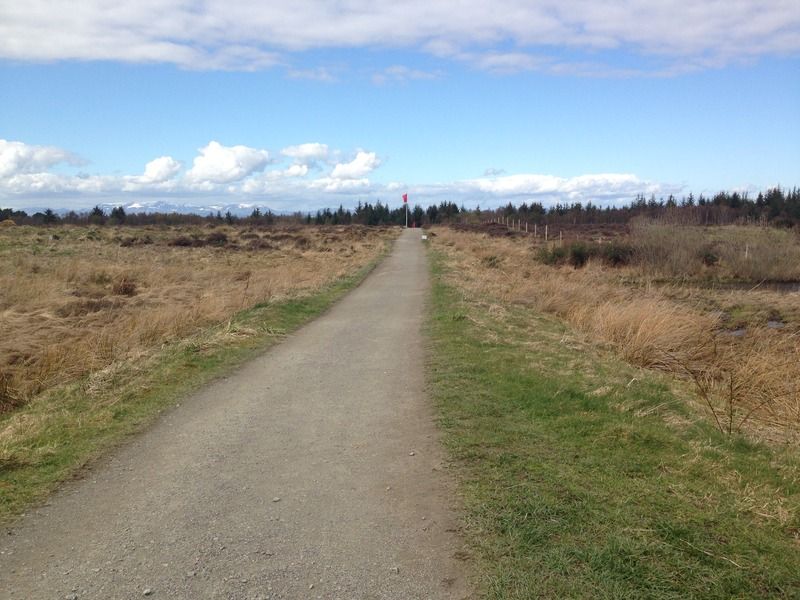
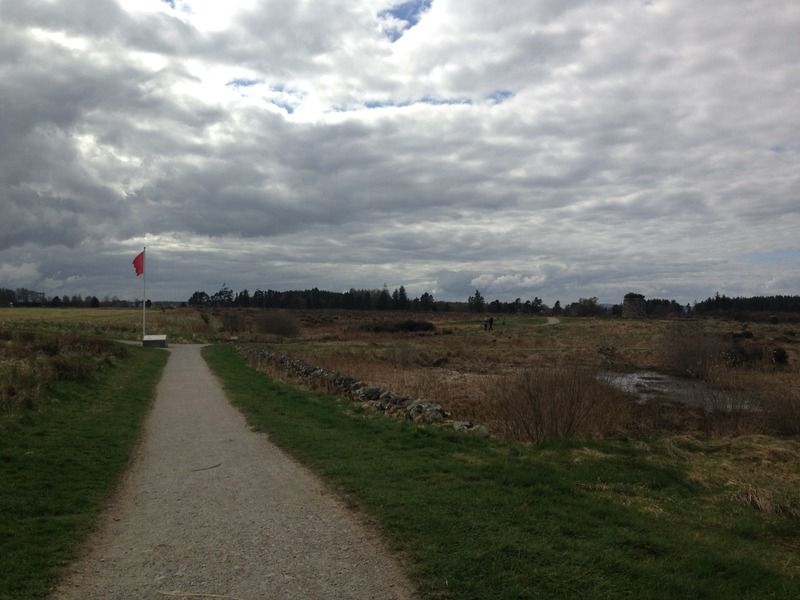
The paths are gravel, but well compacted and fairly smooth - even in April and at the end of a fairly wet week.  The site is not as flat as it first looks (using a wheelchair makes you reassess your definition of "flat"!)  But I made it the whole way round.  The boy gave me a couple of "boosts" (I think he's using Mario as an analogy here!) on some hills, but I didn't really need them.  There was one very small section, by the Well of the Dead, which felt a wee bit tippy, but I made it up that on my own so it can't have been too bad.  


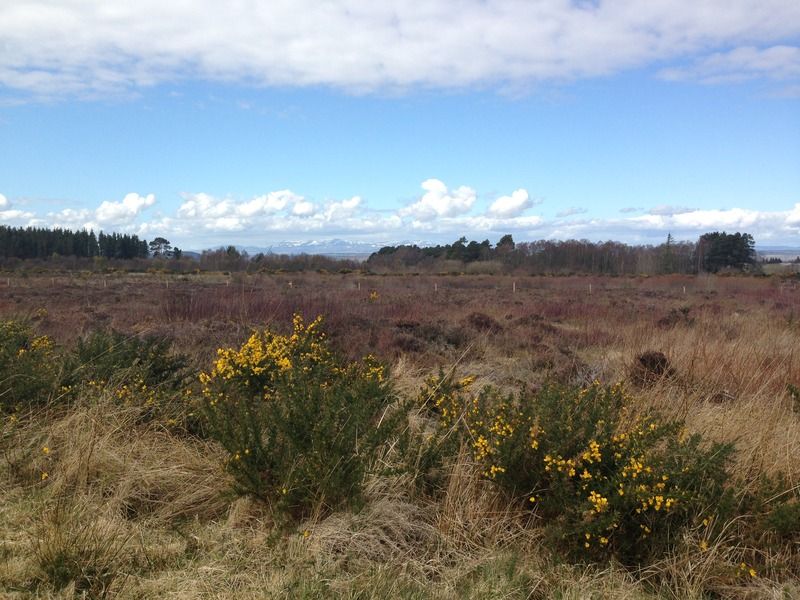
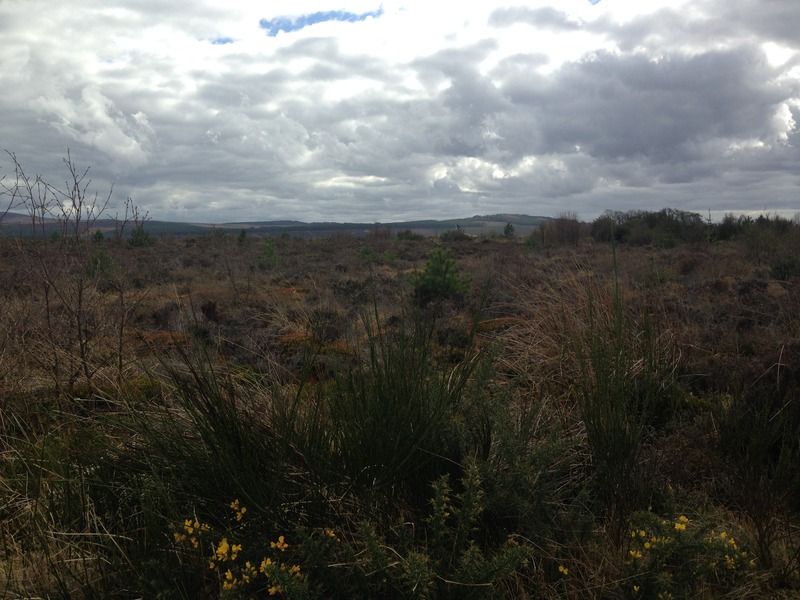
It's a large site and we chose to walk the longer route round (but we didn't walk any of the side paths, which lead to memorial stones).  Google tells me it's a distance of about 2km and includes the areas that the National Trust for Scotland have been returning to moorland - as they would have been in 1746.  


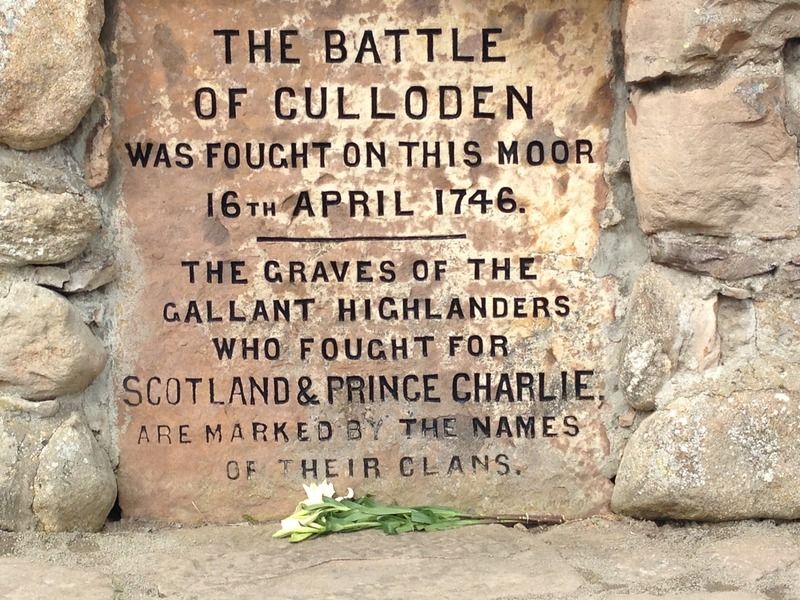
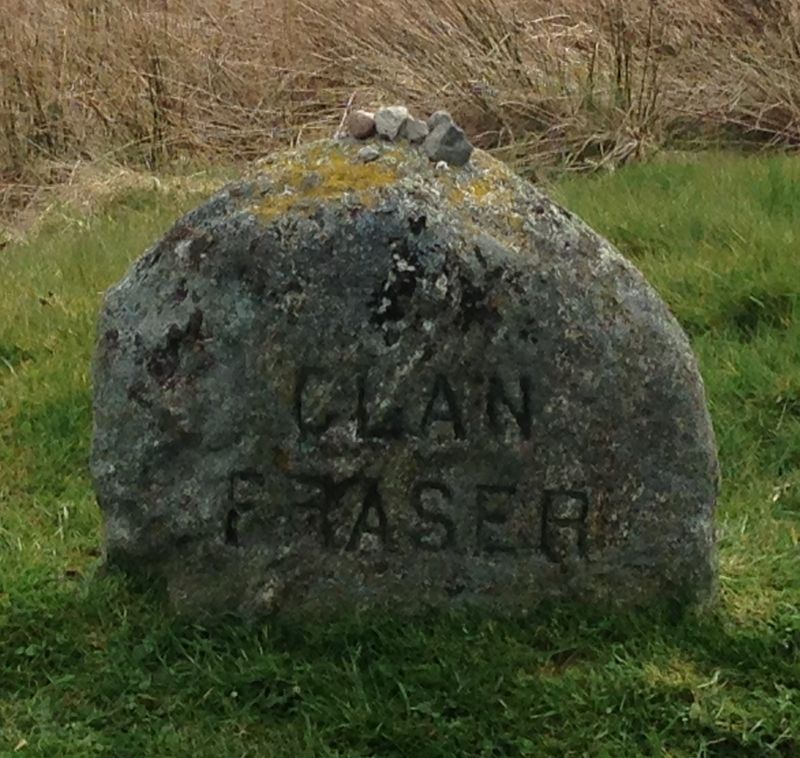
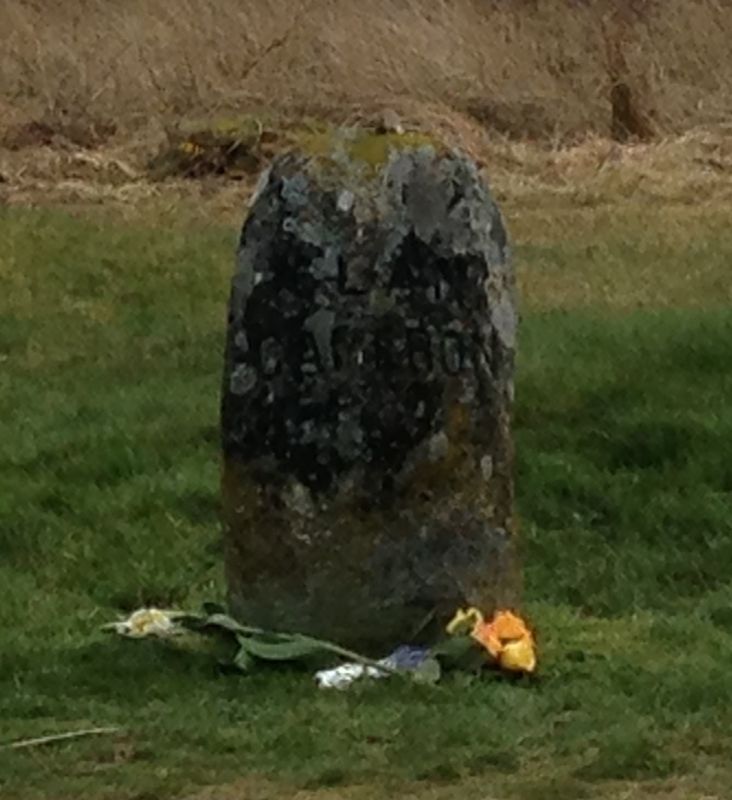
This route takes you along both the Jacobite and Government Lines (marked by blue and red flags respectively) and past most of the main memorials, including the cairn shown at the top of the post.  It was clear there had been some fans of Outlander (which just arrived on TV here) visiting recently, as the Fraser memorial was the only one with wee stones on the top, though some others had flowers (we visited the day after the anniversary of the battle).


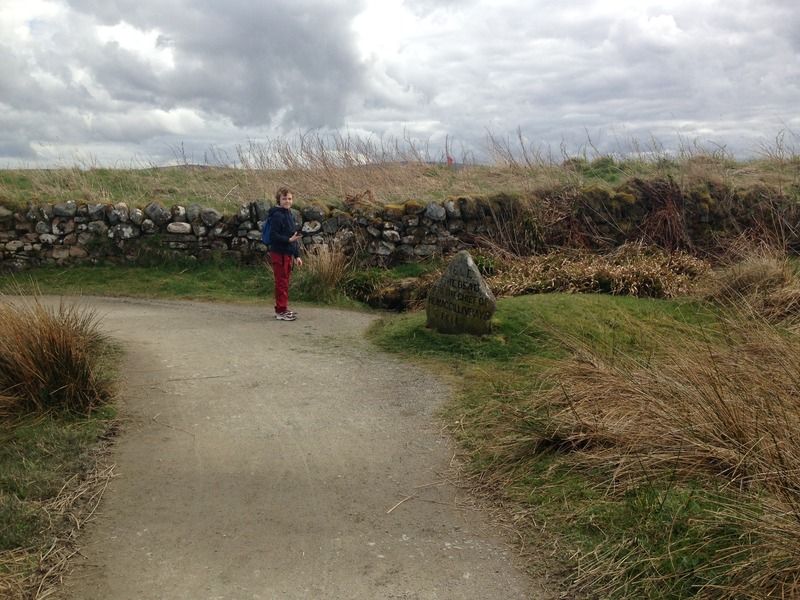
It was by the cairn that I hit the only real problem with access - a section of path that had been resurfaced mere minutes before (there was a tractor there when we started our walk) and hadn't had enough footfall to compact it.  Luckily, the surround grass had been compacted so I could wheel across it instead.  I did get a bit stuck first, though - you can see my attempts to get across on just back wheels before I gave up! 


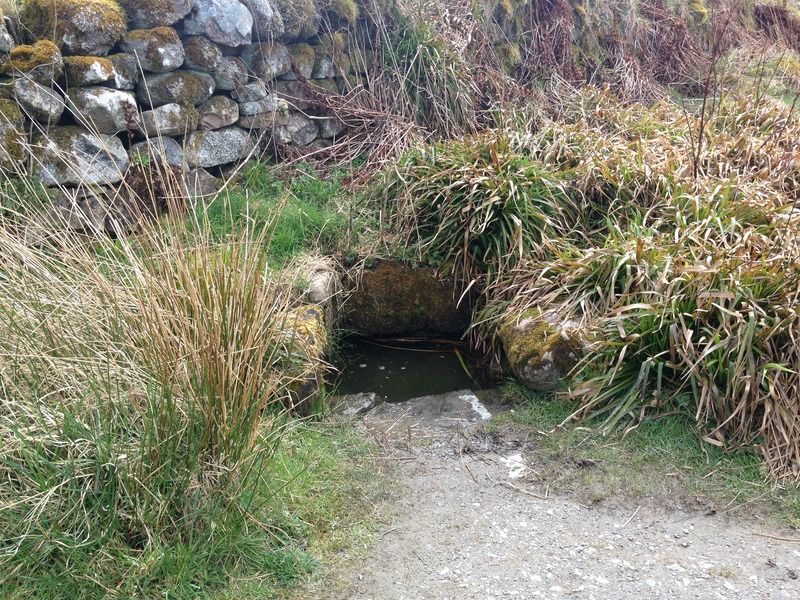
The last section took us past the Well of the Dead and the audio guide didn't satisfy the boy's curiosity about it.  Not sure I did either.  


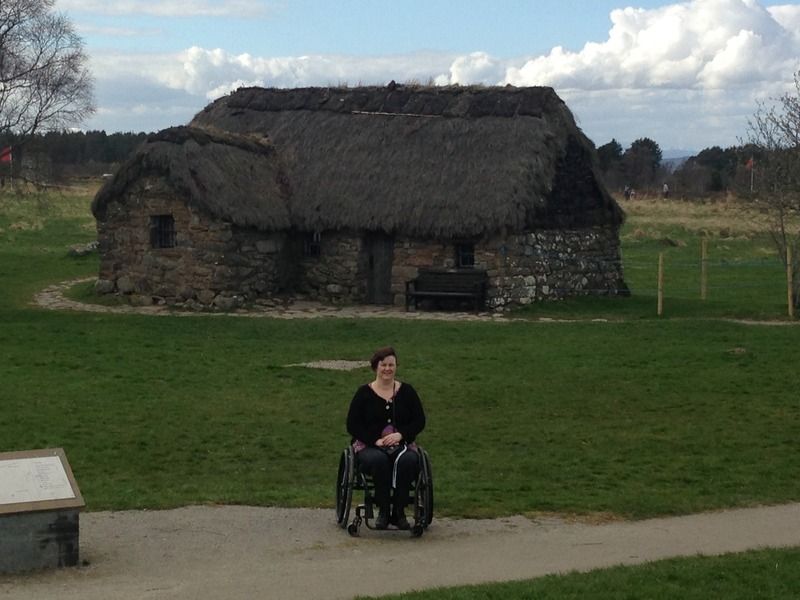
Finally, it was time to bribe the boy so I could get a picture with me in it - this is outside Leanach Cottage, which is the only building on the site which dates from before the battle (Culloden House itself is about 3km away). 


All in all we had a great visit and I was really impressed at how they have managed to make an outdoor, historic site accessible.  A couple of bits would have been easier with something like a Freewheel (particularly the soft sand by the cairn as it was my front wheels that got stuck.  I plan to buy a Freewheel when I have some spare money, but it wasn't essential at Culloden.  


Friday, 27 March 2015

Product Review: Quickie Caddie - Plus the Airports

So, I said I would do a post about my experience using my own chair in airports for the first time.  It was mixed.  First, though, I need to review my latest wheelchair accessory - a pair of Quickie Caddy thingamajigs.  As previously, I bought these myself, this isn't a paid review, etc.

One of the things I'd been thinking hard about was managing luggage with the wheelchair.  I think I am best described as stubbornly independent, but for the last few years I've booked wheelchair assistance at airports.  What I hoped was, with my own chair, to regain some independence at airports - particularly in those long boring hours between check-in and boarding.  On our trip to NZ last year this meant forgoing wheelchair assistance and using crutches to get through the airport.  On previous trips I've found us spending long periods waiting in very dreary corners.

The other place I had worries about was getting from the car to check-in and again from the plane to my accommodation at the other end.  You can't sling a heavy backpack over the handles of a Quickie Helium, because it's so light.  And in my case, it also has no handles.  When I saw the Quickie Caddie it seemed a good solution.  This picture, from Dutch blogger Leven Op Wielen, had me convinced it was viable:


So I bought a pair.  They're not cheap - at over £40 - and I was surprised how light they were when they arrived.  I was also worried about them getting in the way when I was using my chair day to day.
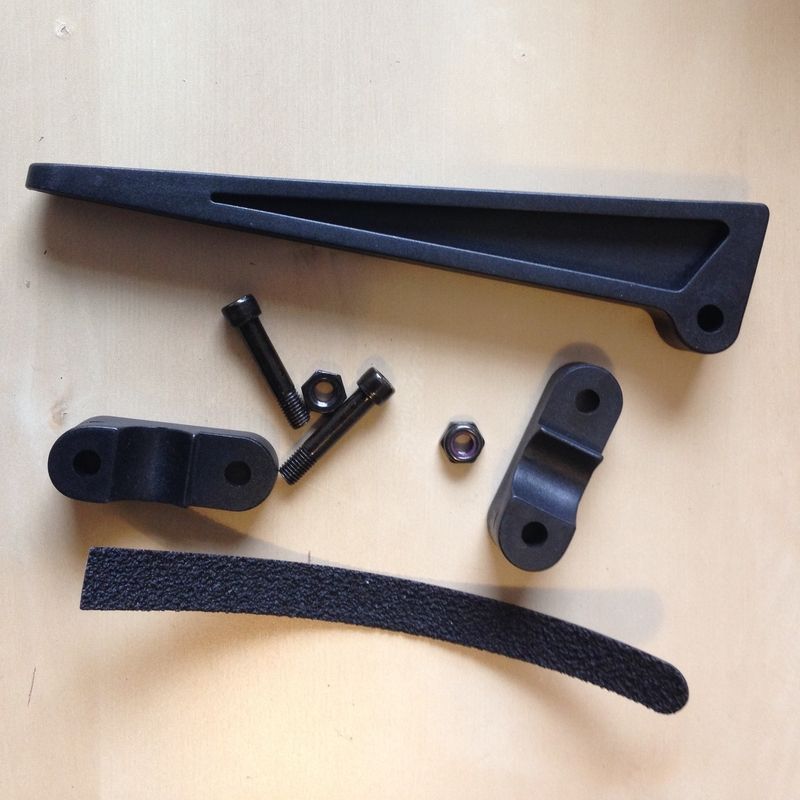
When I unpacked them, this is what I found:


That's one - there are two but I forgot to take the pick before I installed one.  They were easy to fit - apart from the fact that as Quickies are made in the USA they use non-Metric hex keys.  I had to buy a set of those (3 quid from Wilko).  When not in use, the spike thingy (seriously, what's a good name for these!) folds up parallel to the fork of the chair and they weigh next to nothing.  They fold down easily so you can use them for a basket in a shop or, for example a box containing a loom (which was my first use of them!)  I did discover, with the loom, that if you're travelling over bumpy ground, down slopes, or on cobbles, it's best to use a strap of some sort to secure the load.  On a flat smooth surface, for example in a shop,  you don't need to as there are non-slip grips you attach to each one.  For my trip to Paris I invested in a pair of Velcro straps which I wrapped round each wheelchair fork and round the case.  I got 68cm ones and joined together they worked on my carry-on sized case.  Separately they'll be good for smaller loads.

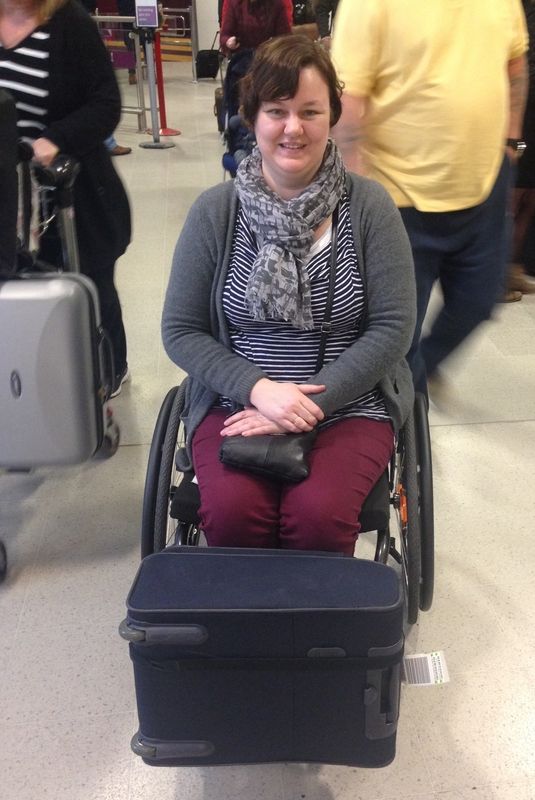
I have to say the Quickie Caddy worked great - I was able to get myself from the disabled surface parking area at Edinburgh Airport to check in (including a diversion back to the car to affix a temporary disabled parking pass to it!) and I would have managed through security and all the way to the plane but I'd opted to check my luggage.  I would have struggled to flick up a kerb because of the extra weight at the front (my case was approximately 10kg) but I didn't feel unstable at all and the manoeuverability wasn't massively impaired - my chair was still much easier to manoeuvre than the Red Cross one I had on loan last year!  There is a ramp from the parking area to the terminal at Edinburgh and I managed that OK.  At Charles De Gaulle I managed to get myself from baggage claim to the minibus which had come to collect us without problems and when I returned to Edinburgh I got from baggage claim back to my car on my own.  I got one of my colleagues to take a picture when we got back:


All in all everything went well - apart from a snag on arrival at both airports.  Even though I'd gate checked my chair, it didn't manage to make it back to me at either airport.  In both cases I was met at the door of the plane by someone with a wheelchair and they took me to baggage claim, where I found my own chair, but I haven't got to the bottom of how to ensure they bring me back my own.  I remember having the same problem with the buggy a few times when L was small.  In Edinburgh they kept assuring me "you'll find yours on the carousel" which had me slightly panicked.  After the third time I said "it's two and a half grand worth of kit, I'd rather it didn't go on the carousel" someone went to intercept it!  I think the lesson is to get it tagged as fragile at check in (they tag your chair at check in, just like other luggage, even though you're gate checking it).

Tuesday, 24 March 2015

Paris(ish) on wheels

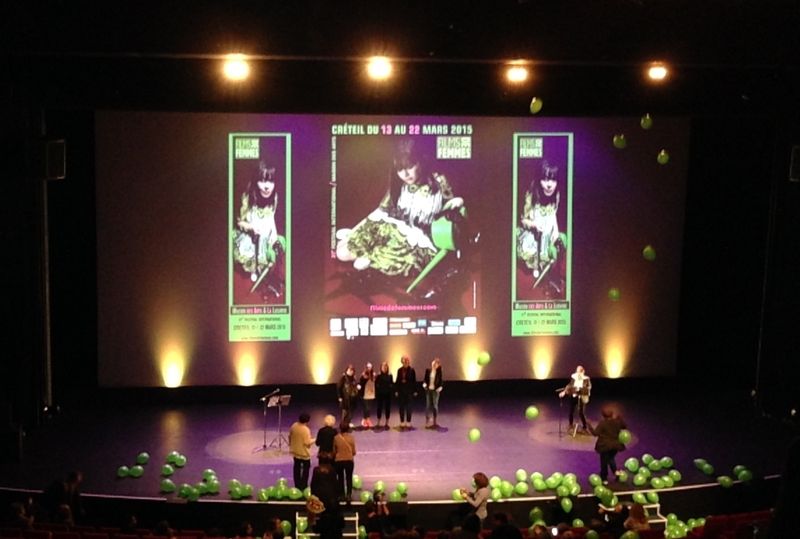
This weekend I've been on my first overseas trip with the wheelchair.  I was a bit nervous, but did it in a way in which I knew I'd have a bit of support.  I've been working with our local twinning association ever since I moved to Scotland, so when I was invited to take part in a trip to the Festival Filmes des Femmes in Créteil I jumped at the chance.  Because the trip was being organised with the help of Créteil Jumelages there was someone arranging things for us  and they would be with us for the whole trip.  I was travelling with two colleagues as well.

We stayed at the Novotel le Lac in Créteil, which I'll do a separate post about and I'll also cover my experiences at the airport separately.  Most of the visit was a mixture of official visits (to schools, their fabulous new Mediatheque and the Conservatoire), excellent food and films at the festival.

Créteil itself is a new town on the edge of the Paris suburbs.  Most of the city has been developed since the 1960s and it is fairly flat, which made it easy to get around.  The town centre has a very 70s raised town square area, with carpark under, which is surrounded by the Hotel de Ville, various civic buildings, some flats and the Maison des Arts de Créteil (MAC) where most of the festival took place.  Access to this part of town was quite good, although the route from the MAC to the single lift into the carpark was a bit circuitous.  The MAC itself was accessible and had a lovely cafe.  There was plenty of room to move around.  Wheelchair access was to the bottom of the cinema, at the very front, which is normal, however we left the wheelchair at the door and I used my crutches to get down the top couple of steps to get a better view from the front.


Connected to the town square was an enormous shopping centre, which we visited briefly for some shopping and ate at on two evenings (once at a creperie, the second time at Flunch).  It was a good shopping centre but again it only had one, small lift, at which queues formed on a Sunday) not as accessible as it should have been.

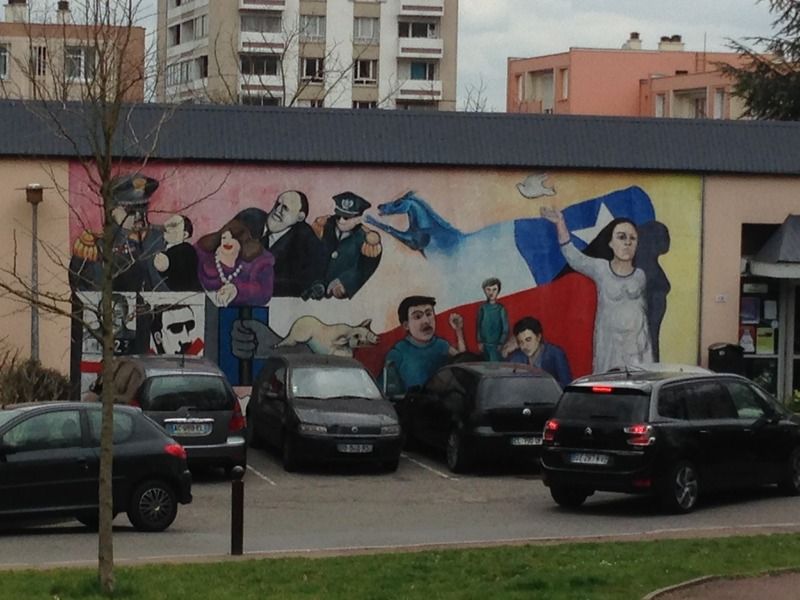
The festival's other venue was a small cinema, La Lucarne, which was located near the Mediatheque in an area of Créteil built in the 1960s, one of the poorer areas of the city.  Unfortunately the 1970s building was not very accessible - there was no disabled toilet and it was the only place I absolutely needed to get someone to help push me up the hill (apart from the ramp at the Novotel, which I'll cover in a separate post).  However I managed to get into the auditorium for the film, so everything worked out.  The mural on the outside of the building was painted by a Chilean artist who fled the Pinochet regime.


The films we saw were Todos estan Meurtes, which eventually one the Youth Jury prize; Sol Branco, the winning short film (which we saw twice); Notre Enfance á Tblisi; the Grand Prix winner Objects in the Mirror and a Beatrice Dalle film, Bye Bye Blondie, which I need to try and watch with subtitles.  It was the only one with no subtitles.  Todos estan Meurtes and Objects in the Mirror both had English subtitles.  Sol Branco and Notre Enfance á Tbilisi had French subtitles which I could sort of follow, so Bye Bye Blondie was the only film I really struggled with.

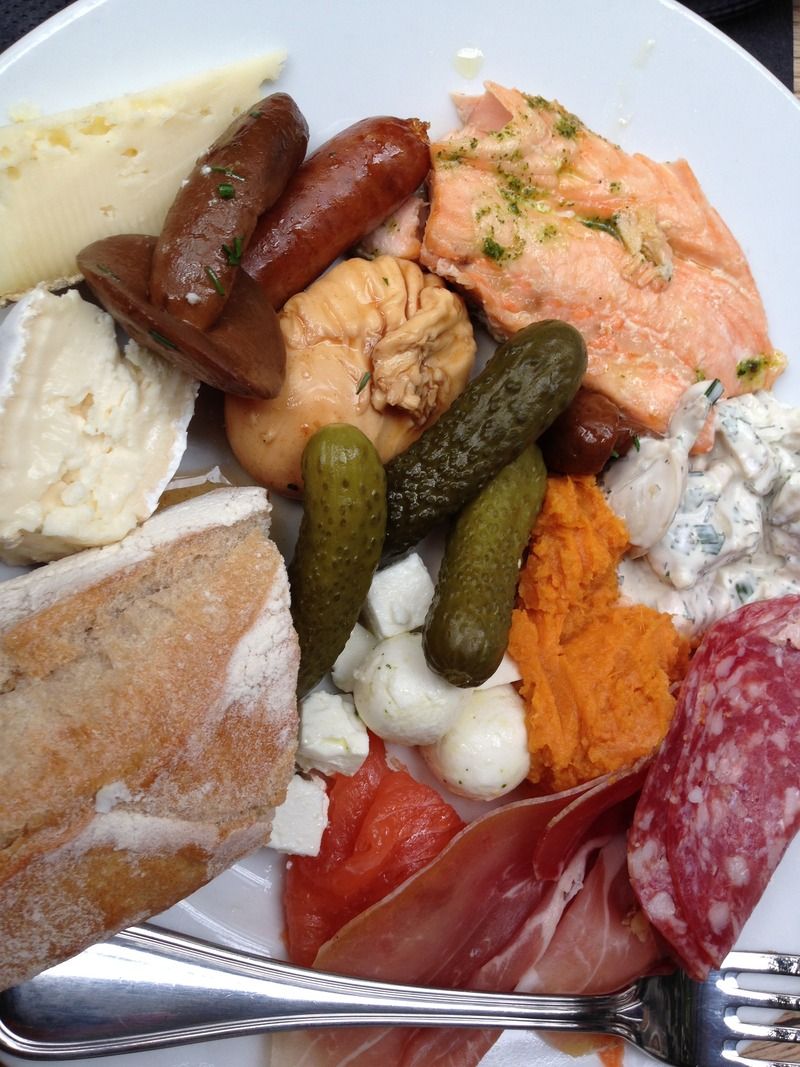
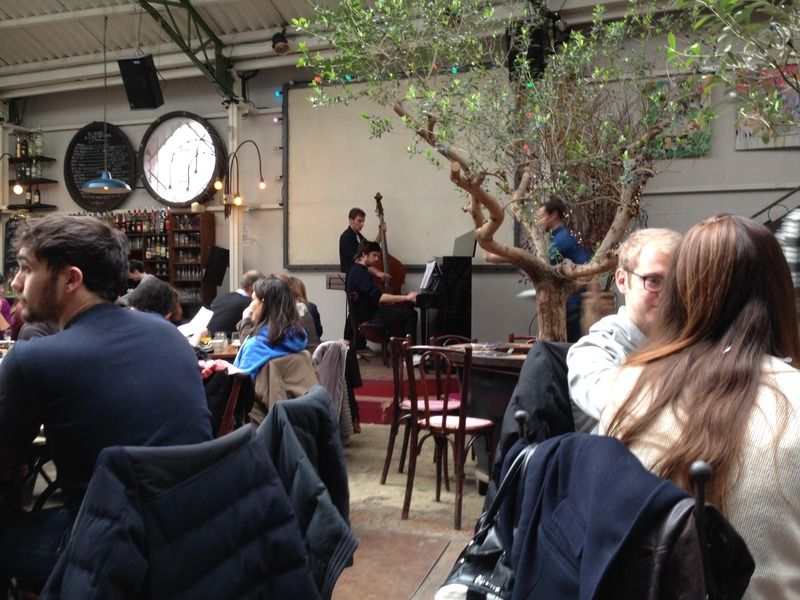
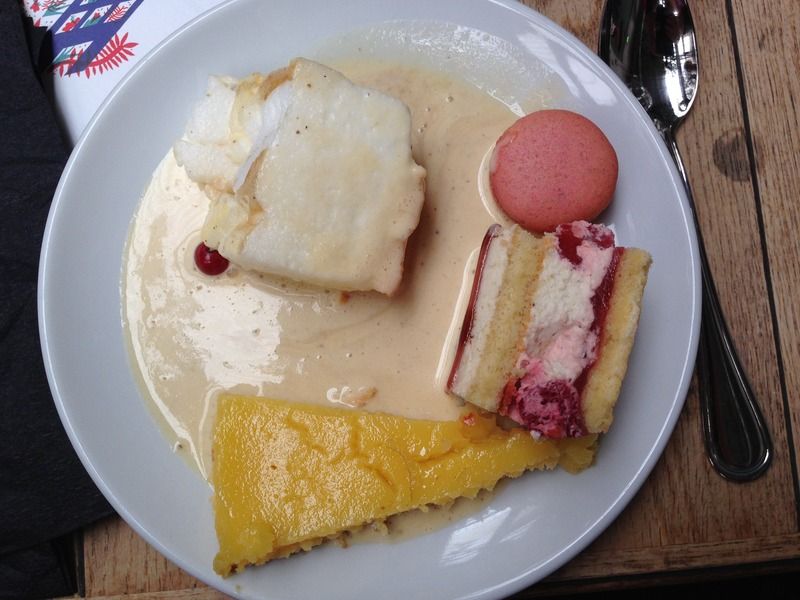
On our "day off" on Sunday we were taken for a brunch at La Bellevilloise it Paris itself.  The meal was *amazing*.  The venue was wheelchair accessible, in that there was level access and a disabled toilet, but very busy so I was glad I had taken the crutches and could use those instead.  I ate way more than I should have (including two desserts!) but look at the food!


The venue was pretty good too.


Our hosts then very generously drove us on a tour of the main sights of Paris, which is as amazing a city as it was last time I was there.  I plan to go again.


Tuesday, 17 March 2015

Legless in Dublin

On Sunday I went to the Edinburgh Yarn Festival, in my wheelchair and was chatting  to Yvonne from Dublin Dye Company (a business she started with an online friend of mine, many years ago).  She recommended I check out the Legless in Dublin's blog and I'm so glad she did!  I've really enjoyed the quick look at it I've had so far and I'll have to read some more later.  I've added a link to the sidebar here so I remember.  I found her entry From Sticks to Wheels really caught a lot of how I've experienced the transition, but I think I could add something about the enormous frustration I've been feeling about other people's attitudes to it. 

She's also given me some ideas for this blog.  First up, but not right now, will be a review of Edinburgh Corn Exchange where the event took place. 

Saturday, 28 February 2015

This just impresses me.

It took me too long to figure this out.

At the moment I need to take the wheels off the chair when putting it in the car.  This means a bit of juggling (standing with my weight mostly on one foot, of course) to take the wheels off.  Once I made this discovery, though, it got a lot easier...


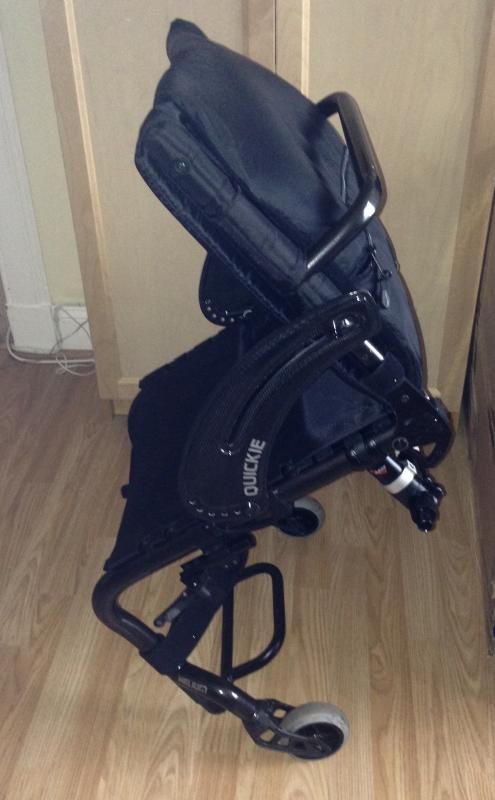
The chair will balance on the front footplate, not just with the wheels off, as shown, but with either or both wheels on.

Someone thought about that.

Product review - Silicone Pushrim/Handrim Covers

One thing I figured out quite quickly was that the standard anodised aluminium pushrims/handrims on my chair were hard to grip, especially in the cold of an Edinburgh January.  Gloves helped (and I'll do a separate entry on them) but weren't always practical and I probably won't want to wear them next time I go to Dubai!  One afternoon we were having a discussion about silicone bakeware and I went "ah! I know what I need - silicone pushrim covers".

When I got home Google told me such a thing already exists!  One of the first pages I found was information on Grippoz, which looked great but sadly are not on the market and their Kickstarter failed to reach it's target.

I found some less innovative options already available though - in a range of colours and a fairly large range of prices from various retailers.  In the end I went with plain black ones (because I am boring!) from Mobility Pit Stop.  Like all wheelchair accessories, as I am discovering, they were not cheap at just short of £50 including postage, but they were delivered within a couple of days and, to my relief, were very easy to fit.

They've made a massive difference to my hands, which no longer end up stiff because they have been on the freezing cold, hard metal.  Pushing is much more effective - making it less effort on the flat and making hills and ramps much easier.  So they've been totally work the money.  I don't need my gloves unless it's actually cold!  I've done a couple of 3-4km outings using them and am very impressed - in particular it was lovely not to have to ask someone to "give me a shove" up a ramp.

One small quibble - they do flick off if I catch them on a tight doorway, which is annoying but easily enough fixed. I suspect making them slightly smaller, so they have to be stretched to put on the rims, would fix this, but make them harder to fit.  


I wasn't paid to write this review and I paid for the product myself - if this is ever not the case I will make it clear.

Sunday, 8 February 2015

At the museum

The National Museum of Scotland has an exhibition on computer games at the moment and I've been meaning to take the Small Scottish Boy since it opened.  We didn't have any plans this weekend, so we went in today.

I've used wheelchairs in the museum before - both the Red Cross one and one of their own ones - so I was interested to see how my own chair compared in a familiar environment.  The answer is, it was a massive difference.  It still astounds me just how easy it is to wheel, compared to even the expertly maintained Red Cross chair, let alone the not-maintained museum one.
I didn't get to try it on the challenging entry slope to the new part of the building, as every single disabled parking bay was already in use (and, as ever, not all by people displaying badges).  I ended up parking further down Chambers Street and on the other side, meaning I discovered that unfortunately, there are no dropped kerbs anywhere near the main entrance (in the old building) and the kerb is well over the 10cm I practiced at the Westmarc centre.  I'm pretty sure it's not actually possible to get up it safely, no matter what the skill level.  Many millions have been spent on the museum over the last 20 years - firstly the extension and then the refurbishment of the older part of the building.  You'd think someone would have thought of a dropped kerb somewhere near the main entrance.
That said, I don't think access was exactly to the fore of anyone's mind.  The building also suffers from a dearth of both disabled/family toilets and lifts (elevators).  In particular, the main entrance is served by two small glass lifts and at weekends there are pretty much always queues of families with pushchairs and/or disabled people waiting for them.  It took us 15 minutes to get up to the 3rd floor and another 15 minutes to get out.  Once you're out of the basement entrance, there are a couple of other lifts in odd corners of the old building, whilst the new part is well served by large lifts (but it has that tricky slope to get in!).

On the plus side, I found our visit way more enjoyable, once we were in, even compared to going round in other wheelchair.  So another thumbs up.  The exhibition was fun too -  we'll go again at least once before it closes, especially since I bought a membership.

Sunday, 1 February 2015

Time for some car shopping.

My Motability contract is coming to an end soon, so the last couple of months have been spent car shopping. This is my third Motability car and once again I get to shop with a friend whose contract ends around the same time - we ordered our first cars together 6 years ago, accompanied by two small boys, walking in saying "we'll have one of those in red and one of those in grey". They're not so small now.

I started my spreadsheet about 3 months ago, having decided on my essentials: cruise control, automatic (I can't manage a clutch), diesel (more economical for the driving I do), some way of plugging in an iPhone or iPod to play music and finally parking sensors. It can be a bit tight in our (shared) driveway, with 4 cars, a transit van and a motorbike. I had a hire car with "beeps" last year and was won over.
That narrowed it down a bit and I started to compare advance payments, fuel economy and features. The arrival of the wheelchair added a criteria - I needed to be able to fit it in the boot (trunk) without taking the wheels off. Whilst it's OK occasionally, on a weekend day when we're going from place to place, often in the rain, doing it every time gets old, quick! So whilst it does fit in my existing car, with the wheels off, I need something bigger.


A few cars went on and off the list but the final shortlist was the Ford Grand C Max, Citroen C4 Piccaso, the Grand C4 Picasso, the Peugeot 3008 and the 5008. A very late addition was the Ford Kuga (aka Escape), which we discovered would fit my wheelchair wheels on and was cool. As my friend (with two kids and a bigger wheelchair) said "someone needs to have a cool car, not a bus or a van!"

In the end, the fuel economy on it wasn't as good and the advance payment (deposit) was high for one with all the features I wanted. In the end, low advance payments and good features meant Peugeot won out and it was down to two cars - the 3008 or the 5008. There's 17cm different in length and two extra seats on the 5008 (though the wheelchair means I couldn't really ever use both). Time for a comparison.  I also really like the semi-automatic gearbox the Peugeots and Citroens have - my last two cars (Grand C4 Picasso and latterly a 308)  have both been semi-automatics.  I'm also clearly a fan of French cars - having owned 2 Peugeots and 5 Citroens.

5008 - more space to the side, but the extra seats folded into the floor makes it higher, so the chair is above the level of the back seat


3008 - the chair fits in, with the back folded, under the parcel shelf. There's marginally less room beside it - the space is narrower, but it's also taller. We have a winner.


I ordered it on Friday, need to go in to do the paperwork one evening this week and it should be here in a few weeks. I've requested an early changeover, if it arrives early, which Motability have approved on the grounds that I'm having to take the wheels off to get my chair in my current car. It will be Shark Grey - a boring colour but one of the three options with the nearest delivery date. It'll look a bit like this.


Tram

Edinburgh's trams caused chaos and no little controversy (which continues) while being built, but finally started running last spring. I've been on them a few times before, but last week took the wheelchair on for the first time. It was great. The Park and Ride at Ingliston has disabled parking right by the tram stop, though it seems to be a well-kept secret and I hesitate to publicise it! The platforms are all engineered so there's level access, without even enough of a gap for my 4" casters (that's the front wheels) to get caught. There's loads of space (4 wheelchair bays in each tram) and they're quick and smooth. They stop longer (and open the centre doors automatically) if you press the stop button with the wheelchair sympbol. I really love the active user logo they have chosen as well.


Despite it's hills, the main streets of Edinburgh's New Town are built along the hill, so there's no more than a gentle slope as you go along Princes Street and, if you alight at St Andrew's Square, the same is true for George Street. There's a slight hill, beyond me just yet, between the two, but the trams do make both of Edinburgh's main shopping streets accessible to me. Which is just as well because the Council have somewhat misguidedly blocked off half of George Street (and thus half it's disabled parking bays) to create outdoor dining spaces (in Edinburgh!). These have proven less than successful, apart from for a few weeks in August. I can even make it to John Lewis without braving the horrors of it's parking building.