The not-so-small boy and I have been enjoying the last few days of his school holidays. Since schools in our area go back later than elsewhere in Scotland, it's a good time to do touristy things, as long as we avoid Edinburgh which is inevitably a zoo in August.
Today we went to New Lanark, which I have wanted to go to for years. It's the second time recently I've been somewhere in that part of Scotland and been thoroughly disappointed. I suspect the same architects may be involved.
New Lanark probably thinks it is accessible. Access throughout the indoor exhibits is via ramps - all the way up five levels of mill buildings and all the way back down again. Unfortunately this means the ramps are steep. I'm not easily bettered by a ramp or a hill. But I don't like to constantly be fighting that tipping feeling you get on a ramp that's just about too steep. Especially when it's a long one. I needed help more than once and anyone who knows me knows how much I hate that.
Coming down the way was almost as bad. No tipping feeling but that constant almost out of control feeling and blisters on the thumbs from gripping the push rims. Luckily it was fairly empty or I might have taken someone out. This ramp between the two buildings gives you an idea of what it's like - though some sections were steeper, some had slopes round corners. None had decent handrails.
There are lifts. With a bit of thought, and maybe a couple of platform lifts, the routes through the building could be adjusted to be level, with lifts between floors, most of the way through. Yes, this is an historic building on a steep site but they have the lifts already.
Instead, when you get to the bottom you're faced with a push up a roadway (access to the adjacent hotel) as you're not even allowed to go backwards through the exhibits to get to the main entrance.
Most of the external buildings (workers house, shop, Robert Owen's house, school) require assistance due to the steep roads.
Oh and it's probably not worth the 20 quid it cost the two of us.
Showing posts with label Scotland. Show all posts
Monday, 21 August 2017
Saturday, 9 January 2016
Transport Museums, near and far
One of the things about being the parent of a small boy is that you go to a lot of transport museums. The small Scottish boy's obsession with trains started when he was still a very small Black Country boy and he got his first Thomas the Tank Engine train set, which had a motorised Thomas. Then we moved to Bo'ness, home of the Bo'ness and Kinneil Railway and the Museum of Scottish Railways, where we spent many weekend days when he was smaller. Recently we've been to three transport-related museums, each of which was a different experience. The first two were on a weekend trip to the north of England with a friend in November.
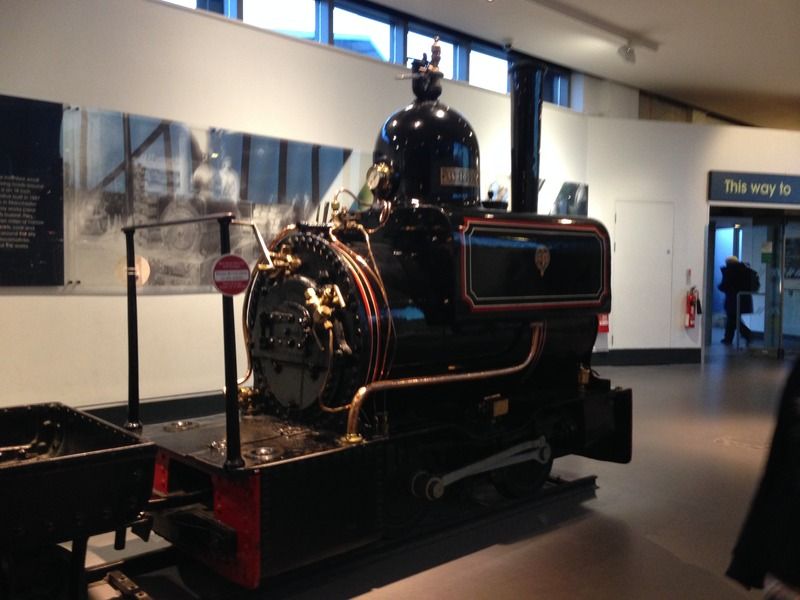
First up was the big one. The National Railway Museum at York. We've been a few times in the past but every visit is different. It's vast and includes trains from the small to the enormous.
The access is very good. The ramps are almost all gentle and there is even access up to some of the trains, including inside the bullet train and up to the side of the "Chinese Train" (actually made in the UK, but used in China). The latter's ramp has a sign warning of a steep slope, but I got up it with not much extra effort.
They'd also made the effort to create complete level access to the inside of the Shinkansen (bullet train - the only one outside Japan) and it was even possible for me to get in there - and have a new pic of me for the blog taken.
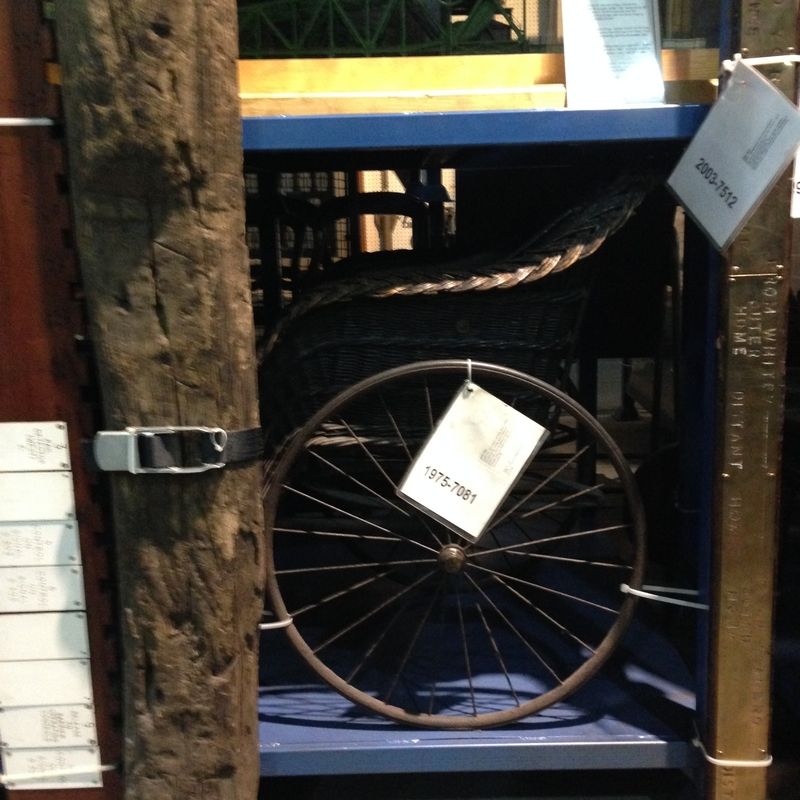
My favourite part of the National Railway Museum is their storage sheds, which are open for the public to look around. Everything is in there. Model trains and ships, old signs, furniture, china, equipment, stonework from demolished stations. This time I spotted a couple of antique wheelchairs.
Next day we made a short visit to the Manchester Museum of Science and Industry. This is based in a disused Victorian train station, but we didn't manage to see all of it, spending a lot of time looking at a weaving demonstration and also eating lunch (excellent pizzas and the salad bar looked great too). The main engine sheds were closed for refurbishment. It's split across quite a large site and my only access gripe was that the accessible (tarmac) route across a large cobbled area was laid diagonally intersecting the train lines. This meant I had to zig zag my way up it to avoid getting my castors stuck between the rails (at York, they put pieces of wood in the gaps to prevent this being an issue).
Somehow I only managed to take two photos - Dougal from the Magic Roundabout on a plane and the Small Scottish Boy sitting in the planes and cars building.
The final visit was just before Christmas, when loose brakes on my wheelchair, meant we were through in Glasgow getting them adjusted (and an annual service for it). After lunch, given the choice of the Riverside Museum, Kelvingrove Museum and Art Gallery or the People's Palace, the Small Scottish Boy predictably chose the one with the trains.
The Riverside is a relatively new museum in a purpose-built building so it's accessibility is good, aside from the huge paved area in front between the disabled parking and the entrance (which in Glasgow, in December, is not fun!) Our local hospital features the same huge empty space and I really think it's a problem for ambulant disabled people, especially in our climate. The museum crams a huge amount into a fairly small site, though, and everything inside is accessible and it's easy to see everything without getting tired. There's even cars and motorbikes on all the walls. Even the Tall Ship, parked on the Clyde behind the museum, has wheelchair access and a lift!
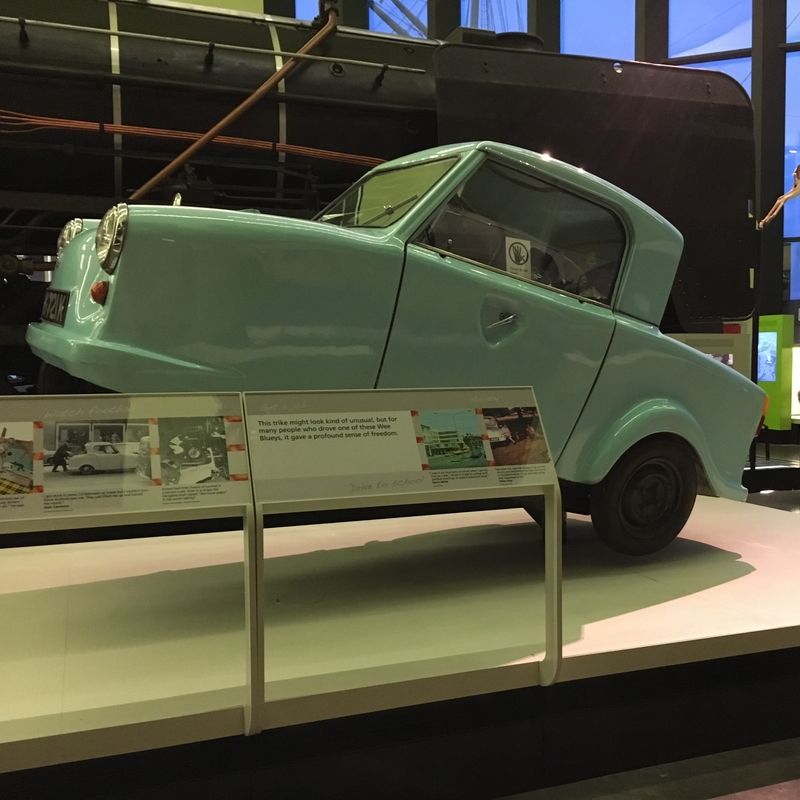
What impressed me on this visit was the increasing visibility of the disabled in the exhibits. I'd seen the small disabled trike-car (the predecessor of the Motability scheme) on a previous visit but this time noticed they have Glasgow's first disabled accessible taxi on display. It was first registered in 1988 - the same year as my first car!
The museum also has two streetscapes. A lengthy two sided street featuring shops from the turn of the 20th century to 1930 and a second from 1930 to 1980. I love these - there was one at the Auckland War Memorial Museum that was my favourite thing as a child, sadly it was removed just last year. The early 20th century street had replica flyers up in each window, marking the centenary of the rent strikes organised by Mary Barbour to protest against steep rent increases while many men were serving during World War I. It was great to see so much social history being explored in a museum I suspect many parents are dragged along to by their train obsessed children. The streets at Riverside also feature the only two Glasgow Subway stations which I can get onto (Glasgow's single line, circular underground railway, with it's tiny trains, is unlikely ever to be accessible).
The great thing at all these museums is that they're all free for everyone. I think it's great that so much is free here, both Glasgow and Edinburgh have a number of fantastic galleries and museusm and not having to pay to get in is a fantastic way of ensuring they're available to everyone. I always try to make a donation, since I can afford it, and we are members of the National Museums of Scotland but we more than get our moneys worth from them!
First up was the big one. The National Railway Museum at York. We've been a few times in the past but every visit is different. It's vast and includes trains from the small to the enormous.
They'd also made the effort to create complete level access to the inside of the Shinkansen (bullet train - the only one outside Japan) and it was even possible for me to get in there - and have a new pic of me for the blog taken.
My favourite part of the National Railway Museum is their storage sheds, which are open for the public to look around. Everything is in there. Model trains and ships, old signs, furniture, china, equipment, stonework from demolished stations. This time I spotted a couple of antique wheelchairs.
Next day we made a short visit to the Manchester Museum of Science and Industry. This is based in a disused Victorian train station, but we didn't manage to see all of it, spending a lot of time looking at a weaving demonstration and also eating lunch (excellent pizzas and the salad bar looked great too). The main engine sheds were closed for refurbishment. It's split across quite a large site and my only access gripe was that the accessible (tarmac) route across a large cobbled area was laid diagonally intersecting the train lines. This meant I had to zig zag my way up it to avoid getting my castors stuck between the rails (at York, they put pieces of wood in the gaps to prevent this being an issue).
Somehow I only managed to take two photos - Dougal from the Magic Roundabout on a plane and the Small Scottish Boy sitting in the planes and cars building.
The final visit was just before Christmas, when loose brakes on my wheelchair, meant we were through in Glasgow getting them adjusted (and an annual service for it). After lunch, given the choice of the Riverside Museum, Kelvingrove Museum and Art Gallery or the People's Palace, the Small Scottish Boy predictably chose the one with the trains.
The Riverside is a relatively new museum in a purpose-built building so it's accessibility is good, aside from the huge paved area in front between the disabled parking and the entrance (which in Glasgow, in December, is not fun!) Our local hospital features the same huge empty space and I really think it's a problem for ambulant disabled people, especially in our climate. The museum crams a huge amount into a fairly small site, though, and everything inside is accessible and it's easy to see everything without getting tired. There's even cars and motorbikes on all the walls. Even the Tall Ship, parked on the Clyde behind the museum, has wheelchair access and a lift!
What impressed me on this visit was the increasing visibility of the disabled in the exhibits. I'd seen the small disabled trike-car (the predecessor of the Motability scheme) on a previous visit but this time noticed they have Glasgow's first disabled accessible taxi on display. It was first registered in 1988 - the same year as my first car!
The museum also has two streetscapes. A lengthy two sided street featuring shops from the turn of the 20th century to 1930 and a second from 1930 to 1980. I love these - there was one at the Auckland War Memorial Museum that was my favourite thing as a child, sadly it was removed just last year. The early 20th century street had replica flyers up in each window, marking the centenary of the rent strikes organised by Mary Barbour to protest against steep rent increases while many men were serving during World War I. It was great to see so much social history being explored in a museum I suspect many parents are dragged along to by their train obsessed children. The streets at Riverside also feature the only two Glasgow Subway stations which I can get onto (Glasgow's single line, circular underground railway, with it's tiny trains, is unlikely ever to be accessible).
The great thing at all these museums is that they're all free for everyone. I think it's great that so much is free here, both Glasgow and Edinburgh have a number of fantastic galleries and museusm and not having to pay to get in is a fantastic way of ensuring they're available to everyone. I always try to make a donation, since I can afford it, and we are members of the National Museums of Scotland but we more than get our moneys worth from them!
Wednesday, 29 April 2015
Scottish Sea Life Centre - Oban
I'm still playing catch-up on our trip away during the school holidays, so here's a belated post about another one of our outings.
On our second day at Ballachulish we decided to try and dodge the rain showers and visit the Scottish Sea Life Centre at Oban. It was featured in Rough Guide to Accessible Travel in Britain as accessible so I thought it would be fine - and have plenty of shelter if it did rain.
This Sea Life Centre is situated in a wooded area, just north of Oban. Unlike the other's we've been to, it wasn't all in one building, but spread across several buildings. The car park is about 100m or so from the main buildings and when we visited the ticket office was closed, so you had to enter through a gate with an uneven path. Once back on the main path, it was smooth enough, with a couple of uneven bits where tree roots had lifted the path. It's down a slight hill and I was a bit nervous about getting back up.
When we arrived the staff gave me a map with details of disabled access. The main aquarium was not built with disabled access in mind, so you have to enter each of three sections separately to see everything - this means doubling back against the flow of other visitors and then going round the side of the building to re-enter via a fire exit. At one point I sent the boy down some steps, saying I'd meet him down there, only to find I ended up stranded at the top of some steps at the other side of the building and had to shout across to get his attention.
The tricky bit highlighted in the Rough Guide was the ramp down to the lower level of the seal enclosure, which you also needed to use (again, against the flow of traffic) to get access to the lower level of the aquarium. It was, as warned, slightly too steep but was also uneven, which made navigating it myself even riskier. I had to ask someone for help pushing me up (and I hate this so much, my chair doesn't have push handles). Likewise the adjacent ramp up to the upper seal viewing area is very uneven as well as slightly too steep and again I felt very much at risk of tipping.
There was also a cafe, in a separate building, with disabled toilet and a lovely view over Loch Creran, and a gift shop, with a viewing platform giving views over the otter enclosure. The entrance to the latter was a little challenging (non-automatic door, plus ramp, plus threshold strip, plus recessed door mat!)
The outdoor areas were not so accessible. I couldn't get up the path to the children's play area - luckily the boy is old enough to send up on his own, but it would have been disappointing for a younger child. Likewise the Terry Nutkin Memorial Nature Trail has a narrow and steep path with steps. The boy went off exploring it on his own, as it was one of the items on the kids' quiz which earned them medals, and was gone long enough I'd started to worry about how to go find him.
All in all we had a good day and I managed to see everything and not permanently lose the boy. I wouldn't like to visit when they were busy, because of the difficulties doubling back and going against the flow of traffic. Unfortunately, though, I don't think it's quite as accessible as the Rough Guide writers think.
My two pieces of advice to the management are:
On our second day at Ballachulish we decided to try and dodge the rain showers and visit the Scottish Sea Life Centre at Oban. It was featured in Rough Guide to Accessible Travel in Britain as accessible so I thought it would be fine - and have plenty of shelter if it did rain.
This Sea Life Centre is situated in a wooded area, just north of Oban. Unlike the other's we've been to, it wasn't all in one building, but spread across several buildings. The car park is about 100m or so from the main buildings and when we visited the ticket office was closed, so you had to enter through a gate with an uneven path. Once back on the main path, it was smooth enough, with a couple of uneven bits where tree roots had lifted the path. It's down a slight hill and I was a bit nervous about getting back up.
When we arrived the staff gave me a map with details of disabled access. The main aquarium was not built with disabled access in mind, so you have to enter each of three sections separately to see everything - this means doubling back against the flow of other visitors and then going round the side of the building to re-enter via a fire exit. At one point I sent the boy down some steps, saying I'd meet him down there, only to find I ended up stranded at the top of some steps at the other side of the building and had to shout across to get his attention.
The tricky bit highlighted in the Rough Guide was the ramp down to the lower level of the seal enclosure, which you also needed to use (again, against the flow of traffic) to get access to the lower level of the aquarium. It was, as warned, slightly too steep but was also uneven, which made navigating it myself even riskier. I had to ask someone for help pushing me up (and I hate this so much, my chair doesn't have push handles). Likewise the adjacent ramp up to the upper seal viewing area is very uneven as well as slightly too steep and again I felt very much at risk of tipping.
There was also a cafe, in a separate building, with disabled toilet and a lovely view over Loch Creran, and a gift shop, with a viewing platform giving views over the otter enclosure. The entrance to the latter was a little challenging (non-automatic door, plus ramp, plus threshold strip, plus recessed door mat!)
The outdoor areas were not so accessible. I couldn't get up the path to the children's play area - luckily the boy is old enough to send up on his own, but it would have been disappointing for a younger child. Likewise the Terry Nutkin Memorial Nature Trail has a narrow and steep path with steps. The boy went off exploring it on his own, as it was one of the items on the kids' quiz which earned them medals, and was gone long enough I'd started to worry about how to go find him.
All in all we had a good day and I managed to see everything and not permanently lose the boy. I wouldn't like to visit when they were busy, because of the difficulties doubling back and going against the flow of traffic. Unfortunately, though, I don't think it's quite as accessible as the Rough Guide writers think.
My two pieces of advice to the management are:
- Fix the ramp at the seal enclosure - I was at serious risk of flipping over and that probably means it's dangerous for mobility scooters and potentially buggies. The combination of uneven surfaces and a steep incline are a real problem.
- Please, please, please, when you're doing a trail for kids, don't include any parts of your site which aren't accessible. Had I had a younger child, or had my child been the one in the wheelchair, they wouldn't have completed it and there would have been tears.
Oh and the hill to the car park? I made it back up that unaided. And very proudly so!
Apologies for the lack of pictures.
Saturday, 18 April 2015
Culloden Battlefield Site
We're just back from 5 days in the Highlands, so I'll be posting a bit about that.
Yesterday, we went to visit the Culloden battlefield site. It's somewhere I've always wanted to go but have been put off by the amount of walking. This time, no walking needed!
I checked the accessibility information on the website before we went. Like a number of sites, they have mobility scooters available, as well as wheelchairs (which were the typical heavyweight ones found at such sites - fine for someone being pushed). I asked the very helpful member of staff at the desk about the accessibility and she said the paths should all be OK, so I decided to try it with my wheelchair.
First off was the indoor exhibition. There are sloped areas inside the building, but they are fairly gentle and weren't difficult to negotiate. The entrance and car park is below the level of the battlefield site, which has a positive effect when you're up on the battlefield itself, so the slopes seem justified and they're well done.
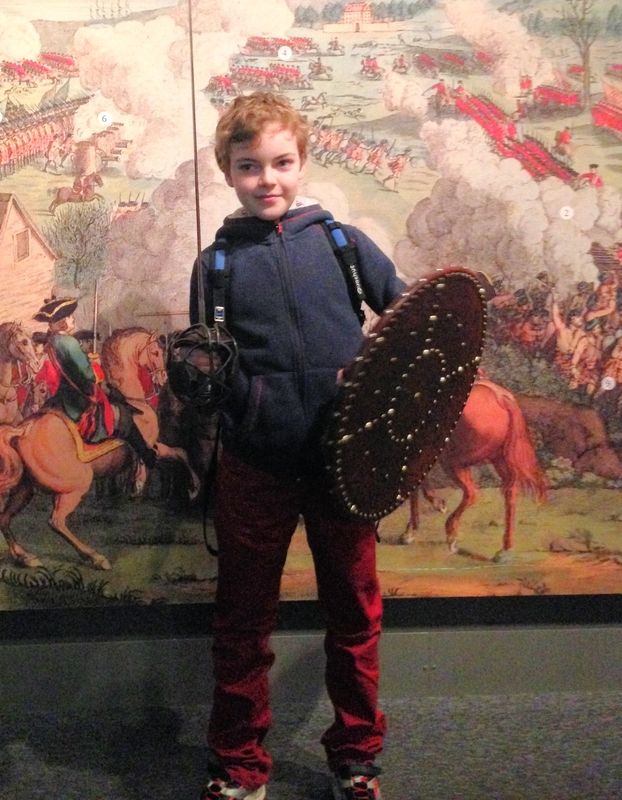
The displays are excellent and easy to see from wheelchair height. There are interactive elements which the boy liked and an immersive cinema that puts you in the middle of the battle, which was a big hit with him. At the end is a display of weapons from the battle and he spent about 20 minutes looking at them. Thanks to some re-enactors from Canada and New York, he got to try a couple of them out.
Yesterday, we went to visit the Culloden battlefield site. It's somewhere I've always wanted to go but have been put off by the amount of walking. This time, no walking needed!
I checked the accessibility information on the website before we went. Like a number of sites, they have mobility scooters available, as well as wheelchairs (which were the typical heavyweight ones found at such sites - fine for someone being pushed). I asked the very helpful member of staff at the desk about the accessibility and she said the paths should all be OK, so I decided to try it with my wheelchair.
First off was the indoor exhibition. There are sloped areas inside the building, but they are fairly gentle and weren't difficult to negotiate. The entrance and car park is below the level of the battlefield site, which has a positive effect when you're up on the battlefield itself, so the slopes seem justified and they're well done.
The displays are excellent and easy to see from wheelchair height. There are interactive elements which the boy liked and an immersive cinema that puts you in the middle of the battle, which was a big hit with him. At the end is a display of weapons from the battle and he spent about 20 minutes looking at them. Thanks to some re-enactors from Canada and New York, he got to try a couple of them out.
And then it was out onto the battlefield itself, in our case armed only with GPS enabled audioguides.
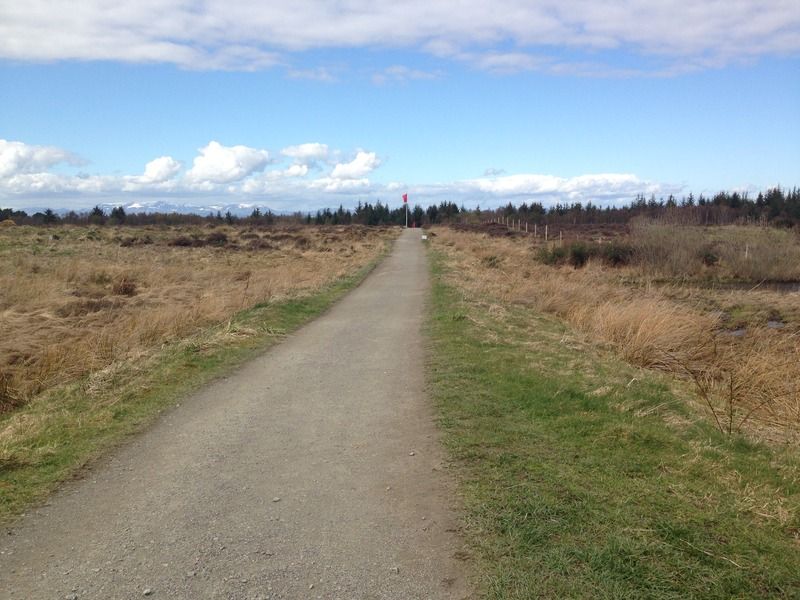
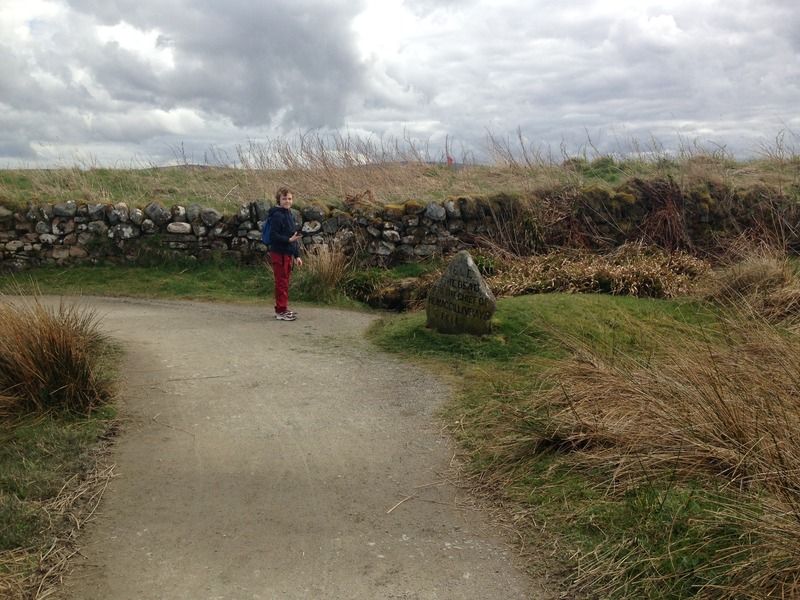
The paths are gravel, but well compacted and fairly smooth - even in April and at the end of a fairly wet week. The site is not as flat as it first looks (using a wheelchair makes you reassess your definition of "flat"!) But I made it the whole way round. The boy gave me a couple of "boosts" (I think he's using Mario as an analogy here!) on some hills, but I didn't really need them. There was one very small section, by the Well of the Dead, which felt a wee bit tippy, but I made it up that on my own so it can't have been too bad.
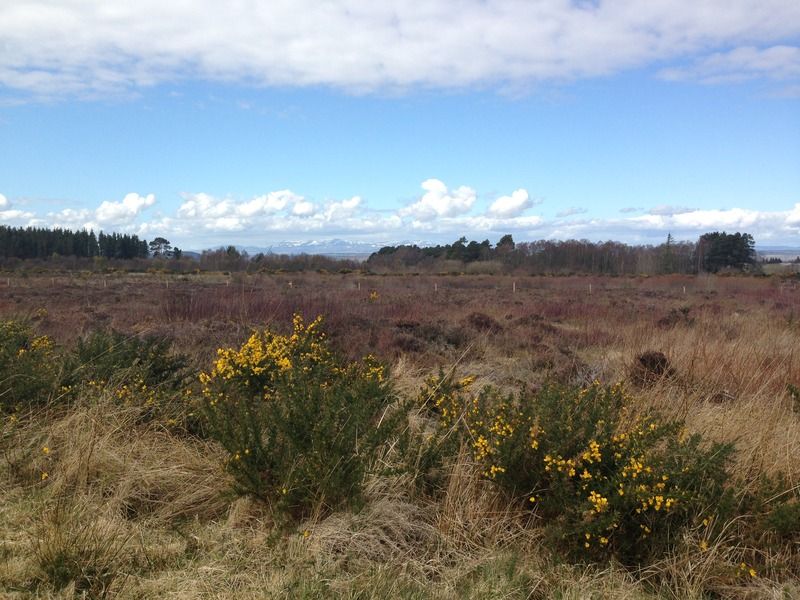
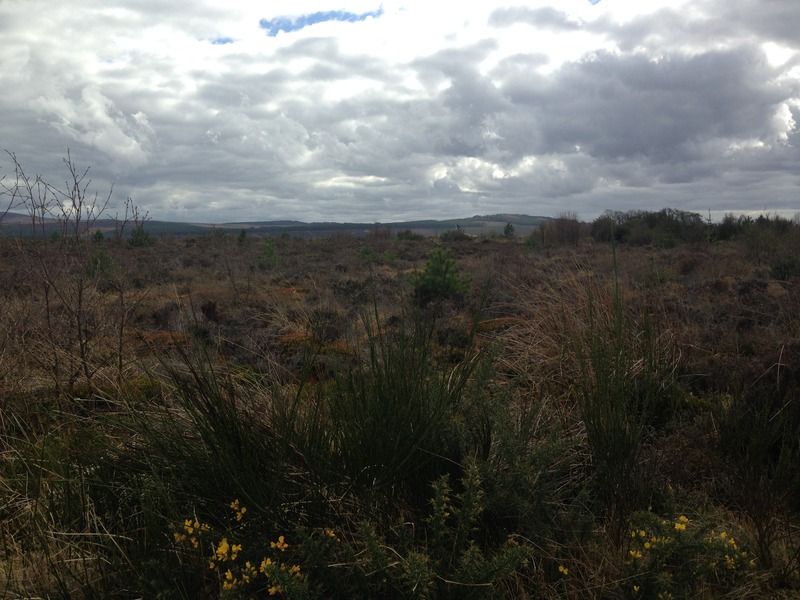
It's a large site and we chose to walk the longer route round (but we didn't walk any of the side paths, which lead to memorial stones). Google tells me it's a distance of about 2km and includes the areas that the National Trust for Scotland have been returning to moorland - as they would have been in 1746.
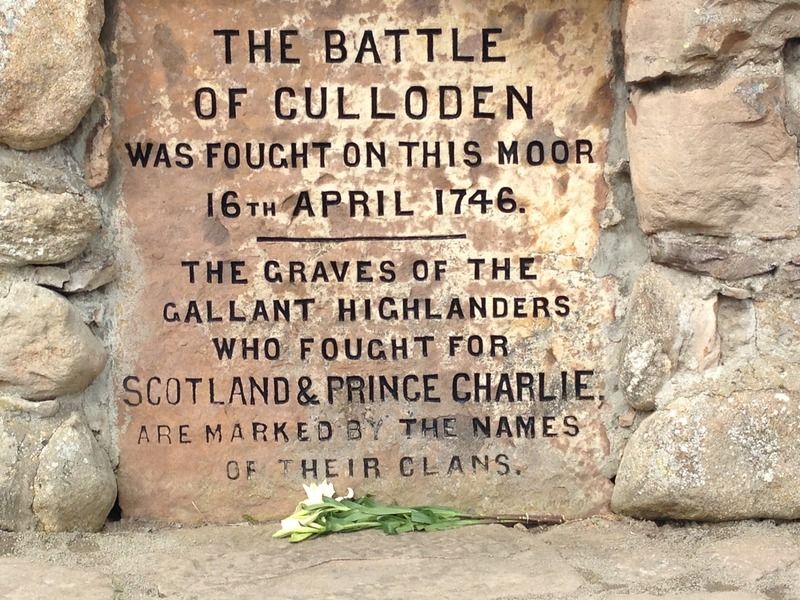
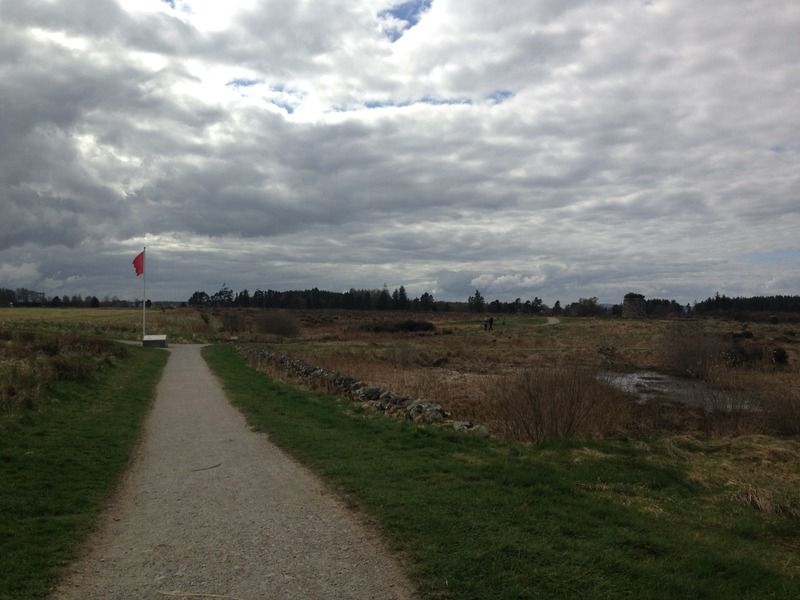
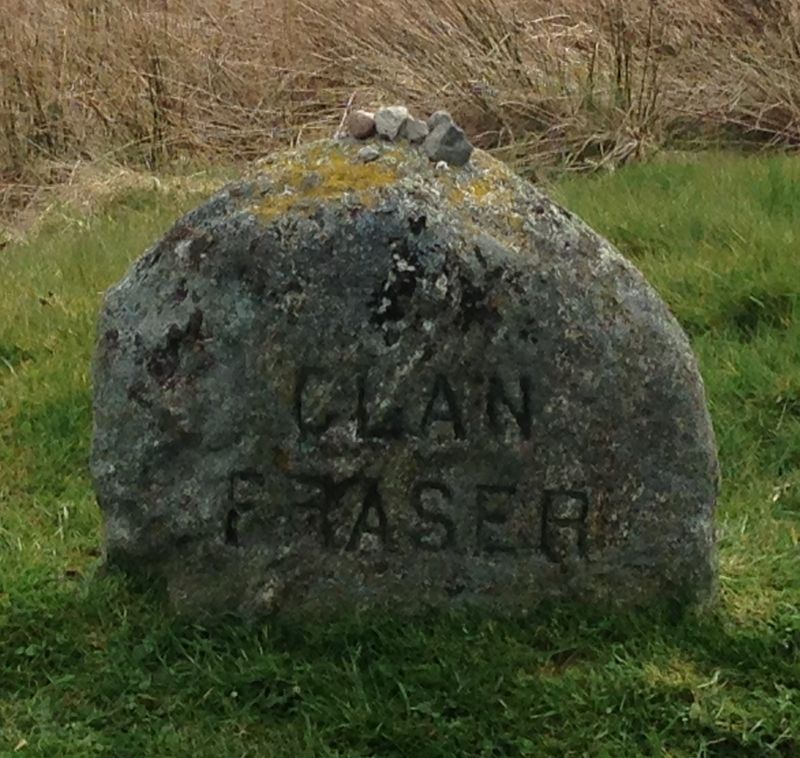
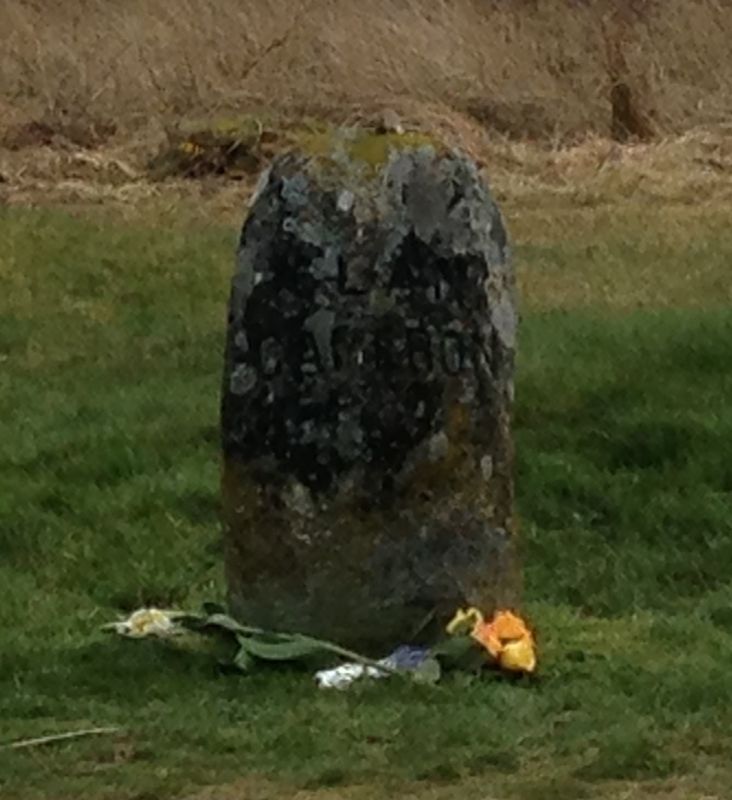
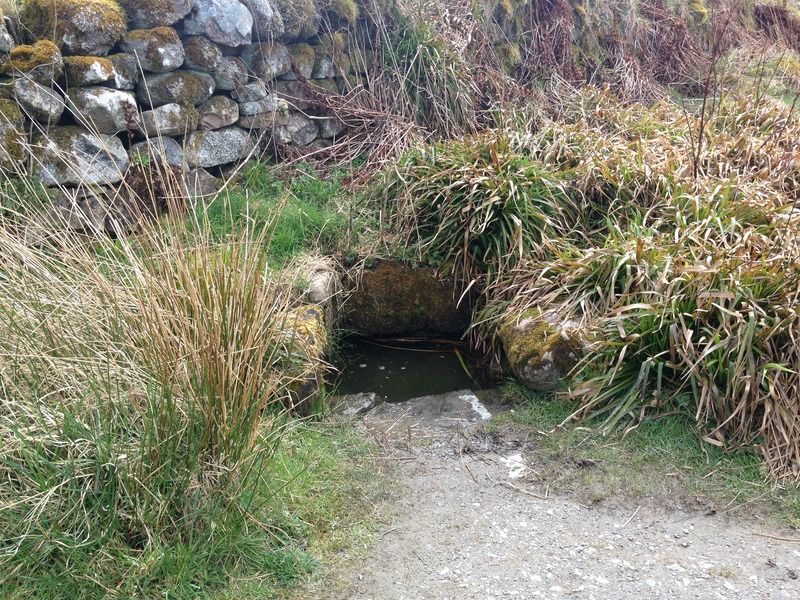
This route takes you along both the Jacobite and Government Lines (marked by blue and red flags respectively) and past most of the main memorials, including the cairn shown at the top of the post. It was clear there had been some fans of Outlander (which just arrived on TV here) visiting recently, as the Fraser memorial was the only one with wee stones on the top, though some others had flowers (we visited the day after the anniversary of the battle).
It was by the cairn that I hit the only real problem with access - a section of path that had been resurfaced mere minutes before (there was a tractor there when we started our walk) and hadn't had enough footfall to compact it. Luckily, the surround grass had been compacted so I could wheel across it instead. I did get a bit stuck first, though - you can see my attempts to get across on just back wheels before I gave up!
The last section took us past the Well of the Dead and the audio guide didn't satisfy the boy's curiosity about it. Not sure I did either.
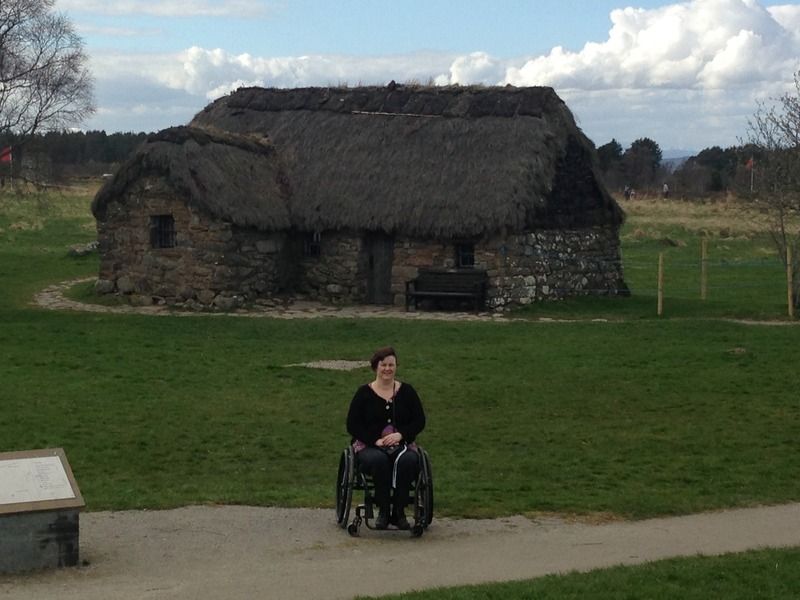
Finally, it was time to bribe the boy so I could get a picture with me in it - this is outside Leanach Cottage, which is the only building on the site which dates from before the battle (Culloden House itself is about 3km away).
All in all we had a great visit and I was really impressed at how they have managed to make an outdoor, historic site accessible. A couple of bits would have been easier with something like a Freewheel (particularly the soft sand by the cairn as it was my front wheels that got stuck. I plan to buy a Freewheel when I have some spare money, but it wasn't essential at Culloden.
Sunday, 8 February 2015
At the museum
The National Museum of Scotland has an exhibition on computer games at the moment and I've been meaning to take the Small Scottish Boy since it opened. We didn't have any plans this weekend, so we went in today.
I've used wheelchairs in the museum before - both the Red Cross one and one of their own ones - so I was interested to see how my own chair compared in a familiar environment. The answer is, it was a massive difference. It still astounds me just how easy it is to wheel, compared to even the expertly maintained Red Cross chair, let alone the not-maintained museum one.
I didn't get to try it on the challenging entry slope to the new part of the building, as every single disabled parking bay was already in use (and, as ever, not all by people displaying badges). I ended up parking further down Chambers Street and on the other side, meaning I discovered that unfortunately, there are no dropped kerbs anywhere near the main entrance (in the old building) and the kerb is well over the 10cm I practiced at the Westmarc centre. I'm pretty sure it's not actually possible to get up it safely, no matter what the skill level. Many millions have been spent on the museum over the last 20 years - firstly the extension and then the refurbishment of the older part of the building. You'd think someone would have thought of a dropped kerb somewhere near the main entrance.
That said, I don't think access was exactly to the fore of anyone's mind. The building also suffers from a dearth of both disabled/family toilets and lifts (elevators). In particular, the main entrance is served by two small glass lifts and at weekends there are pretty much always queues of families with pushchairs and/or disabled people waiting for them. It took us 15 minutes to get up to the 3rd floor and another 15 minutes to get out. Once you're out of the basement entrance, there are a couple of other lifts in odd corners of the old building, whilst the new part is well served by large lifts (but it has that tricky slope to get in!).
On the plus side, I found our visit way more enjoyable, once we were in, even compared to going round in other wheelchair. So another thumbs up. The exhibition was fun too - we'll go again at least once before it closes, especially since I bought a membership.
I've used wheelchairs in the museum before - both the Red Cross one and one of their own ones - so I was interested to see how my own chair compared in a familiar environment. The answer is, it was a massive difference. It still astounds me just how easy it is to wheel, compared to even the expertly maintained Red Cross chair, let alone the not-maintained museum one.
I didn't get to try it on the challenging entry slope to the new part of the building, as every single disabled parking bay was already in use (and, as ever, not all by people displaying badges). I ended up parking further down Chambers Street and on the other side, meaning I discovered that unfortunately, there are no dropped kerbs anywhere near the main entrance (in the old building) and the kerb is well over the 10cm I practiced at the Westmarc centre. I'm pretty sure it's not actually possible to get up it safely, no matter what the skill level. Many millions have been spent on the museum over the last 20 years - firstly the extension and then the refurbishment of the older part of the building. You'd think someone would have thought of a dropped kerb somewhere near the main entrance.
That said, I don't think access was exactly to the fore of anyone's mind. The building also suffers from a dearth of both disabled/family toilets and lifts (elevators). In particular, the main entrance is served by two small glass lifts and at weekends there are pretty much always queues of families with pushchairs and/or disabled people waiting for them. It took us 15 minutes to get up to the 3rd floor and another 15 minutes to get out. Once you're out of the basement entrance, there are a couple of other lifts in odd corners of the old building, whilst the new part is well served by large lifts (but it has that tricky slope to get in!).
On the plus side, I found our visit way more enjoyable, once we were in, even compared to going round in other wheelchair. So another thumbs up. The exhibition was fun too - we'll go again at least once before it closes, especially since I bought a membership.
Sunday, 1 February 2015
Tram
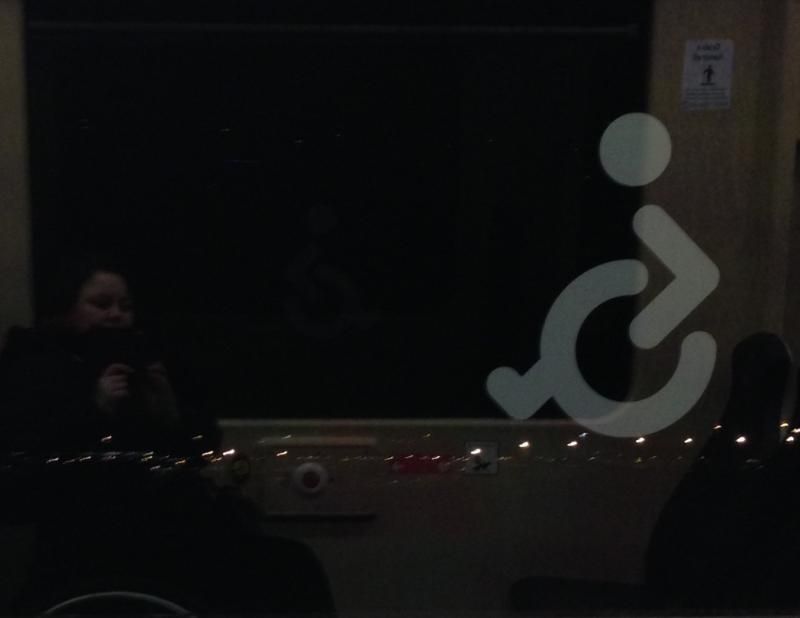
Edinburgh's trams caused chaos and no little controversy (which continues) while being built, but finally started running last spring. I've been on them a few times before, but last week took the wheelchair on for the first time. It was great. The Park and Ride at Ingliston has disabled parking right by the tram stop, though it seems to be a well-kept secret and I hesitate to publicise it! The platforms are all engineered so there's level access, without even enough of a gap for my 4" casters (that's the front wheels) to get caught. There's loads of space (4 wheelchair bays in each tram) and they're quick and smooth. They stop longer (and open the centre doors automatically) if you press the stop button with the wheelchair sympbol. I really love the active user logo they have chosen as well.

Despite it's hills, the main streets of Edinburgh's New Town are built along the hill, so there's no more than a gentle slope as you go along Princes Street and, if you alight at St Andrew's Square, the same is true for George Street. There's a slight hill, beyond me just yet, between the two, but the trams do make both of Edinburgh's main shopping streets accessible to me. Which is just as well because the Council have somewhat misguidedly blocked off half of George Street (and thus half it's disabled parking bays) to create outdoor dining spaces (in Edinburgh!). These have proven less than successful, apart from for a few weeks in August. I can even make it to John Lewis without braving the horrors of it's parking building.
Monday, 19 January 2015
Well, hello again
I'm dusting this blog off through a combination of a new year's resolution to blog more and because various things are happening and I thought this is a good place to record them.
Over the last few years I've been thinking hard about the transition to using a wheelchair, at least part of the time. I've been borrowing them at museums and galleries and last autumn hired one from the local Red Cross. The chair I got from them was a basic folding one, of the sort the NHS used to provide, but it wasn't too heavy and I was able to hack it to make it relatively maneuverable - removing the footrests and armrests and half folding the back. It was significantly lighter than the heavy duty ones you find at museums. It got me through a conference and the Scottish Referendum count and sold me on the benefits of getting one. That decided, I started looking at the bewildering range available. You can buy a folding wheelchair for £100 or a lightweight one for £400 and I suspect many people start with these. I was lucky though in that a friend pointed me in the direction of the new NHS wheelchair service National Wheelchair Eligibility Criteria and it seemed like I might be eligible for an energy efficient lightweight wheelchair, so I had my GP write the referral and, after an initial hiccup when I was sent a non-energy efficient chair (within a week!) I had an appointment with a lovely Occupational Therapist (OT) to discuss my needs.
I have to say - I have never been so impressed with an NHS service. And I'm a fan of the NHS.
Lovely OT listened to my views of my disability and discussed with me what might be suitable. She discussed the pros and cons of a lightweight chair and was frank about what I would need to do to use one - that I would need to commit to going through to Glasgow to learn how to use it safely and that it wouldn't be ordered until I had demonstrated I could. It might take 2 or 3 visits to get my skills up. Not a problem.
So, a couple of weeks later I was through in Glasgow, with Lovely OT again, trying out wheelchairs. She had me try a Quickie Life which was amazingly easy to use, compared to the Red Cross one. At the Westmarc centre, they have an obstacle course to try out and the reason they do this was clear as I arrived. Somewhat sadly, an older lady was failing her skills test for an electric wheelchair. The course has a range of surfaces, two ramps of different gradients, a narrow "parking space" and different height kerbs. Here's a picture:

In addition to this obstacle course, the main skill is what are called caster flicks - flicking up your front casters (those dinky wee wheels that are really maneuverable) so you don't get stuck in tram lines or at a kerb. So I got to do that over a broom handle, over the cracks in the pavement, up a 5cm kerb and eventually up a 10cm kerb. The idea is you do them whilst moving - going up kerbs you need the momentum to get the large back wheels up.
Lightweight chairs are very different to standard chairs. The word Lovely OT used was "tippy", which is a good word, because what they want to do, lots, is tip over backwards. So most of the skill involved is learning how to use your upper body to counterbalance them so you don't end up flat on your back (which apparently, everyone does at some point). Lovely OT followed me round, holding a strap attached to the back bar of the chair, to prevent this, and she has given me one to bring home for practicing the hardest skill of all - back wheel balancing. This is different for everyone and very dependent on your weight, but I'm told it's like riding a bicyle - once you learn, it's easy. All I know is it will involve a bit of abdominal muscle development as well!
It turned out I was able to do everything the first time, which I credit to some practice in the Red Cross chair but also to having pretty good upper body strength after 5 years on crutches. So we talked chairs. She ended up ordering me the Quickie Helium - one of the lightest (and therefore tippiest) chairs on the market. I even got to pick the colour (black with faint sparkles) but sadly not the colour of the aluminium bits (I'd have gone for red), which are also black. I picked it up last week, but I think that should be another post.
Over the last few years I've been thinking hard about the transition to using a wheelchair, at least part of the time. I've been borrowing them at museums and galleries and last autumn hired one from the local Red Cross. The chair I got from them was a basic folding one, of the sort the NHS used to provide, but it wasn't too heavy and I was able to hack it to make it relatively maneuverable - removing the footrests and armrests and half folding the back. It was significantly lighter than the heavy duty ones you find at museums. It got me through a conference and the Scottish Referendum count and sold me on the benefits of getting one. That decided, I started looking at the bewildering range available. You can buy a folding wheelchair for £100 or a lightweight one for £400 and I suspect many people start with these. I was lucky though in that a friend pointed me in the direction of the new NHS wheelchair service National Wheelchair Eligibility Criteria and it seemed like I might be eligible for an energy efficient lightweight wheelchair, so I had my GP write the referral and, after an initial hiccup when I was sent a non-energy efficient chair (within a week!) I had an appointment with a lovely Occupational Therapist (OT) to discuss my needs.
I have to say - I have never been so impressed with an NHS service. And I'm a fan of the NHS.
Lovely OT listened to my views of my disability and discussed with me what might be suitable. She discussed the pros and cons of a lightweight chair and was frank about what I would need to do to use one - that I would need to commit to going through to Glasgow to learn how to use it safely and that it wouldn't be ordered until I had demonstrated I could. It might take 2 or 3 visits to get my skills up. Not a problem.
So, a couple of weeks later I was through in Glasgow, with Lovely OT again, trying out wheelchairs. She had me try a Quickie Life which was amazingly easy to use, compared to the Red Cross one. At the Westmarc centre, they have an obstacle course to try out and the reason they do this was clear as I arrived. Somewhat sadly, an older lady was failing her skills test for an electric wheelchair. The course has a range of surfaces, two ramps of different gradients, a narrow "parking space" and different height kerbs. Here's a picture:
In addition to this obstacle course, the main skill is what are called caster flicks - flicking up your front casters (those dinky wee wheels that are really maneuverable) so you don't get stuck in tram lines or at a kerb. So I got to do that over a broom handle, over the cracks in the pavement, up a 5cm kerb and eventually up a 10cm kerb. The idea is you do them whilst moving - going up kerbs you need the momentum to get the large back wheels up.
Lightweight chairs are very different to standard chairs. The word Lovely OT used was "tippy", which is a good word, because what they want to do, lots, is tip over backwards. So most of the skill involved is learning how to use your upper body to counterbalance them so you don't end up flat on your back (which apparently, everyone does at some point). Lovely OT followed me round, holding a strap attached to the back bar of the chair, to prevent this, and she has given me one to bring home for practicing the hardest skill of all - back wheel balancing. This is different for everyone and very dependent on your weight, but I'm told it's like riding a bicyle - once you learn, it's easy. All I know is it will involve a bit of abdominal muscle development as well!
It turned out I was able to do everything the first time, which I credit to some practice in the Red Cross chair but also to having pretty good upper body strength after 5 years on crutches. So we talked chairs. She ended up ordering me the Quickie Helium - one of the lightest (and therefore tippiest) chairs on the market. I even got to pick the colour (black with faint sparkles) but sadly not the colour of the aluminium bits (I'd have gone for red), which are also black. I picked it up last week, but I think that should be another post.
Sunday, 7 October 2012
Those breast cancer "awareness raising" memes
It's that time of year again and the breast cancer memes are coming out. Your shoe size, the colour of your bra or how long it takes to do your hair are not going to raise anything other than a snigger. If you want to raise awareness of breast cancer, link to something informative, that increases women's knowledge of the signs of breast cancer (or other cancers).
I'm going to start with this ad by Elaine C Smith which is running on Scottish TV at the moment. The message is to look for more than a lump - and that's a very important one. Oh and for non-Scots, she says "three kids later ones", not freaky...
Subscribe to:
Posts (Atom)