Showing posts with label being disabled and working. Show all posts

Wednesday, 22 November 2017

Athens

Five days in Athens in November - what an opportunity.  I was asked to go to a conference from the Sunday evening to the Tuesday afternoon and flight times meant the easiest solution was to fly out  on Saturday and back on Wednesday.  This meant I had Sunday for sightseeing.  I flew with Easyjet and all went well with arrangements.

First off I arrived at Athens Airport about 8:30 and debated whether I should get a taxi (€38) or the metro (€10) in to my hotel.  As usual I had used Google Maps to check out the route from the metro to the hotel as, despite good instructions from the conference organisers, I know all too well how a "gentle slope" can in fact be insurmountable in a wheelchair.  I had mixed feelings on whether I could easily get to the hotel as I was fairly well loaded down - with my carryon bag on the front, freewheel stowed on the back and my carry on bag on my lap.

The metro ticket office said there was no charge for me so I went with that.  What a pleasant surprise - it's a brand new metro so every single station is fully accessible and in all my travels I saw no more than a 3cm gap between train and platform.  The norm was a much, much smaller gap.  Don't mind the gap.  There isn't one.


When I got to the Megaro Mousikis station, near my hotel, I could see it was a gentle downhill slope to my hotel so opted to walk, which was fine apart from dodgy the branches of an orange tree (complete with oranges) and a few detours for dropped kerbs.  Hotel was lovely, room was nice and accessible, but the lift doors were only about 70cm wide - I had to remove the silicon grips from my push rims to fit in one!

Sunday morning I got up early and had the most ridiculously generous breakfast in my room - for a €3 surcharge over breakfast in the dining room. Conveniently this avoided dealing with the stairs to the dining room.  Each morning I would tick fewer boxes on the menu and still get more than I could eat.  By the time I left I had an impressively stocked fruit bowl in my room. Really all I wanted was a piece of fruit, some Greek yoghurt and honey and a couple of pastries.

I headed back to the metro station, feeling much more confident about using it, to discover the Athens Classic Marathon underway.  You know - the one that actually starts at Marathon and finishes in the ancient Panathenaic Stadium.  I managed to find a gap in the runners (who were going pretty slowly, it being the 40km mark) to cross to the metro station's lift and headed off.


First stop on my itinerary was the Acropolis museum - built to house the Elgin Marbles should they ever be returned.  It's an amazing museum, taking you up through the different periods of Athenian history with well chosen examples of each periods treasures.  Given the sheer quantity of archaeological treasures in Athens - they even have mini-museums in many of the metro stations - it could have ended up looking like your Granny's attic.  Instead it's light and airy and everything is well displayed.  The top floor is constructed to the exact dimensions of the Parthenon, which overlooks it.  There are spaces for each of the panels currently in the British Museum.  It really is where they should be.  No photos allowed, though.  Apart from of the Lego version.


Slight comedy moment at the entrance:

Me:  One adult please
Cashier:  Oh, you are free, do you have proof of the percentage of your disability?
Me:  Um, no.
Cashier, looking me up and down:  Can you walk?
Me: A little, a few metres at most.
Cashier, handing me a ticket:  I guess you must qualify, no charge.

Note to others:  Take your Blue Badge or similar to Greece with you!

Next up - I'd heard from friends that there is a lift up to the Acropolis itself.  Keen to add another site to my list of "World Heritage Sites I've been in a lift in", I started wheeling myself up.  It was a warm day, at least for someone who lives in Scotland.  The Athenians were in coats and hats.  I was in a summer dress and knee length leggings.  The first stage was a gentle hill with marble pavements.  I well recommend marble as an outdoor wheeling surface.  Effortless. 


Next up was a steeper hill with what were basically marble cobbles and poorly grouted.  Very hard work, with zig-zagging not really helping because it just made it more likely the wheels would get stuck.  I accepted a few offers for help on steeper bits, but only for a few minutes lest my helper expired.  Eventually reached the ticket area, over halfway up the Acropolis hill, to discover that whilst there is indeed a lift there is also a ramp (I think they mean one of those platform lifts) which was out of order.  So I didn't get my trip to the top.  I got pretty close though.


The climb was well worth it though as I went down the north side of the hill - much steeper but more interesting.  Including this view over the Ancient Agora.


After some detours when streets turned out to be staircases, I made it down to Monastiraki, which is very much tourist central of Athens.  Lots of little lanes with small shops, some of which I could even get into, interspersed with ruins from various periods. 


It's a fun place just to walk around, people watch and see what's around the next corner. 


Being Sunday there was a flea market on.  I worked my way down through the tiny streets to Thissiou station, where I wandered a wee way up the Apostolou Pavlou Avenue, a walking route through the centre of Athens which is a much more sensible route from the Acropolis Museum than the one I had taken. There was a great view here of the Temple of Hephaestus (which I'd seen from the Acropolis earlier) but by this time I was too tired to attempt to get closer to it - and it was time for me to head for the start of my conference.

Saturday, 24 June 2017

Choo choo, I'm a train.

Last week I ventured on a long distance train for the first time.  My office overlooks a train station and I do occasionally find myself pondering the width of the doors and the size of the step down from the train.  Neither reassured me.  Then there were the posts I read on social media and in the press about booked assistance not turning up.  I've seen statistics as high as a 20% failure rate.  I can't image having to commute via train with a wheelchair, when on 2 journeys a week you either can't get on, or can't get off, the train.  And I'm not sure which is worse.  I used to joke that I was worried I'd end up in Penzance.

Anyway, a work trip to Durham, on a Monday at the start of a very busy week, meant there really was no option but the train.

Guess what.  I had to get a  Penzance train.

I managed to book online and using the Cross Country website had, I thought, booked assistance. What I wanted was to put my wheelchair in the luggage area and sit on a seat - lightweight wheelchairs are inherently unstable, that's what you trade for maneuverability.  On a fast, bumpy train that's not ideal.  Were there a way of securing the wheelchair, it would be OK, but there is no way to secure a wheelchair in most train carriages.  The same is true of buses.  20 years ago we had guidance that Wheelchair and Occupant Restraint Systems should be in place on public transport.  Somehow, that has disappeared.

So.  I e-mailed and checked.  No answer.  Then I got three e-mails confirming my assistance for the return journey (which, due to it costing a mere 20p extra, was in first class) but none for the outbound trip.  After more e-mails, in frustration I took to twitter.  Cross Country's PR team claimed that the wheelchair couldn't go as luggage, as it wasn't luggage.  It couldn't go in the bike area, as it wasn't a bike.  It couldn't go in the wheelchair space if I wasn't in it (reasonable).  It seemed like an impasse.  Eventually I phoned the Cross Country assistance team.  They confirmed assistance was booked, at least, and conceded that the wheelchair could go in the luggage area but only if I could stow it and take the wheels off myself as the assistance staff could not board the train.

Monday was D-day.  I was at the station at least half an hour before departure and chatted to a nice woman who was the sole member of staff assisting passengers on a busy mainline station. My train wasn't on the board yet so I said I would wait on the concourse.  25 minutes later, with less than 10 minutes to go and with the colleague I was travelling with having arrived, I asked their gate staff to let the assistance woman know that I was heading down to the platform.  She arrived a couple of minutes later.  I got on the train no problems.

Once on the train I started disassembling the wheelchair, much to the confusion of the Train Manager.  It seems they are very frustrated with what is said by both the PR team and the assistance booking team.  My situation is not unusual (there are a lot of lightweight users out there) and what they advise is to book for Coach D or F.  Then they just wheel the wheelchair through to the luggage area. So now I know for next time.

My journey of course wasn't over.  When we got to Durham there was no sign of the booked assistance.  Virgin East Coast had no record of my request for assistance.  My colleague and a stranger helped me down from the train - just as well or I could have ended up in Penzance after all!

On the way back, I got to the station an hour in advance and, thankfully, everyone had a record of me and I got all the help I needed.  Since the train was quiet, my wheelchair sat in the wheelchair space and I sat in my seat.  I suspect the fact I was in First Class helped.  I hate to say it, but I suspect that's what I'll do in future, if I can.

My assistance failure rate - 25%

Time for a gratuitous use of this wonderful moment in Glasgow.

Thursday, 30 June 2016

Almost but not quite...

I'm at the Nottingham Human Rights Law Centre Summer School this week and we are staying in a Premier Inn in the centre of Nottingham.  I've been given an accessible room, which usually I don't bother with as I can walk the short distances in a hotel room.

The hotel is almost brand new and very comfortable.  It has a wet room with plenty of hand rails.  The basin is a decent size and there is counter space for toiletries and make up.  There's plenty of space to move around.  All in all the architect designed an accessible room that meets all the right standards but doesn't feel like a public toilet.

And then, I suspect, someone with a bit less knowledge came along to fit it out.


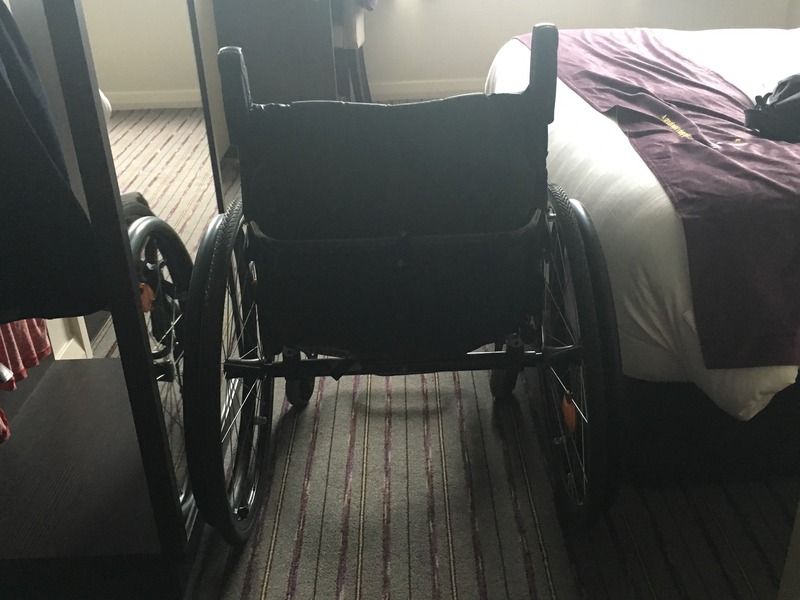
There's a shelf unit (with wheelchair height hanging rail) that sticks out into the room making it very difficult to squeeze a wheelchair through.  They should have put hooks on the wall.  


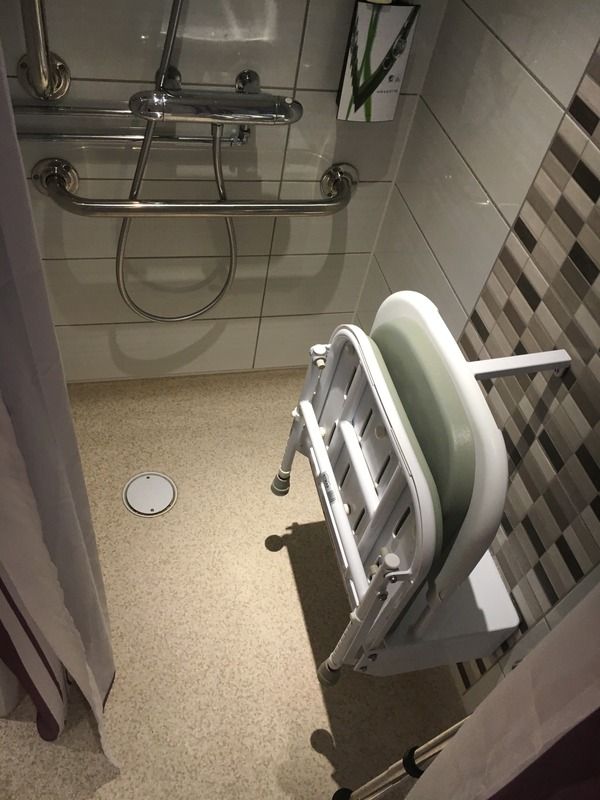
There's a very bulky shower seat in a small but otherwise workable shower area.  It makes it tricky to shower whether or not you're using it.  You can get much smaller ones than this, that take up less space or they could provided a freestanding chair or stool that could be moved out of the way.  

The phenomenon of a building being designed accessible but obstacles being added that reduce accessibility is not limited to hotels.  Shops are really goo at adding free standing displays that block aisles or even the tills!  

Saturday, 2 April 2016

Belfast

Going through my photographs is a good way of remembering the blog posts I've written in my head but which I've not managed to actually write on screen yet.  This picture was the prompt for my first solo business trip in my new job.


A conference on children's right to play took me to Belfast, by plane.  It was the first time I've travelled completely alone by plane since I got the wheelchair but after last year's Paris trip I wasn't too worried.  It was also great that no one at my work hesitated about me going for a second.  The assumption was that if I thought I could manage, that was fine.  The cup in the picture is from the dinner the night before, which was held at the Titanic Belfast.

I flew across on FlyBe .  Work booked the flight and indicated I need assistance and then the airline contacted us and asked me to complete an information form with the dimensions of my wheelchair (assembled and broken down) and my assistance needs.  It was the first time I've needed to provide so much detail - but it's a pretty small plane.  At both airports (Edinburgh and Belfast City/George Best) I made myself known to the assistance team, confirmed I needed the ambulift as there wouldn't be an airbridge, but wouldn't need the aisle chair (I'm learning the routine!), then said I would meet them at the gate at the agreed time.  They were both fine with this - an improvement from a few years ago when they didn't seem to like you getting out of their control.  

I'd booked late and wasn't able to get into the same hotel as the rest of the conference delegates and with the Premier Inn right by the Titanic Belfast fully booked, picked the Hilton as being the nearest to the airport, Titanic and the right side of the city for the conference venue.  It was slightly dearer than the Premier Inn but not much.  Really spacious hotel room and really accessible while still being comfortable and fully furnished (I once stayed in a room where all the furniture had been removed to make it accessible!)

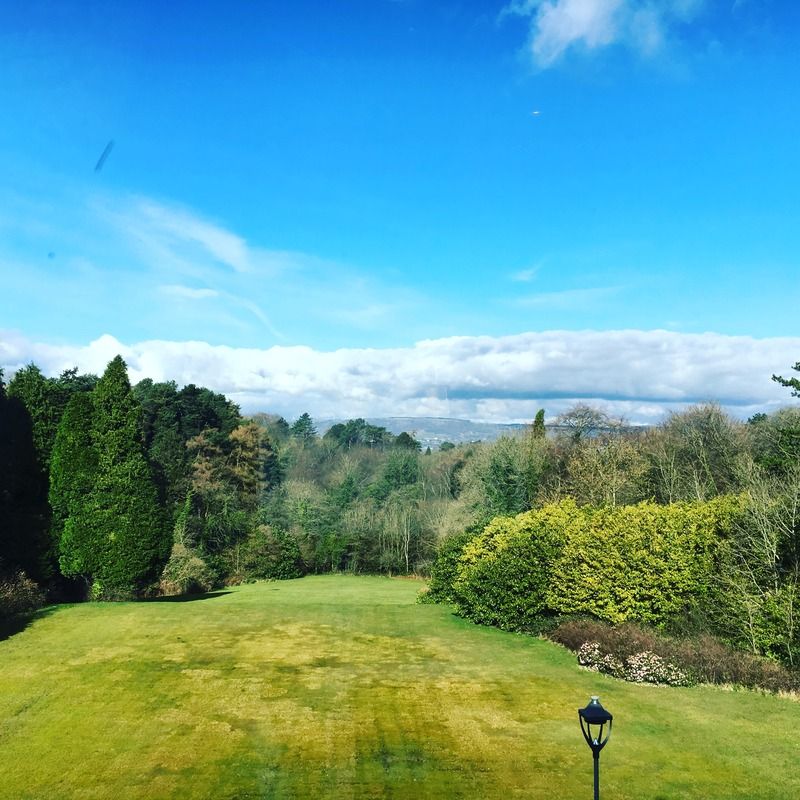
The conference itself was at Cultra Manor, which is within the grounds of the Ulster Folk and Transport Museum (which is a massive site - mostly wooded and very beautiful on a sunny spring day).  It's a lovely venue with good access - nice ramp and a proper lift.  Lovely view across Belfast Lough.


The only disappointment of the trip was the taxis.  I'm used to cities, certainly in Britain, having plenty of London taxis.  It's pretty easy to just lift the chair in.  Private Hire cars are usually hatchbacks or estates, with plenty of room.  However in Belfast most of the taxis were very large, mostly upmarket saloon cars - Audis, Mercedes. VWs.  I discovered that my wheelchair would not fit in an Audi A6's boot, even with the wheels off and the back folded.  There was also a real scarcity of wheelchair accessible taxis.  As a result, I was advised by both the main taxi companies that I would need to request an estate car (station wagon) - at an extra cost of £5.  The Northern Irish contingent at the conference were horrified but it seems there are some ongoing issues with taxi companies treatment of disabled people in Northern Ireland.

Wednesday, 13 January 2016

New job

I started a new job last week.  So far it has involved a lot of reading - more than I have done since I finished my MA - but I think I am going to enjoy it.  It's getting back to doing policy work, whereas my old job, with a local Council, had moved away from that.

Inevitably, a new job is a source of anxiety but this is the first time I've been "properly" disabled and changing job.  When I started my last job, back in 2008, I already had back and leg problems and had been using a stick, but I didn't have a disabled parking badge and could mostly get about OK.  A few months after I started, I seriously injured my right SI joint, which resulted in the transition to using crutches.  2 years later I broke my tailbone causing even more problems and a year ago I started using a wheelchair.  I've more than once had to fight to get adjustments made or had to work around accessibility issues.

So, I found myself dealing with the practicalities of disability with a new employer.  I have to say I am incredibly lucky in that everything has gone very smoothly with my employer.  A parking space was made available for me without me having to ask and they're happy to do whatever I need.  This is just as well, as Access to Work, the government scheme I first used for adaptations (a specialist office chair and some other equipment) about 10 years ago, has been much watered down in the meantime.

When I attended the Unison Disabled Members Conference back in October there was a lot of discussion about the effect changes to the scheme have had on disabled workers.  It's particularly affecting workers with hearing and visual impairments, but it is also having an impact on those with a physical disability who require adjustments in the workplace .  Increasingly, employers are expected to make these, in line with their obligations under the Equality Act.  But while I now have the luxury of an employer who will do what is necessary and would not dream of discriminating, I don't doubt this is providing a barrier to employment to some disabled people - and it seems like very little is being done to challenge that.

When I first used the scheme, you could apply within the first six weeks at a new job and they would provide any equipment needed at no cost to your employer.  This reduced the risk that an employer would reject a disabled candidate because of the potential cost of adjustments.  When I changed jobs, because my chair had been provided by Access to Work, it was mine to take with me to my new job.  This support was subsequently restricted to smaller employers and latterly it seems the expectations on employers have increased.  I'm still not sure what support will be available this time round.

The cuts to Access to Work make me particularly angry as this is a scheme which is supposed to remove barriers to disabled people working.  We still don't know what effect the scale of the cuts.    Reducing and restricting what it covers means that it is harder for a disabled person to find work, it adds another potential cost to employing a disabled person which serves as a disincentive for all but the very best employers.  And for some people, the cuts may mean work is no longer a viable option.  Surely that's the opposite of what should be happening.

Thursday, 4 October 2012

Technology is getting disabled people back into work

This article on the BBC News website was brought to my attention by a friend who has fairly serious ME. My first reaction was anger, a sort of slightly pent up anger that has been brewing all summer. The Paralympics presented me with very mixed feelings. The achievements of the athletes are phenomenal, just as those of their Olympian compatriots are. What angered me, though, was that they perpetuated a discourse on disability that focuses on a narrow range of disabilities and that much of the coverage of people like Oscar Pistorius also focuses on the way technology can "eliminate" disability. I'm a fan of technology and it helps a lot but no expensive titanium wheelchair will help if, for example, you turn up to an event to discover the only accessible access to the building has been locked up because it's past 6pm so the only access is via 20 steps. Yes, this happened to me last week at a major Scottish university. Presumably all disabled students should be tucked up in their beds, rather than attending the lectures taking place that night. If I see that picture of Pistorius and the wee girl with blades, with the "the only disability is a bad attitude" quote, I may become homicidal. The guy at the start of this article elicits the same reactions. His hi-tech legs did not get him back into work - they got him back rock climbing (which was how he lost his original legs) which is all well and good but he was clearly an extremely athletic person with or without his lower legs. I'm glad technology can help disabled people - I'm very much hoping that one day someone will come up with something that will help me. My Orthopedic Consultant sent me away with "the good news they are doing clever things with carbon fibre, so that might be an option soon". But I am very much aware that not all disabilities can be overcome with technology. The article improves as it goes on. The section at the end, which does mention the ways attitudes to disabled employees need to be overcome, makes some good points, but it still focuses on ways disabled people need to use technology to navigate the workplace, not ways that the workplace can become more accessible to disabled people.