Saturday, 24 June 2017

Choo choo, I'm a train.

Last week I ventured on a long distance train for the first time.  My office overlooks a train station and I do occasionally find myself pondering the width of the doors and the size of the step down from the train.  Neither reassured me.  Then there were the posts I read on social media and in the press about booked assistance not turning up.  I've seen statistics as high as a 20% failure rate.  I can't image having to commute via train with a wheelchair, when on 2 journeys a week you either can't get on, or can't get off, the train.  And I'm not sure which is worse.  I used to joke that I was worried I'd end up in Penzance.

Anyway, a work trip to Durham, on a Monday at the start of a very busy week, meant there really was no option but the train.

Guess what.  I had to get a  Penzance train.

I managed to book online and using the Cross Country website had, I thought, booked assistance. What I wanted was to put my wheelchair in the luggage area and sit on a seat - lightweight wheelchairs are inherently unstable, that's what you trade for maneuverability.  On a fast, bumpy train that's not ideal.  Were there a way of securing the wheelchair, it would be OK, but there is no way to secure a wheelchair in most train carriages.  The same is true of buses.  20 years ago we had guidance that Wheelchair and Occupant Restraint Systems should be in place on public transport.  Somehow, that has disappeared.

So.  I e-mailed and checked.  No answer.  Then I got three e-mails confirming my assistance for the return journey (which, due to it costing a mere 20p extra, was in first class) but none for the outbound trip.  After more e-mails, in frustration I took to twitter.  Cross Country's PR team claimed that the wheelchair couldn't go as luggage, as it wasn't luggage.  It couldn't go in the bike area, as it wasn't a bike.  It couldn't go in the wheelchair space if I wasn't in it (reasonable).  It seemed like an impasse.  Eventually I phoned the Cross Country assistance team.  They confirmed assistance was booked, at least, and conceded that the wheelchair could go in the luggage area but only if I could stow it and take the wheels off myself as the assistance staff could not board the train.

Monday was D-day.  I was at the station at least half an hour before departure and chatted to a nice woman who was the sole member of staff assisting passengers on a busy mainline station. My train wasn't on the board yet so I said I would wait on the concourse.  25 minutes later, with less than 10 minutes to go and with the colleague I was travelling with having arrived, I asked their gate staff to let the assistance woman know that I was heading down to the platform.  She arrived a couple of minutes later.  I got on the train no problems.

Once on the train I started disassembling the wheelchair, much to the confusion of the Train Manager.  It seems they are very frustrated with what is said by both the PR team and the assistance booking team.  My situation is not unusual (there are a lot of lightweight users out there) and what they advise is to book for Coach D or F.  Then they just wheel the wheelchair through to the luggage area. So now I know for next time.

My journey of course wasn't over.  When we got to Durham there was no sign of the booked assistance.  Virgin East Coast had no record of my request for assistance.  My colleague and a stranger helped me down from the train - just as well or I could have ended up in Penzance after all!

On the way back, I got to the station an hour in advance and, thankfully, everyone had a record of me and I got all the help I needed.  Since the train was quiet, my wheelchair sat in the wheelchair space and I sat in my seat.  I suspect the fact I was in First Class helped.  I hate to say it, but I suspect that's what I'll do in future, if I can.

My assistance failure rate - 25%

Time for a gratuitous use of this wonderful moment in Glasgow.

Thursday, 19 January 2017

There's a ramp!

I'm on a panel today and am very impressed to find there is a ramp up to the podium!  Well done NHS Lanarkshire.


Thursday, 30 June 2016

Almost but not quite...

I'm at the Nottingham Human Rights Law Centre Summer School this week and we are staying in a Premier Inn in the centre of Nottingham.  I've been given an accessible room, which usually I don't bother with as I can walk the short distances in a hotel room.

The hotel is almost brand new and very comfortable.  It has a wet room with plenty of hand rails.  The basin is a decent size and there is counter space for toiletries and make up.  There's plenty of space to move around.  All in all the architect designed an accessible room that meets all the right standards but doesn't feel like a public toilet.

And then, I suspect, someone with a bit less knowledge came along to fit it out.


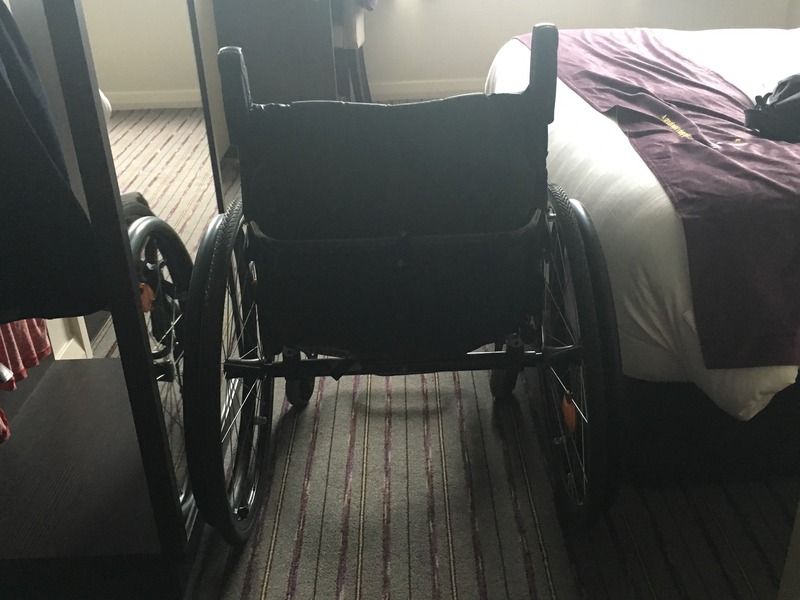
There's a shelf unit (with wheelchair height hanging rail) that sticks out into the room making it very difficult to squeeze a wheelchair through.  They should have put hooks on the wall.  


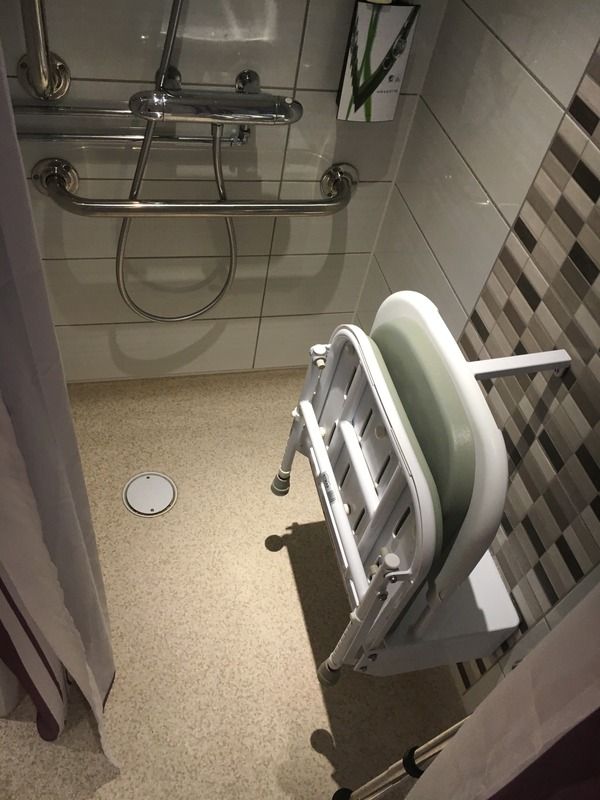
There's a very bulky shower seat in a small but otherwise workable shower area.  It makes it tricky to shower whether or not you're using it.  You can get much smaller ones than this, that take up less space or they could provided a freestanding chair or stool that could be moved out of the way.  

The phenomenon of a building being designed accessible but obstacles being added that reduce accessibility is not limited to hotels.  Shops are really goo at adding free standing displays that block aisles or even the tills!  

Tuesday, 7 June 2016

Where did the ramp go?

It's actually reassuring to discover that problems with ramps are not confined to this country.  A friend pointed me in the direction of this article from a local paper in Connecticut, USA, about a perfectly good ramp being moved in a way that made it barely accessible.

I wonder if they thought to move the disabled parking bays as well?

Friday, 3 June 2016

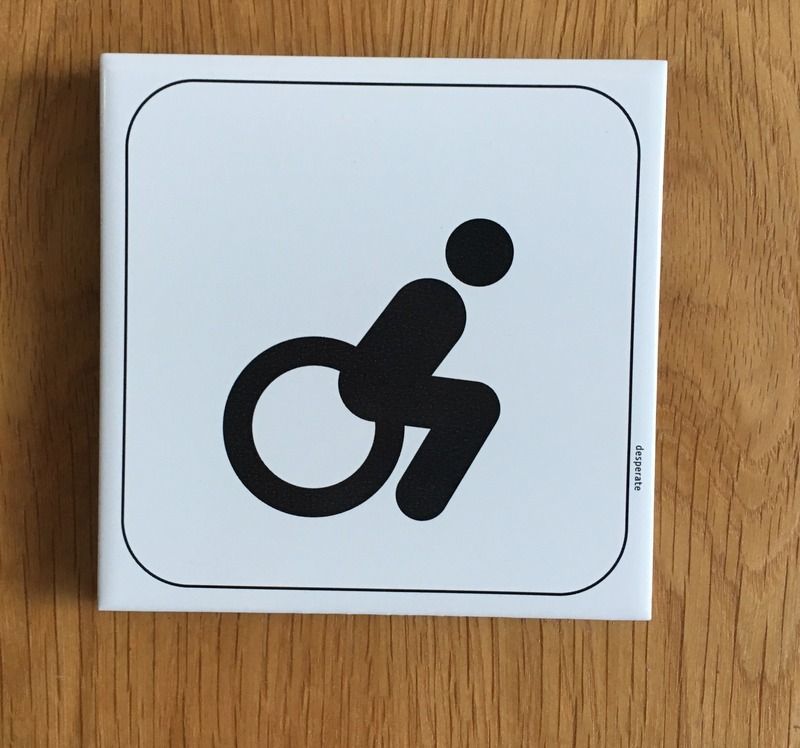
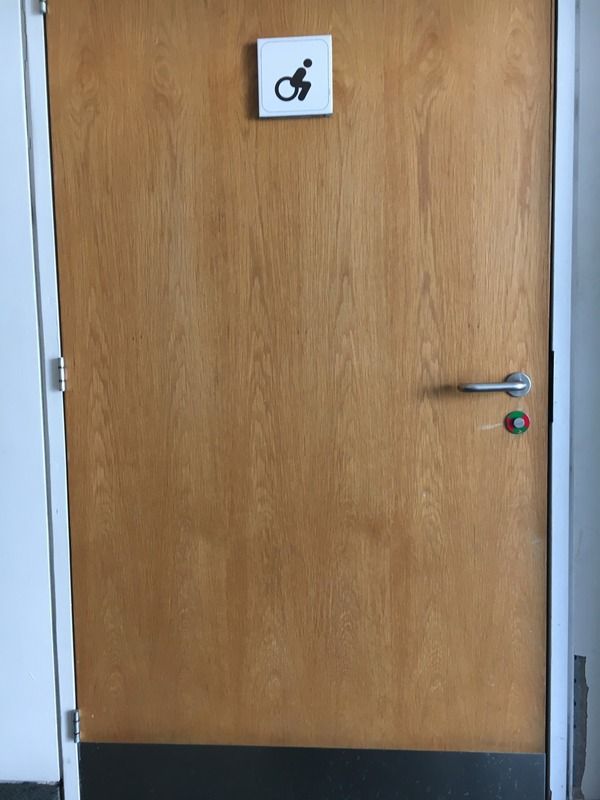
I'm at an event today at the Lighthouse in Glasgow and had to take a picture of this symbol they've used in all the signage for their disabled toilets.


I love active wheelchair logos, like the one on the Edinburgh trams I posted about a couple of years ago.  This person is clearly going up a very steep hill!

I'd suggest one small change - maybe it should be at the eye level of a wheelchair user.


Friday, 15 April 2016

Money, money money

We're off to Denmark* on our holidays, so I dug out the Danish coins in our random coins jar.

The small Scottish boy had a look through some of the others - I have lira, Deutschmark, Belgian Franc, Guilder and even some Czechoslovak and Soviet coins (bonus points for having not only currencies which no longer exist, but ones from countries which no longer exist). Also, for some unknown reason, I have about 10Fr in 10 and 20 centime coins.

Anyway, conferred with the Nationalbanken website to see if the Danish coins were still OK. They all are, except the old style 25øre and 5øre but they had been withdrawn in 1991 when I got them.

I don't have any notes, which is good, because they've been replaced twice since I lived there. The new ones have bridges (real ones, not the Euro fake ones) on one side and Viking things on the other.

I was impressed though that the last series (which I'd not really looked at - they were just coming out when I left in 1999) was gender balanced - given the debate about having just one woman (aside from the Queen) on bank notes generates here. There were five notes, so the 1000kr had Anna and Michael Ancher. Karen Blixen, Carl Nielsen, Johanne Luise Heiberg (who was played by Sidse Babett Knudsen in 1864) and Niels Bohr were on the others.

The ones before, the ones I know from living there, are the 1972 series. All but one of those have women on. Prior to that was a portrait series of all men. I do wonder if any other nation has had as many physicists on it's notes - Bohr, Ørsted and Rømer have all featured down the years.

*Yes, I know, Abba are Swedish. Three years of Scandinavian Studies at University here! Our plans also include a quick visit to Sweden one evening for dinner. I've been there just once, for a few hours one Easter Sunday in the 90s. I had no Swedish money with me, but as nothing was open, it didn't matter.

Wednesday, 13 April 2016

Copenhagen

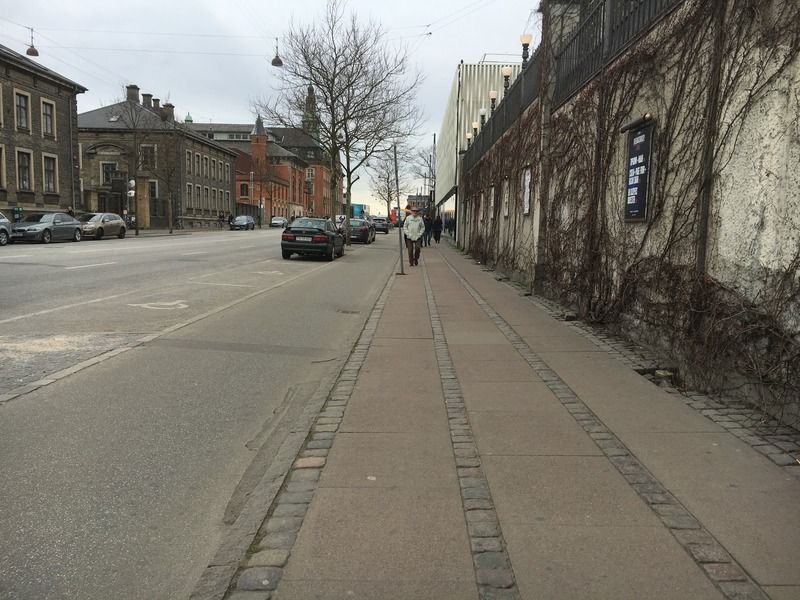
Frustratingly, though Copenhagen's streets are fantastic for cyclists, they're a bloody nightmare for wheelchair users.  It's so tempting to head up that beautiful smooth cycle path but when I briefly did, because the footpath was blocked by parked cycles, I got shouted at (and shouted back I might add!).


So I've struggled along with those rows of cobbles which are almost exactly the width of my chair apart.  Even with the freewheel, the least worst option is to follow the cobbles with it.  This is pretty good path.  Most are half the width and very uneven.

Also, when everyone cycles, there are as many arseholes cyclists as arsehole drivers.

Saturday, 2 April 2016

Belfast

Going through my photographs is a good way of remembering the blog posts I've written in my head but which I've not managed to actually write on screen yet.  This picture was the prompt for my first solo business trip in my new job.


A conference on children's right to play took me to Belfast, by plane.  It was the first time I've travelled completely alone by plane since I got the wheelchair but after last year's Paris trip I wasn't too worried.  It was also great that no one at my work hesitated about me going for a second.  The assumption was that if I thought I could manage, that was fine.  The cup in the picture is from the dinner the night before, which was held at the Titanic Belfast.

I flew across on FlyBe .  Work booked the flight and indicated I need assistance and then the airline contacted us and asked me to complete an information form with the dimensions of my wheelchair (assembled and broken down) and my assistance needs.  It was the first time I've needed to provide so much detail - but it's a pretty small plane.  At both airports (Edinburgh and Belfast City/George Best) I made myself known to the assistance team, confirmed I needed the ambulift as there wouldn't be an airbridge, but wouldn't need the aisle chair (I'm learning the routine!), then said I would meet them at the gate at the agreed time.  They were both fine with this - an improvement from a few years ago when they didn't seem to like you getting out of their control.  

I'd booked late and wasn't able to get into the same hotel as the rest of the conference delegates and with the Premier Inn right by the Titanic Belfast fully booked, picked the Hilton as being the nearest to the airport, Titanic and the right side of the city for the conference venue.  It was slightly dearer than the Premier Inn but not much.  Really spacious hotel room and really accessible while still being comfortable and fully furnished (I once stayed in a room where all the furniture had been removed to make it accessible!)

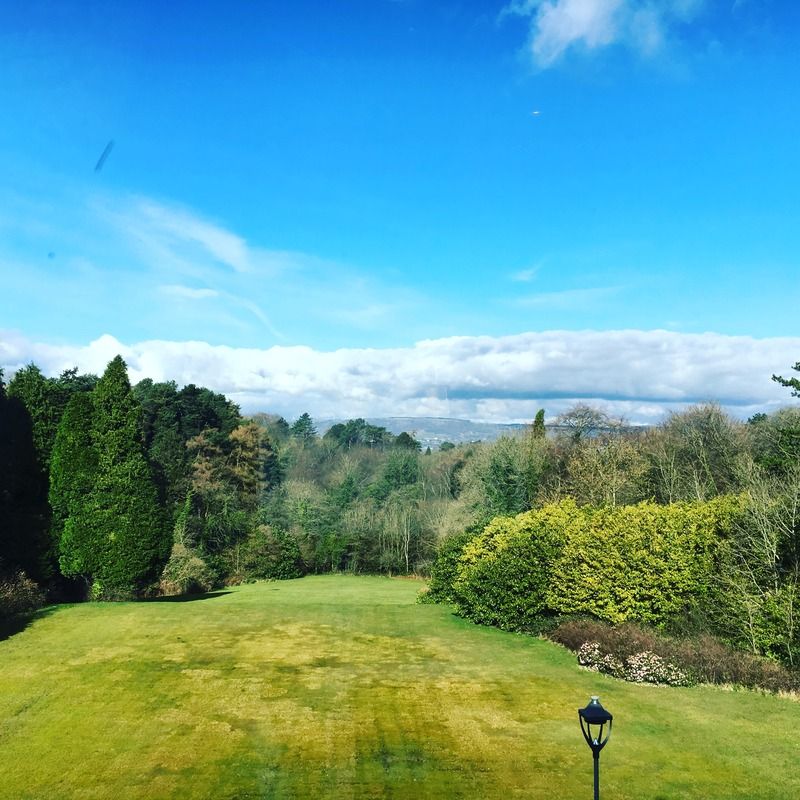
The conference itself was at Cultra Manor, which is within the grounds of the Ulster Folk and Transport Museum (which is a massive site - mostly wooded and very beautiful on a sunny spring day).  It's a lovely venue with good access - nice ramp and a proper lift.  Lovely view across Belfast Lough.


The only disappointment of the trip was the taxis.  I'm used to cities, certainly in Britain, having plenty of London taxis.  It's pretty easy to just lift the chair in.  Private Hire cars are usually hatchbacks or estates, with plenty of room.  However in Belfast most of the taxis were very large, mostly upmarket saloon cars - Audis, Mercedes. VWs.  I discovered that my wheelchair would not fit in an Audi A6's boot, even with the wheels off and the back folded.  There was also a real scarcity of wheelchair accessible taxis.  As a result, I was advised by both the main taxi companies that I would need to request an estate car (station wagon) - at an extra cost of £5.  The Northern Irish contingent at the conference were horrified but it seems there are some ongoing issues with taxi companies treatment of disabled people in Northern Ireland.

Thursday, 31 March 2016

A good idea this, but first, toilets.

Disabled toilets are actually quite interesting in their variety.  And also in the ways that they can be done badly.  I'm lucky - I can stand and walk so transferring isn't a problem, so my interest is mostly theoretical, but for those who have to transfer horizontally (i.e. slide from wheelchair to toilet and then back again) it must be a nightmare. It doesn't surprise me at all that there is a whole blog on the subject.

The basics are pretty easy.  Lots of space, some handrails and a big door.  Easy?  That first criteria, it turns out, is the biggest problem.  Disabled toilets have loads of space.  And space is often at a premium in restaurants and shops.  You can see the thought process - lovely big space, we'll just store the high chairs/bulk pack of toilet roll/cleaning equipment in there.  The other thing is that they see the lovely space, realise they also need to provide a baby change area, so in goes a changing table and a really bulky bio-waste bin for nappies.   The problem is, if the toilet is the minimum size and you add those in, suddenly there's not enough room for a wheelchair user to get in, turn around, maneuver alongside the toilet (from either side) and then transfer across.  Add in a helper and it's pretty crowded in there.  Now I've nothing against baby change areas (I've used them enough myself) but if the disabled toilet is going to do double duty, it needs to be bigger.

Then there's the sinks.  Often they're tiny, probably because it's in some guideline somewhere and because the room is probably too small to start with.  But if the water pressure is too high, you end up with a very wet lap.  And the tiny ones don't feel like they're any easy to use than a bigger one, with clearance underneath would be.  They usually require a lot of leaning at an odd angle.

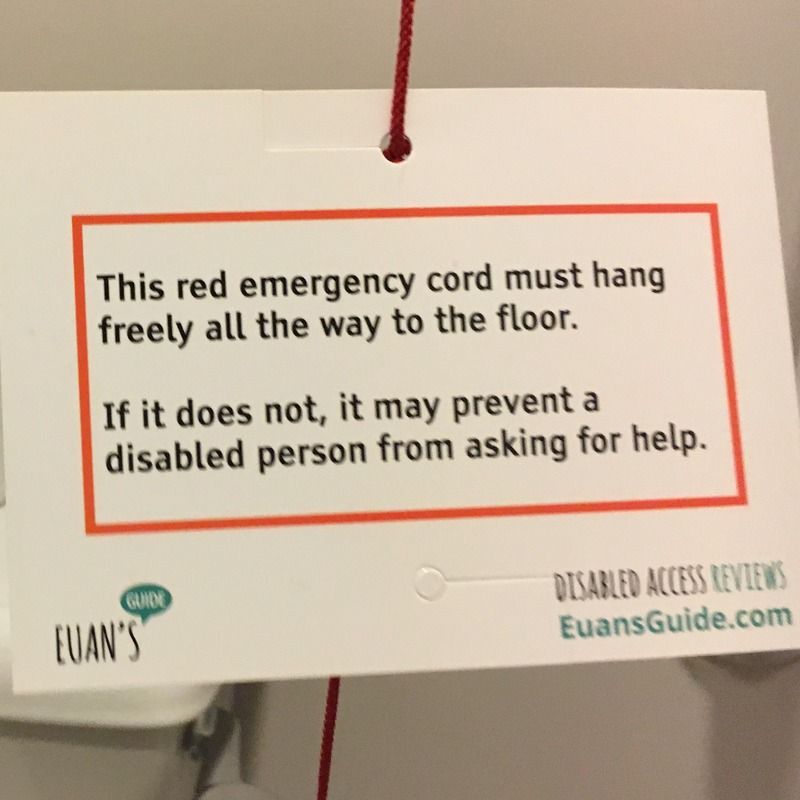
Finally, that red emergency pull cord.  It's not something I'm likely to use, but it's there for a reason.  A very good reason.  If a disabled person falls, for example because they're trying to transfer at a strange angle, they need to be able to grab it to get help.  Easily.  Without standing up (because perhaps they can't).  But cleaners clearly find the cord extremely annoying.  I've seen all sorts of efforts to tidy it "out of the way" - in one extreme case a hook had been installed, a foot below the ceiling, for it to be wound round!  One of the most annoying being to wrap it round the fold down handrails.  Thing is, they're there for a reason as well and it's pretty embarrassing to fold down the handrail (which I do need) and set it off.  Even if you can reach the reset button in a hurry (they're usually clear across the room), even if someone knocks rather than barging straight in while your knickers are down, you're going to do a walk (or wheel) of shame back to your table when that happens in a busy restaurant.

It seems like I'm not the only one who has been silently fuming about the safety cords.  The great Euan's Guide, who run a Scottish version of the J'accede app I used in France last year, have started a campaign and produced A5 cards to raise awareness of the cords.  Here's one I snapped at the Dovecot Studios in Edinburgh a couple of weeks ago.


I've ordered a supply and have already deployed my first - in an Asda store which had the cord very firmly wrapped around the hand rail (and yes, I did set it off when I untangled it!)