Saturday, 2 April 2016

Belfast

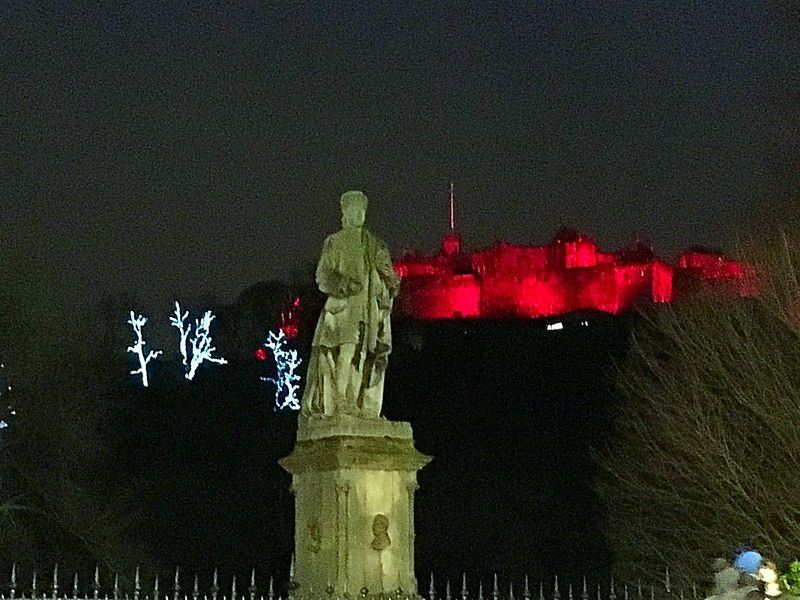
Going through my photographs is a good way of remembering the blog posts I've written in my head but which I've not managed to actually write on screen yet.  This picture was the prompt for my first solo business trip in my new job.


A conference on children's right to play took me to Belfast, by plane.  It was the first time I've travelled completely alone by plane since I got the wheelchair but after last year's Paris trip I wasn't too worried.  It was also great that no one at my work hesitated about me going for a second.  The assumption was that if I thought I could manage, that was fine.  The cup in the picture is from the dinner the night before, which was held at the Titanic Belfast.

I flew across on FlyBe .  Work booked the flight and indicated I need assistance and then the airline contacted us and asked me to complete an information form with the dimensions of my wheelchair (assembled and broken down) and my assistance needs.  It was the first time I've needed to provide so much detail - but it's a pretty small plane.  At both airports (Edinburgh and Belfast City/George Best) I made myself known to the assistance team, confirmed I needed the ambulift as there wouldn't be an airbridge, but wouldn't need the aisle chair (I'm learning the routine!), then said I would meet them at the gate at the agreed time.  They were both fine with this - an improvement from a few years ago when they didn't seem to like you getting out of their control.  

I'd booked late and wasn't able to get into the same hotel as the rest of the conference delegates and with the Premier Inn right by the Titanic Belfast fully booked, picked the Hilton as being the nearest to the airport, Titanic and the right side of the city for the conference venue.  It was slightly dearer than the Premier Inn but not much.  Really spacious hotel room and really accessible while still being comfortable and fully furnished (I once stayed in a room where all the furniture had been removed to make it accessible!)

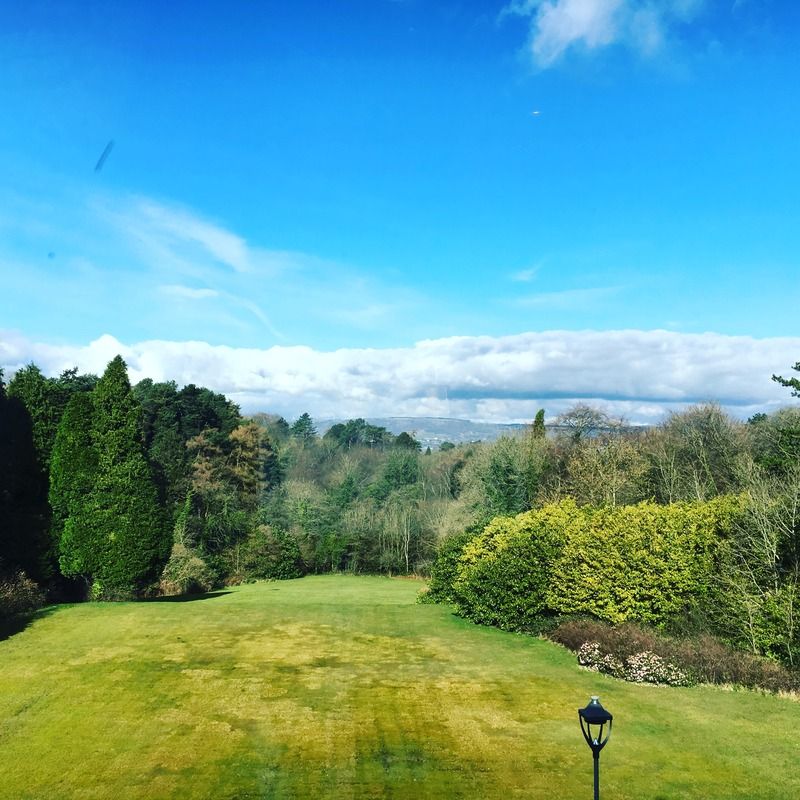
The conference itself was at Cultra Manor, which is within the grounds of the Ulster Folk and Transport Museum (which is a massive site - mostly wooded and very beautiful on a sunny spring day).  It's a lovely venue with good access - nice ramp and a proper lift.  Lovely view across Belfast Lough.

The only disappointment of the trip was the taxis.  I'm used to cities, certainly in Britain, having plenty of London taxis.  It's pretty easy to just lift the chair in.  Private Hire cars are usually hatchbacks or estates, with plenty of room.  However in Belfast most of the taxis were very large, mostly upmarket saloon cars - Audis, Mercedes. VWs.  I discovered that my wheelchair would not fit in an Audi A6's boot, even with the wheels off and the back folded.  There was also a real scarcity of wheelchair accessible taxis.  As a result, I was advised by both the main taxi companies that I would need to request an estate car (station wagon) - at an extra cost of £5.  The Northern Irish contingent at the conference were horrified but it seems there are some ongoing issues with taxi companies treatment of disabled people in Northern Ireland.

Thursday, 31 March 2016

A good idea this, but first, toilets.

Disabled toilets are actually quite interesting in their variety.  And also in the ways that they can be done badly.  I'm lucky - I can stand and walk so transferring isn't a problem, so my interest is mostly theoretical, but for those who have to transfer horizontally (i.e. slide from wheelchair to toilet and then back again) it must be a nightmare. It doesn't surprise me at all that there is a whole blog on the subject.

The basics are pretty easy.  Lots of space, some handrails and a big door.  Easy?  That first criteria, it turns out, is the biggest problem.  Disabled toilets have loads of space.  And space is often at a premium in restaurants and shops.  You can see the thought process - lovely big space, we'll just store the high chairs/bulk pack of toilet roll/cleaning equipment in there.  The other thing is that they see the lovely space, realise they also need to provide a baby change area, so in goes a changing table and a really bulky bio-waste bin for nappies.   The problem is, if the toilet is the minimum size and you add those in, suddenly there's not enough room for a wheelchair user to get in, turn around, maneuver alongside the toilet (from either side) and then transfer across.  Add in a helper and it's pretty crowded in there.  Now I've nothing against baby change areas (I've used them enough myself) but if the disabled toilet is going to do double duty, it needs to be bigger.

Then there's the sinks.  Often they're tiny, probably because it's in some guideline somewhere and because the room is probably too small to start with.  But if the water pressure is too high, you end up with a very wet lap.  And the tiny ones don't feel like they're any easy to use than a bigger one, with clearance underneath would be.  They usually require a lot of leaning at an odd angle.

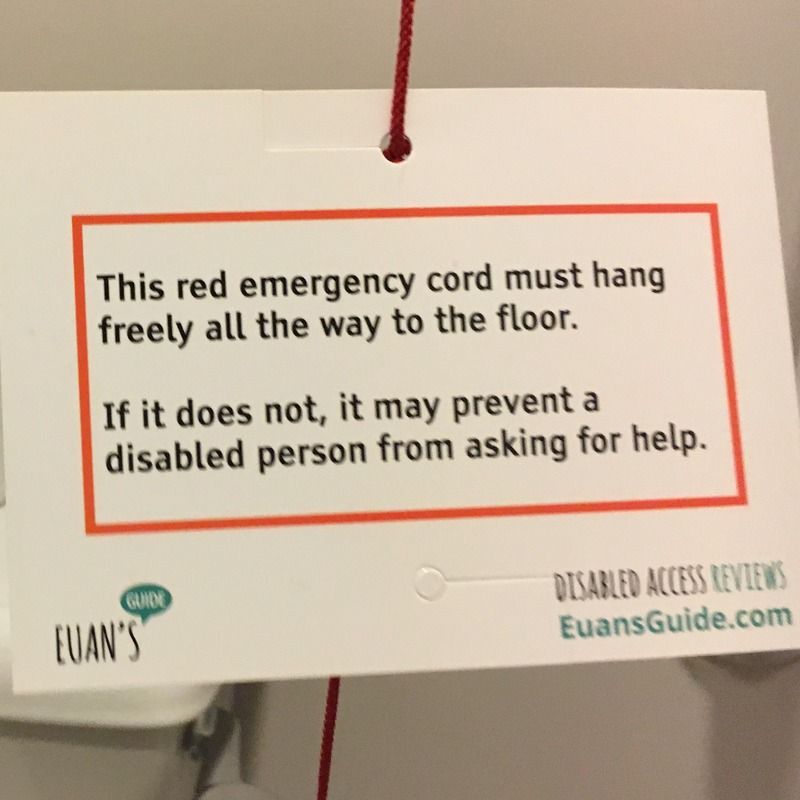
Finally, that red emergency pull cord.  It's not something I'm likely to use, but it's there for a reason.  A very good reason.  If a disabled person falls, for example because they're trying to transfer at a strange angle, they need to be able to grab it to get help.  Easily.  Without standing up (because perhaps they can't).  But cleaners clearly find the cord extremely annoying.  I've seen all sorts of efforts to tidy it "out of the way" - in one extreme case a hook had been installed, a foot below the ceiling, for it to be wound round!  One of the most annoying being to wrap it round the fold down handrails.  Thing is, they're there for a reason as well and it's pretty embarrassing to fold down the handrail (which I do need) and set it off.  Even if you can reach the reset button in a hurry (they're usually clear across the room), even if someone knocks rather than barging straight in while your knickers are down, you're going to do a walk (or wheel) of shame back to your table when that happens in a busy restaurant.

It seems like I'm not the only one who has been silently fuming about the safety cords.  The great Euan's Guide, who run a Scottish version of the J'accede app I used in France last year, have started a campaign and produced A5 cards to raise awareness of the cords.  Here's one I snapped at the Dovecot Studios in Edinburgh a couple of weeks ago.


I've ordered a supply and have already deployed my first - in an Asda store which had the cord very firmly wrapped around the hand rail (and yes, I did set it off when I untangled it!)

Saturday, 23 January 2016

Wheelchair fashion

A friend pointed me in the direction of IZ Collection, an American company who specialise in clothing for wheelchair users.  It hadn't occurred to me that such a thing existing but I can definitely see the point.

One of the things they don't tell you when you get a wheelchair is that you'll end up replacing most of your clothes.  All my trousers were too short because when you're sitting down the whole time, it pulls the hems up and your ankles get cold - I've gone from wearing a short to a regular length.  And you don't want a lot of bulk round your middle (and mine perhaps has enough built in!) so I'm afraid treggings and jeggings, much as I hate the words, are the answer.   Cardigans and jackets have to be fastened or they catch in the wheels (and get filthy!).  And the bits of you that feel the cold change. My lovely down jacket, bought last winter, is too warm on all but the coldest days, if I'm moving about much, but at the same time my legs are often freezing.  I have a couple of men's ski jackets, in dark colours because otherwise they'd be turned grey, quickly, by the muck from the wheels.  This hybrid jacket does a good job of not cooking my arms but keeping the bits that get cold warm.  They're far lighter than any coat I'd normally wear.  Finally, none of my tailored jackets fit anymore because I've developed arm muscles.  Just as well the dress code is fairly casual at my new job.

A lot of the clothes on the IZ website, particularly in the sale, are along the lines of things I've figured out already.  Tunics were already part of my wardrobe.  I've added cropped, fastening cardigans - some bought, some hand knitted.  I hate ironing, so jersey is a great fabric - it also doesn't crease when you're sitting all day.  The thing that interested me most - and what I am most likely to order - is their trousers.  I'd not anticipated the draughts down the back of my trousers, even when wearing a longer top and a vest (US - undershirt) tucked in underneath.  I've bought a couple of pairs of elastic waisted trousers from M&S which are comfortable and fit round the waist but IZ's look really interesting.  That slanted waistline looks like it could be very useful at stopping what my Grandma used to call "a chill in your kidneys".


The other conundrum I've been mulling over is how to cover my legs to keep them warm and dry without feeling like a granny.  I quite like a couple of the options on the IZ website, but I do wonder whether I couldn't make them myself.   On the other hand, a friend suggested one of these:


Wednesday, 13 January 2016

New job

I started a new job last week.  So far it has involved a lot of reading - more than I have done since I finished my MA - but I think I am going to enjoy it.  It's getting back to doing policy work, whereas my old job, with a local Council, had moved away from that.

Inevitably, a new job is a source of anxiety but this is the first time I've been "properly" disabled and changing job.  When I started my last job, back in 2008, I already had back and leg problems and had been using a stick, but I didn't have a disabled parking badge and could mostly get about OK.  A few months after I started, I seriously injured my right SI joint, which resulted in the transition to using crutches.  2 years later I broke my tailbone causing even more problems and a year ago I started using a wheelchair.  I've more than once had to fight to get adjustments made or had to work around accessibility issues.

So, I found myself dealing with the practicalities of disability with a new employer.  I have to say I am incredibly lucky in that everything has gone very smoothly with my employer.  A parking space was made available for me without me having to ask and they're happy to do whatever I need.  This is just as well, as Access to Work, the government scheme I first used for adaptations (a specialist office chair and some other equipment) about 10 years ago, has been much watered down in the meantime.

When I attended the Unison Disabled Members Conference back in October there was a lot of discussion about the effect changes to the scheme have had on disabled workers.  It's particularly affecting workers with hearing and visual impairments, but it is also having an impact on those with a physical disability who require adjustments in the workplace .  Increasingly, employers are expected to make these, in line with their obligations under the Equality Act.  But while I now have the luxury of an employer who will do what is necessary and would not dream of discriminating, I don't doubt this is providing a barrier to employment to some disabled people - and it seems like very little is being done to challenge that.

When I first used the scheme, you could apply within the first six weeks at a new job and they would provide any equipment needed at no cost to your employer.  This reduced the risk that an employer would reject a disabled candidate because of the potential cost of adjustments.  When I changed jobs, because my chair had been provided by Access to Work, it was mine to take with me to my new job.  This support was subsequently restricted to smaller employers and latterly it seems the expectations on employers have increased.  I'm still not sure what support will be available this time round.

The cuts to Access to Work make me particularly angry as this is a scheme which is supposed to remove barriers to disabled people working.  We still don't know what effect the scale of the cuts.    Reducing and restricting what it covers means that it is harder for a disabled person to find work, it adds another potential cost to employing a disabled person which serves as a disincentive for all but the very best employers.  And for some people, the cuts may mean work is no longer a viable option.  Surely that's the opposite of what should be happening.

Saturday, 9 January 2016

Transport Museums, near and far

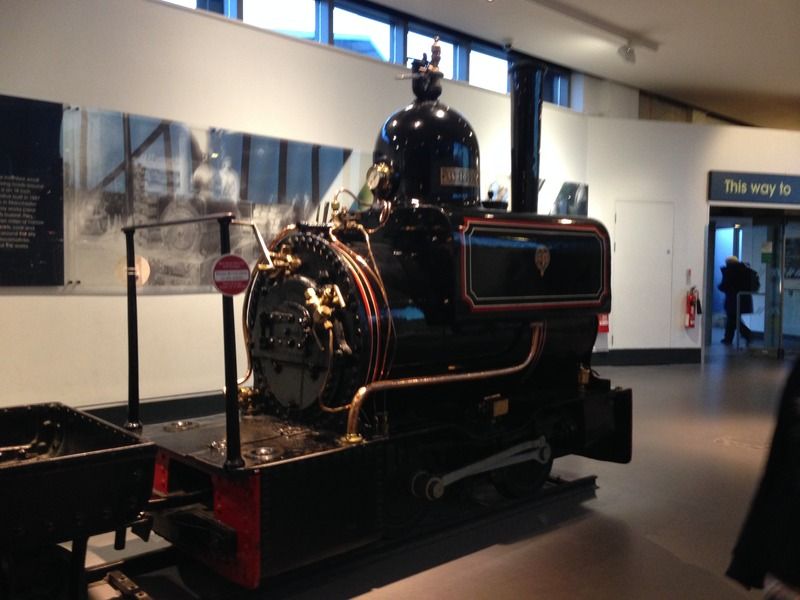
One of the things about being the parent of a small boy is that you go to a lot of transport museums. The small Scottish boy's obsession with trains started when he was still a very small Black Country boy and he got his first Thomas the Tank Engine train set, which had a motorised Thomas.  Then we moved to Bo'ness, home of the Bo'ness and Kinneil Railway and the Museum of Scottish Railways,  where we spent many weekend days when he was smaller.  Recently we've been to three transport-related museums, each of which was a different experience.  The first two were on a weekend trip to the north of England with a friend in November.


First up was the big one.  The National Railway Museum at York.  We've been a few times in the past but every visit is different.  It's vast and includes trains from the small to the enormous.

The access is very good.  The ramps are almost all gentle and there is even access up to some of the trains, including inside the bullet train and up to the side of the "Chinese Train" (actually made in the UK, but used in China).  The latter's ramp has a sign warning of a steep slope, but I got up it with not much extra effort.

Sign saying "Caution Steep Ramp" and offering assistance from staff   Doorway to bullet train, with level access and no gap

They'd also made the effort to create complete level access to the inside of the Shinkansen (bullet train - the only one outside Japan) and it was even possible for me to get in there - and have a new pic of me for the blog taken.


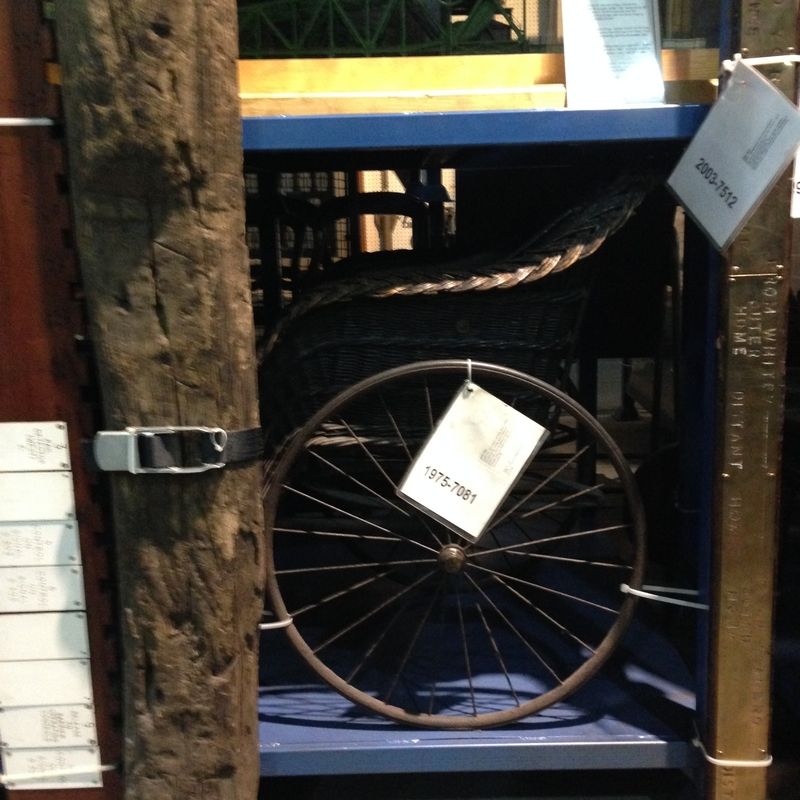
My favourite part of the National Railway Museum is their storage sheds, which are open for the public to look around.  Everything is in there.  Model trains and ships, old signs, furniture, china, equipment, stonework from demolished stations.  This time I spotted a couple of antique wheelchairs.

Next day we made a short visit to the Manchester Museum of Science and Industry.  This is based in a disused Victorian train station, but we didn't manage to see all of it, spending a lot of time looking at a weaving demonstration and also eating lunch (excellent pizzas and the salad bar looked great too).  The main engine sheds were closed for refurbishment.  It's split across quite a large site and my only access gripe was that the accessible (tarmac) route across a large cobbled area was laid diagonally intersecting the train lines.  This meant I had to zig zag my way up it to avoid getting my castors stuck between the rails (at York, they put pieces of wood in the gaps to prevent this being an issue).


Somehow I only managed to take two photos - Dougal from the Magic Roundabout on a plane and the Small Scottish Boy sitting in the planes and cars building.

The final visit was just before Christmas, when loose brakes on my wheelchair,  meant we were through in Glasgow getting them adjusted (and an annual service for it).  After lunch, given the choice of the Riverside Museum, Kelvingrove Museum and Art Gallery or the People's Palace, the Small Scottish Boy predictably chose the one with the trains.

The Riverside is a relatively new museum in a purpose-built building so it's accessibility is good, aside from the huge paved area in front between the disabled parking and the entrance (which in Glasgow, in December, is not fun!)   Our local hospital features the same huge empty space and I really think it's a problem for ambulant disabled people, especially in our climate. The museum crams a huge amount into a fairly small site, though, and everything inside is accessible and it's easy to see everything without getting tired.  There's even cars and motorbikes on all the walls.  Even the Tall Ship, parked on the Clyde behind the museum, has wheelchair access and a lift!


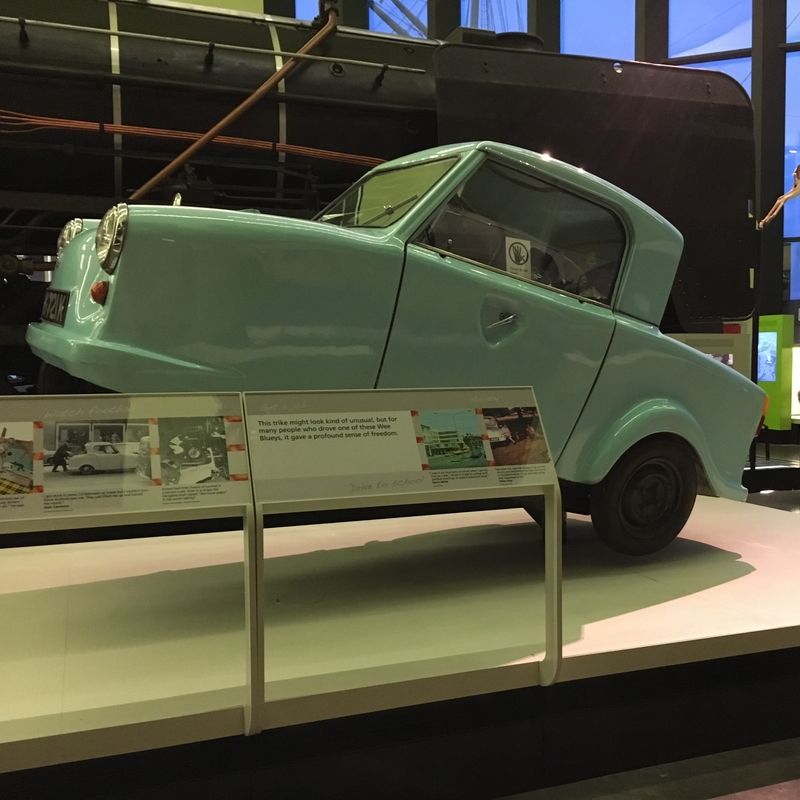
What impressed me on this visit was the increasing visibility of the disabled in the exhibits.  I'd seen the small disabled trike-car (the predecessor of the Motability scheme) on a previous visit but this time noticed they have Glasgow's first disabled accessible taxi on display.  It was first registered in 1988 - the same year as my first car!

The museum also has two streetscapes.  A lengthy two sided street featuring shops from the turn of the 20th century to 1930 and a second from 1930 to 1980.  I love these - there was one at the Auckland War Memorial Museum that was my favourite thing as a child, sadly it was removed just last year.    The early 20th century street had replica flyers up in each window, marking the centenary of the rent strikes organised by Mary Barbour to protest against steep rent increases while many men were serving during World War I.   It was great to see so much social history being explored in a museum I suspect many parents are dragged along to by their train obsessed children. The streets at Riverside also feature the only two Glasgow Subway stations which I can get onto (Glasgow's single line, circular underground railway, with it's tiny trains, is unlikely ever to be accessible).

The great thing at all these museums is that they're all free for everyone.  I think it's great that so much is free here, both Glasgow and Edinburgh have a number of fantastic galleries and museusm and not having to pay to get in is a fantastic way of ensuring they're available to everyone.  I always try to make a donation, since I can afford it, and we are members of the National Museums of Scotland but we more than get our moneys worth from them!


Monday, 14 September 2015

Musée de l'Armistice

One of the other things on my shortlist for the Compiegne area was the Glade of the Armistice and  Musée de l'Armistice - the French national war memorial in the middle of the forest of Compiegne.  It was here that the Armistice was signed in November 1918, in Marechal Foch's private railway carriage.  It was also where the invading Germans had the French sign the surrender in 1940, after which they destroyed the site and had the railway carriage taken to Berlin, where it was destroyed.

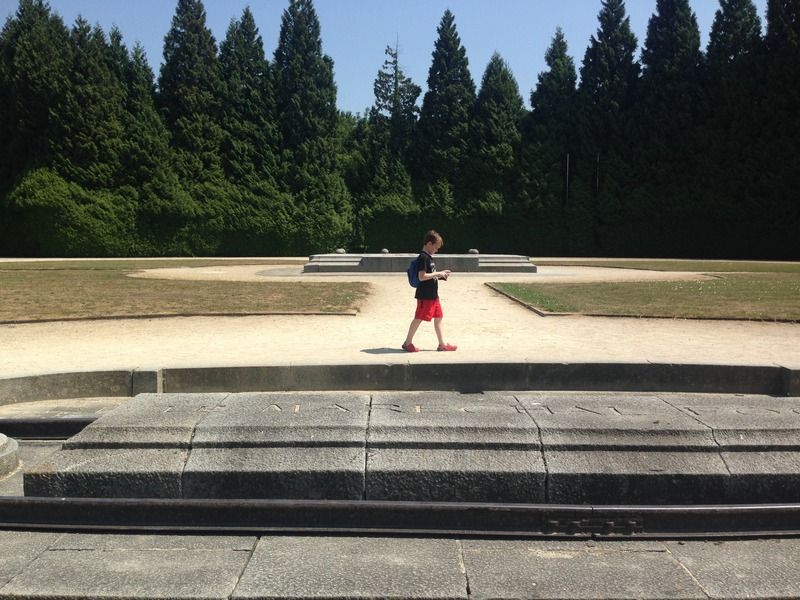
After World War Two the site was restored and another carriage from the same manufacturer was turned into a replica of Foch's carriage.  It's this that you can still see today.  Outside the small but interesting museum, there are a number of memorials related to both World Wars and the location of the tracks and carriages is marked out in stone.


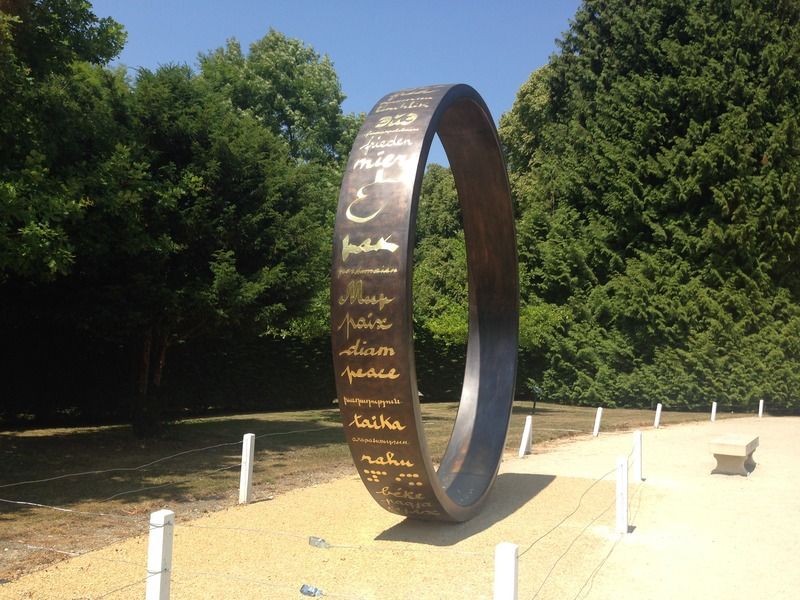
One of the more modern memorials - this one to peace. 


The site is level with fine gravel paths - it's quite a wheel from the car park but completely flat and thankfully shaded - this was the day it hit 40 degrees in Paris!  The museum itself is accessed by several steps and there is a small, elderly but serviceable platform lift.  I had to get No-so-small Scottish Boy to fetch someone with the key (his first French lesson turned out to be "l'acenseur s'il vous plait").  There's another platform lift inside, which is worth using to get up to the rest of the exhibit.  

There seems to be big plans to update the museum - and hopefully also both the access and the website, which is a gem of a site, complete with Forrest Gump soundtrack and a Wanadoo e-mail address, that will take you right back to the late 90s!

Thursday, 10 September 2015

The Somme

I set a few conditions about our trip.  I wanted to see a Cathedral, I wanted to see some of the Somme and I wanted to see the Carriage in which the Armistice was signed (of which, more later).

The afternoon of our day in Amiens, having seen the Cathedral before lunch, we took a drive out along the Somme to Péronne, to see the Historial de la Grande Guerre.  This was a brilliant museum in a setting which really emphasised how tranquil the Somme is.  The museum itself is set within a Norman castle and despite this is completely accessible - albeit that they are quite keen on ramps (down to the entrance and within the building).  There was a real range of material, including plenty of interest to children.  There were sections about each of the main nations involved in the Somme (including Germany) and also about civilian life during the war.  The final section was an art exhibition.

No photography inside, so the only pictures are of Not-so-small Scottish Boy exploring the defences of the castle and of the view from the terrace of the cafe.

 photo FA02DCD6-4444-4F0D-B1A6-ACA9E37B8979.jpg

 photo 7C3E676F-1E0F-4065-A80E-357EE6B99942_1.jpg

After visiting we took a slow route back along the Somme itself, away from the main roads.  These tend to go along the plain, whereas the local roads wind their way down into the river valleys, hidden away below what seems from the main road to be flat fields.  You'll dip down and find a picturesque village, a water meadow or a meandering tributary of the river.  For a place with such violent historic resonances as The Somme, it's a beautiful, peaceful corner of France.  It's hard to imagine how it could have been hell on earth, only 100 years ago, were it not for the many, many military cemeteries.

Cobbles

This post has been lurking in drafts since our holidays - poor internet connection prevented me from adding pictures, so I'm posting it now.  Pretend I'm still in France, it's 40 degrees outside, the sun is shining and I have a glass of 3 quid AOC white wine in my hand!


Cobbles have always been a bit lost on me. They look very historic and picturesque but even walking they're hard work - as any number of turned ankles evidences. On wheels, they're a nightmare. However, there are good cobbles and bad cobbles. Good ones look as good, perhaps better, but are a smooth enough surface to wheel over without trapping a caster, which carries the threat of an undignified headfirst tumble out of the chair. Good cobbles also take a fraction of the effort to push across.

We got quite a lot of experience of different cobbles surfaces in Amiens, where the signage for the disabled entrance to the cathedral has disappeared due to building works. Here's some lovely cobbles from Amiens:

 photo FD3A4C20-E882-4AC7-B812-23029616EDE1.jpg

And here's some that aren't. Notice that the good ones look nicer and are free of cigarette ends. These were only a few metres up the same street.

 photo D49D0001-7AA1-4239-8A8E-4CCEA995CC85.jpg

This evening we had dinner in a family restaurant, Leon, on the outskirts of Amiens. The man at the next table had the same model of Quickie Helium as me, but larger casters. Maybe that was for the cobbles!

Here's a few shots from Amiens.   The Cathedral was wheelchair accessible (aside from dodgy cobbles and a slightly too steep ramp at one point) but the entrance was poorly signposted as there were building works.

 photo D8BC6F1B-0682-44B2-AC7D-D45F0FDC4641_1.jpg

 photo B734E38C-3501-4990-862C-E35BFB590D76.jpg

 photo 0D1F2B44-A563-4EFB-B30A-6AA1D698896D.jpg

 photo E8D07FDE-F05C-4D2F-B62F-532A14B03801.jpg

And we found a New Zealand memorial inside.

 photo 77BD5DA6-5278-44D3-AD37-EF22570CAACC_1.jpg


Catch-up time

I have so many half-composed entries in my head from the summer - I am going to make a concerted effort to put some of them on here in the next couple of weeks, especially as I went and chatted to the lovely people at Blether FM, a local community radio station, this evening and promised to share this blog with them.  It needs to have some up to date content first!  So, I've all sorts of things on the way - more on France, some other things I've done over the summer and my first wheeled trip to the Helix and the Kelpies.

Right now, however, I need to think of a new nickname for the Small Scottish Boy.  He's had that nickname since he was a toddler, but at 139cm tall and in his last year of primary school,  he is now not so small.  This week he celebrated the massive milestone of his first proper rock concert - Foo Fighters at Murrayfield.

Until I come up with anything better, I think he'll need to be No-so-small Scottish Boy.