Wednesday, 22 November 2017

Athens

Five days in Athens in November - what an opportunity.  I was asked to go to a conference from the Sunday evening to the Tuesday afternoon and flight times meant the easiest solution was to fly out  on Saturday and back on Wednesday.  This meant I had Sunday for sightseeing.  I flew with Easyjet and all went well with arrangements.

First off I arrived at Athens Airport about 8:30 and debated whether I should get a taxi (€38) or the metro (€10) in to my hotel.  As usual I had used Google Maps to check out the route from the metro to the hotel as, despite good instructions from the conference organisers, I know all too well how a "gentle slope" can in fact be insurmountable in a wheelchair.  I had mixed feelings on whether I could easily get to the hotel as I was fairly well loaded down - with my carryon bag on the front, freewheel stowed on the back and my carry on bag on my lap.

The metro ticket office said there was no charge for me so I went with that.  What a pleasant surprise - it's a brand new metro so every single station is fully accessible and in all my travels I saw no more than a 3cm gap between train and platform.  The norm was a much, much smaller gap.  Don't mind the gap.  There isn't one.


When I got to the Megaro Mousikis station, near my hotel, I could see it was a gentle downhill slope to my hotel so opted to walk, which was fine apart from dodgy the branches of an orange tree (complete with oranges) and a few detours for dropped kerbs.  Hotel was lovely, room was nice and accessible, but the lift doors were only about 70cm wide - I had to remove the silicon grips from my push rims to fit in one!

Sunday morning I got up early and had the most ridiculously generous breakfast in my room - for a €3 surcharge over breakfast in the dining room. Conveniently this avoided dealing with the stairs to the dining room.  Each morning I would tick fewer boxes on the menu and still get more than I could eat.  By the time I left I had an impressively stocked fruit bowl in my room. Really all I wanted was a piece of fruit, some Greek yoghurt and honey and a couple of pastries.

I headed back to the metro station, feeling much more confident about using it, to discover the Athens Classic Marathon underway.  You know - the one that actually starts at Marathon and finishes in the ancient Panathenaic Stadium.  I managed to find a gap in the runners (who were going pretty slowly, it being the 40km mark) to cross to the metro station's lift and headed off.


First stop on my itinerary was the Acropolis museum - built to house the Elgin Marbles should they ever be returned.  It's an amazing museum, taking you up through the different periods of Athenian history with well chosen examples of each periods treasures.  Given the sheer quantity of archaeological treasures in Athens - they even have mini-museums in many of the metro stations - it could have ended up looking like your Granny's attic.  Instead it's light and airy and everything is well displayed.  The top floor is constructed to the exact dimensions of the Parthenon, which overlooks it.  There are spaces for each of the panels currently in the British Museum.  It really is where they should be.  No photos allowed, though.  Apart from of the Lego version.


Slight comedy moment at the entrance:

Me:  One adult please
Cashier:  Oh, you are free, do you have proof of the percentage of your disability?
Me:  Um, no.
Cashier, looking me up and down:  Can you walk?
Me: A little, a few metres at most.
Cashier, handing me a ticket:  I guess you must qualify, no charge.

Note to others:  Take your Blue Badge or similar to Greece with you!

Next up - I'd heard from friends that there is a lift up to the Acropolis itself.  Keen to add another site to my list of "World Heritage Sites I've been in a lift in", I started wheeling myself up.  It was a warm day, at least for someone who lives in Scotland.  The Athenians were in coats and hats.  I was in a summer dress and knee length leggings.  The first stage was a gentle hill with marble pavements.  I well recommend marble as an outdoor wheeling surface.  Effortless. 


Next up was a steeper hill with what were basically marble cobbles and poorly grouted.  Very hard work, with zig-zagging not really helping because it just made it more likely the wheels would get stuck.  I accepted a few offers for help on steeper bits, but only for a few minutes lest my helper expired.  Eventually reached the ticket area, over halfway up the Acropolis hill, to discover that whilst there is indeed a lift there is also a ramp (I think they mean one of those platform lifts) which was out of order.  So I didn't get my trip to the top.  I got pretty close though.


The climb was well worth it though as I went down the north side of the hill - much steeper but more interesting.  Including this view over the Ancient Agora.


After some detours when streets turned out to be staircases, I made it down to Monastiraki, which is very much tourist central of Athens.  Lots of little lanes with small shops, some of which I could even get into, interspersed with ruins from various periods. 


It's a fun place just to walk around, people watch and see what's around the next corner. 


Being Sunday there was a flea market on.  I worked my way down through the tiny streets to Thissiou station, where I wandered a wee way up the Apostolou Pavlou Avenue, a walking route through the centre of Athens which is a much more sensible route from the Acropolis Museum than the one I had taken. There was a great view here of the Temple of Hephaestus (which I'd seen from the Acropolis earlier) but by this time I was too tired to attempt to get closer to it - and it was time for me to head for the start of my conference.

Monday, 21 August 2017

New Lanark World Heritage Site - Oh what a steep ramp you have.

The not-so-small boy and I have been enjoying the last few days of his school holidays.  Since schools in our area go back later than elsewhere in Scotland, it's a good time to do touristy things, as long as we avoid Edinburgh which is inevitably a zoo in August.

Today we went to New Lanark, which I have wanted to go to for years.  It's the second time recently I've been somewhere in that part of Scotland and been thoroughly disappointed.  I suspect the same architects may be involved.

New Lanark probably thinks it is accessible.  Access throughout the indoor exhibits is via ramps - all the way up five levels of mill buildings and all the way back down again.  Unfortunately this means the ramps are steep.  I'm not easily bettered by a ramp or a hill.  But I don't like to constantly be fighting that tipping feeling you get on a ramp that's just about too steep.  Especially when it's a long one.  I needed help more than once and anyone who knows me knows how much I hate that.


Coming down the way was almost as bad.  No tipping feeling but that constant almost out of control feeling and blisters on the thumbs from gripping the push rims.  Luckily it was fairly empty or I might have taken someone out.  This ramp between the two buildings gives you an idea of what it's like - though some sections were steeper, some had slopes round corners.  None had decent handrails.

There are lifts.  With a bit of thought, and maybe a couple of platform lifts, the routes through the building could be adjusted to be level, with lifts between floors, most of the way through.  Yes, this is an historic building on a steep site but they have the lifts already.

Instead, when you get to the bottom you're faced with a push up a roadway (access to the adjacent hotel) as you're not even allowed to go backwards through the exhibits to get to the main entrance.

Most of the external buildings (workers house, shop, Robert Owen's house, school) require assistance due to the steep roads.

Oh and it's probably not worth the 20 quid it cost the two of us.

Friday, 28 July 2017

Just discovered Izzywheels.  I particularly love this one.


Photos.

Photobucket, who I have a paid account with and have used for years, now want $400 a year for me to link to photos from here.  That won't be happening.  I'm checking out alternatives but in the meantime apologise for the broken photos in older posts.

Thursday, 27 July 2017

Camping

I find camping holidays very relaxing.  The level of expectation, in all sorts of ways, is so much lower.  You're not expected to be glamorous, dress up or wear make up.  You're not required to be anywhere, at any time, for the most part.  You don't need to eat particular things at particular times.  As I say, it's relaxing.

French campsites, and I suspect others on the continent, are also fantastic for children.  So many activities available.  Plenty of other children around.  Safety and freedom.  Also, cheap wine. 

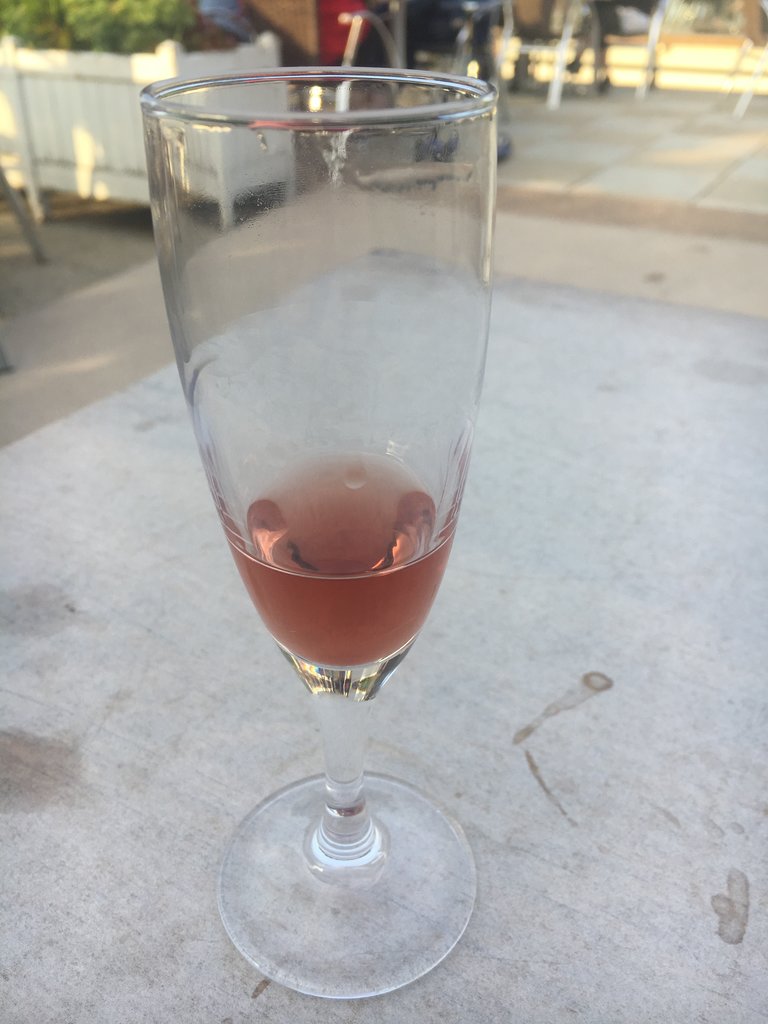
A glass of kir, nearly empty


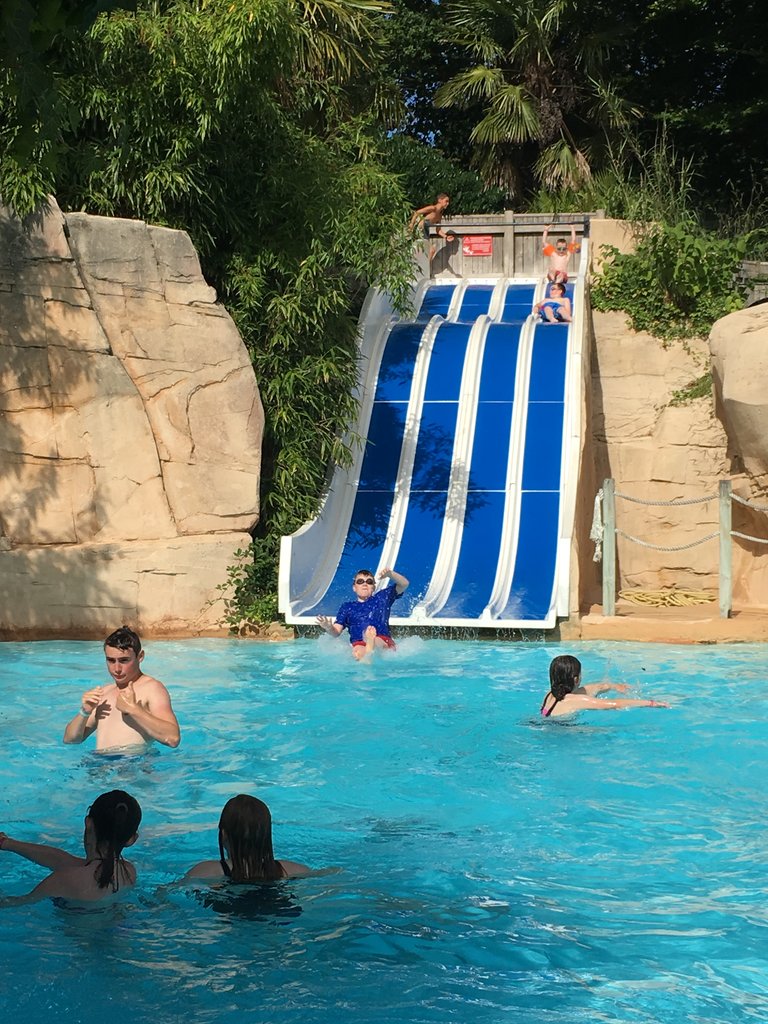
The last few trips we have been at large sites with lots of activities.  The not-so-small boy enjoys water slides and swimming pools and can spend hours entertaining himself on them, so that is a priority.  As he gets bigger, things like zip wires and ropes courses appeal more and more.  

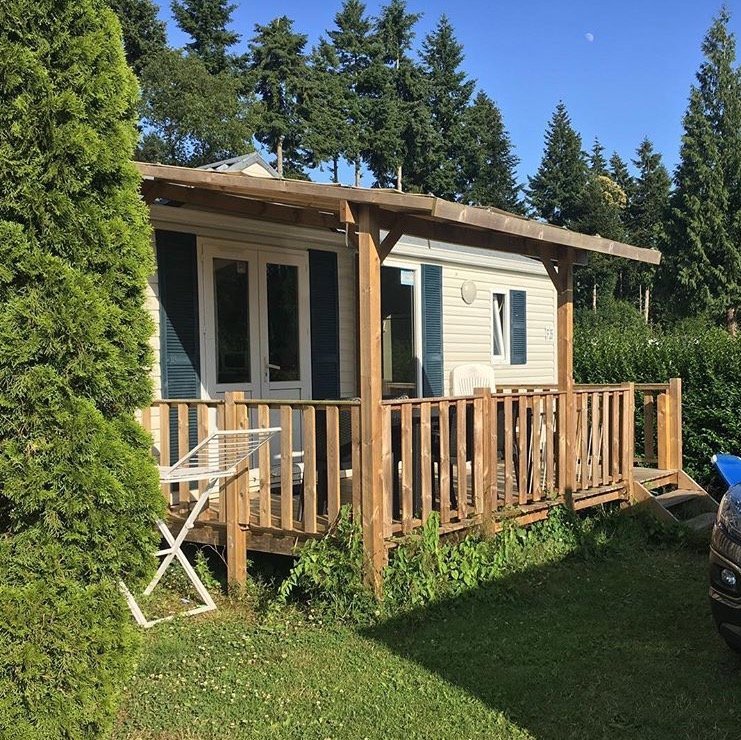
This year's trip to Les Ormes worked out really well.  We went with Al Fresco, because we could use Tesco Clubcard vouchers in part payment (we've previously booked with Siblu on the same basis).  As we booked late, we ended up with a 3 bedroom mobile home.  It had a deck with a canopy and plenty of space.  This year's example was a bit more dated, a bit more tatty, than previous examples, but very comfortable.  We didn't have a wheelchair accessible mobile home (I can manage the two or three steps into a standard one and can walk the short distances inside).  Wheelchair adapted accommodation is available from Al Fresco, Siblu and Eurocamp at other sites. 

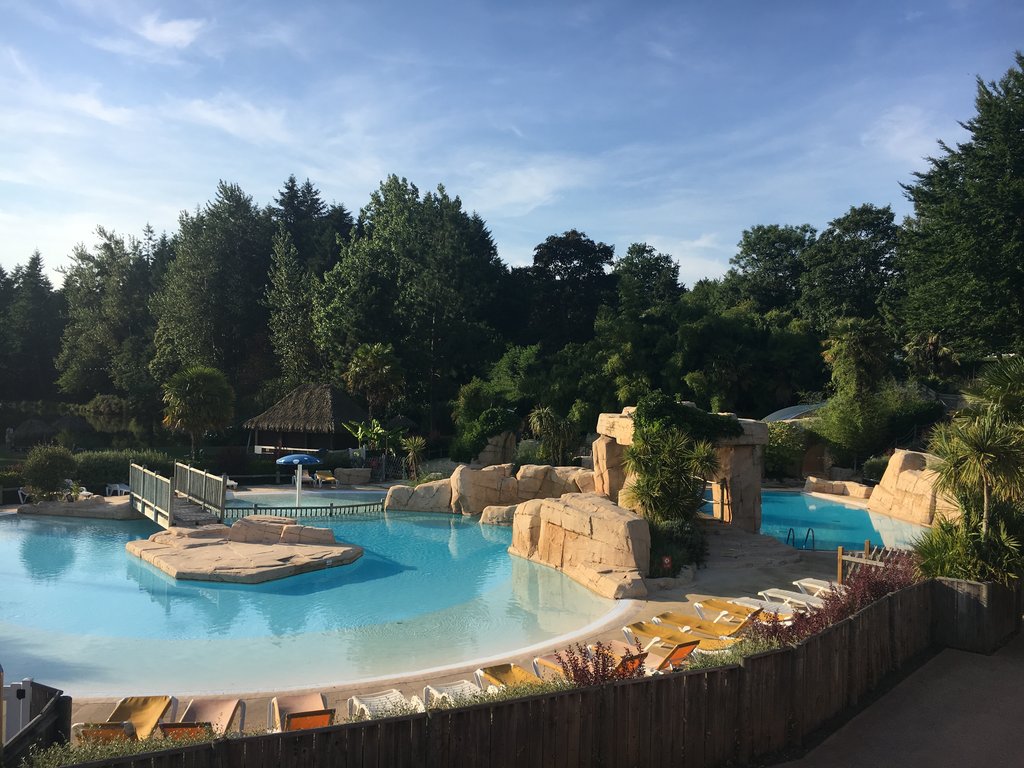
The campsite facilities were great - two pool areas, both with a range of slides, shallow and deeper areas and loungers.  Inevitably there were not enough loungers, but we discovered that if we headed down about four o'clock, people were starting to leave.   Since it was very warm and I had an injured elbow, I had a brief swim to cool off them enjoyed reading in the sun while the boy swam.  


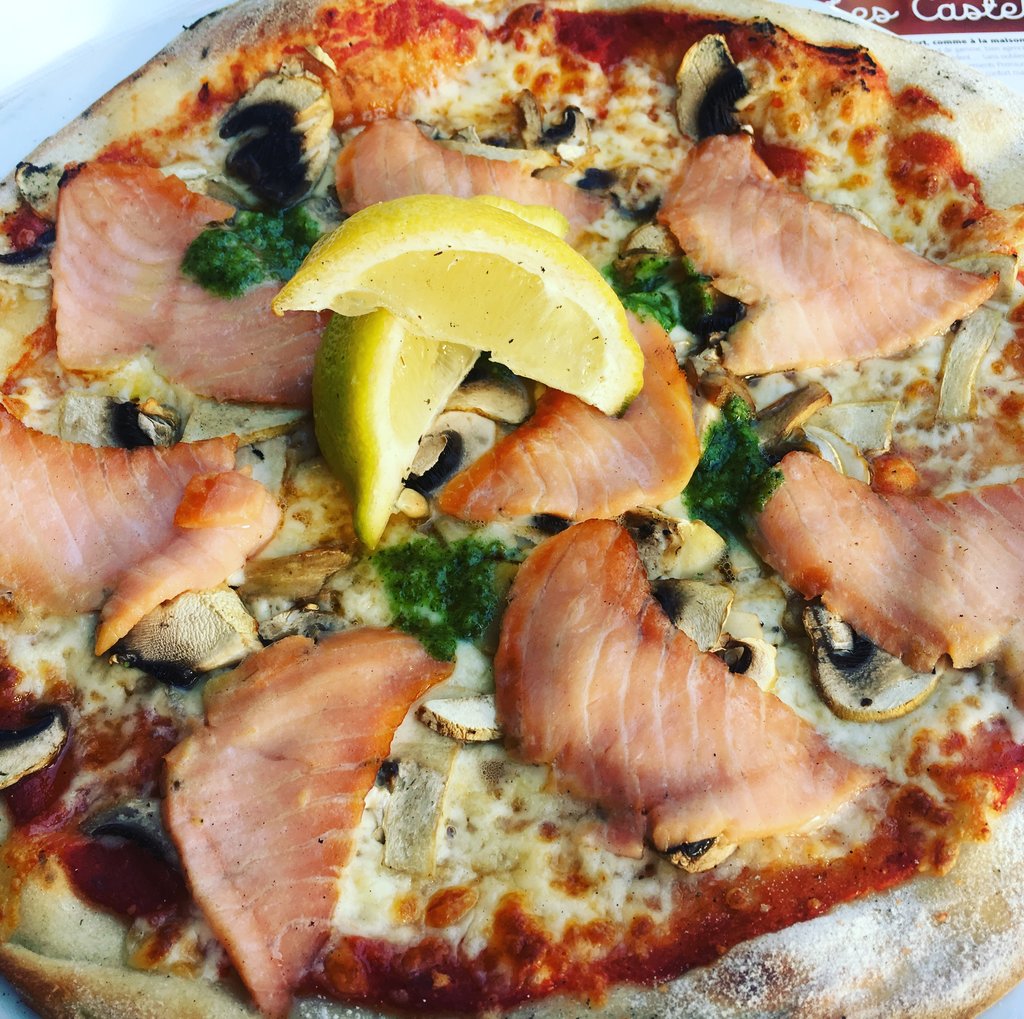
We also enjoyed the pizza place onsite, the market on Tuesday evening, the "Pink Cabana" which served crepes, waffles and ice cream.  
Pizza with smoked salmon


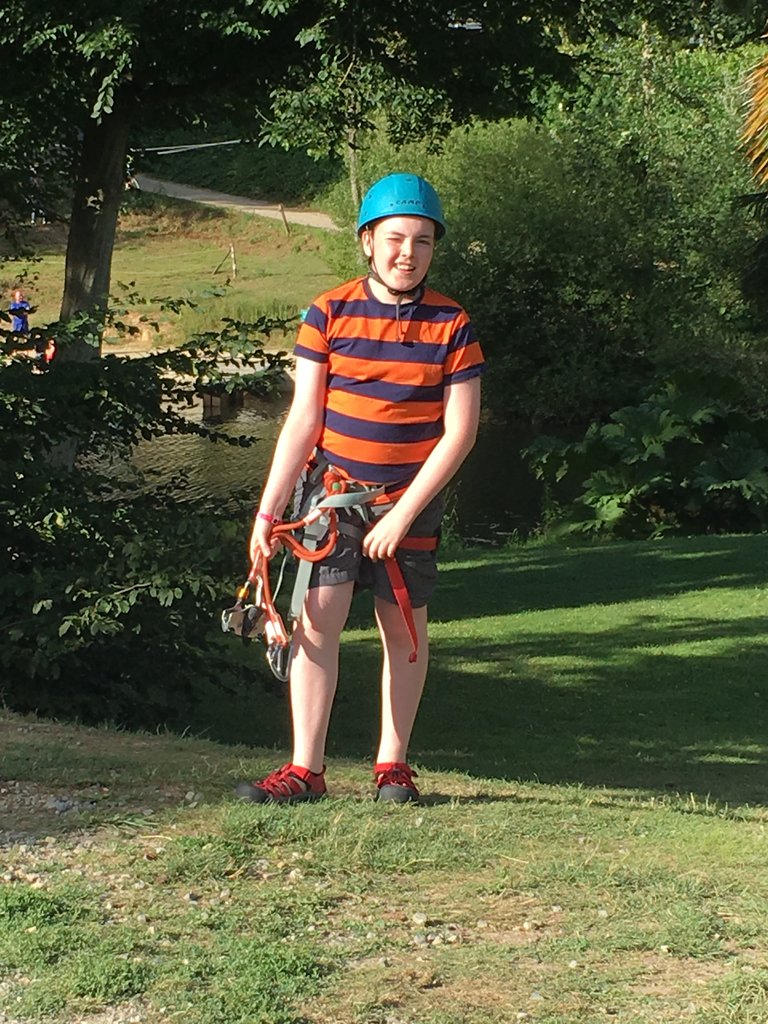
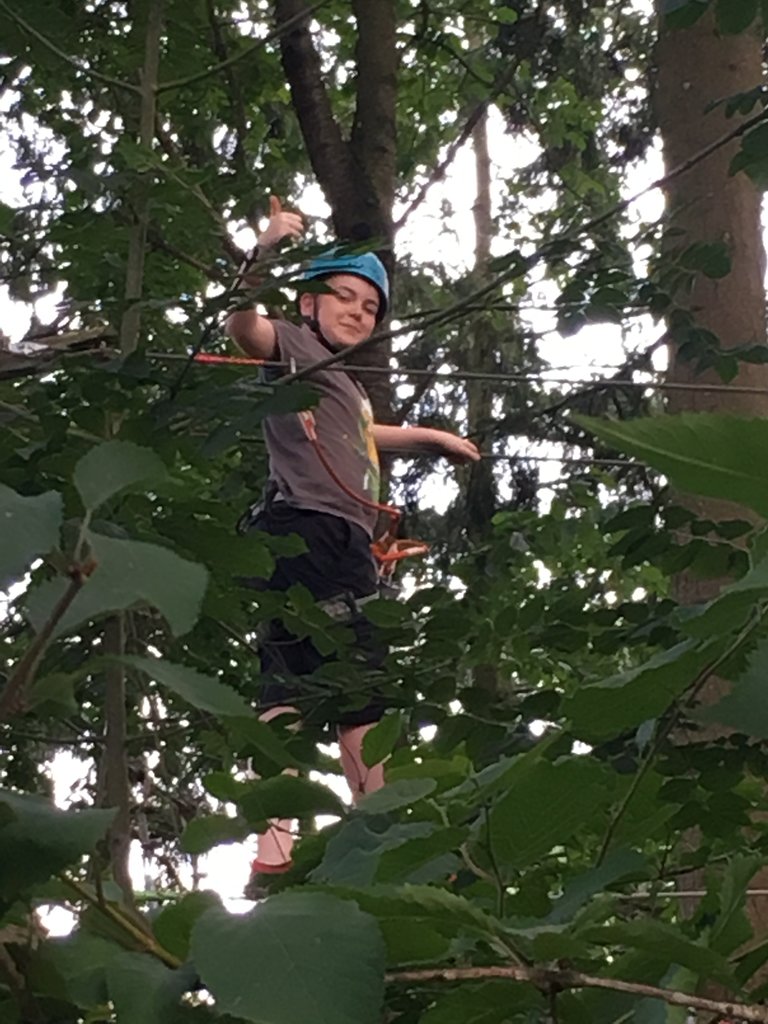
The boy went down to the play ground and football area in the evenings and made a few friends.  He had a number of goes on the zipwire (€6 for two goes) and the ropes courses (€13 for two goes). 

Boy in rope course/zip wire gear   
Boy in trees


Once again, despite my hopes, the kids' club provided by Al Fresco (with Eurocamp) didn't prove to be a success.  This year, the boy was the eldest in his age group and didn't particularly enjoy it.  I'm sure these are great if your kids do enjoy them and, now he's 12, I'm glad that the boy is old enough I get down time without them.  

We did a few side trips from Les Ormes, which I will hopefully get a chance to write about soon. 

Monday, 3 July 2017

France

We're on holiday in France again this year - our usual mix of a little travelling and a spell on a campsite.  This time we're at Les Ormes (aka Domaine des Ormes) on the border of Normandy and Brittany. We'll be spending the next nine nights here:


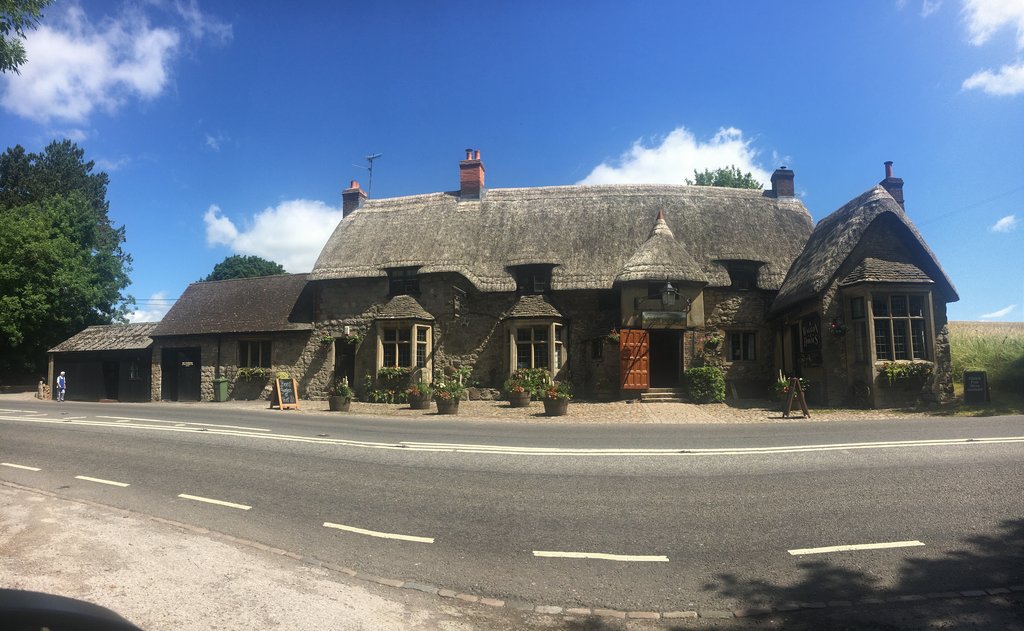
On the way here we spent a couple of nights in Swindon and then last night at a very basic Ibis on the outskirts of Caen (our ferry arrived at 21:30). On our way to the ferry we did very drive by visits to Avebury and Stonehenge.  I did stop to take a picture of this amazing pub. 


Today we did a slightly less drive by visit to Arromanches where we stopped to look at the Mulberry Harbour and saw the Arromanches 360 film which I thought was worth the €6 entry.  Even better, it was free for me due to the wheelchair.  

I used to have a picture of the two of us, taken at Arromanches 7 years ago, on this blog.  I did contemplate recreating it, but we escaped quickly ahead of four coach loads of English school kids.  

For the next few days, the plan is wine, swimming and packing the boy off to kids club. 

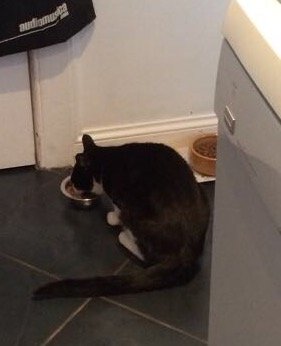
Meanwhile I was pleased to get this picture from my friend who is staying at my house looking after my cats. Dougie has been known to avoid cat sitters for entire holidays.  This time, he's shown up for dinner on day 2. 


Sunday, 25 June 2017

Product Review: Ossenberg Crutches

Been a while since I did one of these.

I've had loads of crutches down the years, several of which have been mentioned on here before now.  Bizarrely this blog gets a lot of hits, still, from my misspelling of cannes anglaises, way back in 2011.  Since then I've had a couple of pairs of folding Vilgo crutches  but the elastic in them worked loose over time.  I then found a pair of OPO ones which were not bad, indeed I still use them around the house, but it seems that, pre-wheelchair, a year was about as long as any crutches lasted without worrisome squeaks and creaks.  And when I came to replace them, there didn't seem to be a UK distributor for the OPOs.  So I took the plunge, about three years ago, and bought a pair Ossenbergs.

Now, Ossenbergs have a reputation for being amongst the best crutches there are.  Their folding ones are carbon fibre.  But they're not cheap, so until then I'd tried various other ones.  I kind of wish I hadn't bothered.

I love them.  They're not as light as I thought, similar in weight to the Vilgos and slightly heavier than the OPOs, because the anatomically moulded grip and sturdier forearm section offsets the gain from the lighter tubes.  They tolerated 20 hours folded on a flight from Dubai to Auckland last year and sprung back into life when put back together.  By contrast, I had a Vilgo become next to useless after being folded for a couple of hours on a flight to Rome. The anatomic grips took a while to get used to and inevitably if I grab for just one, I end up with the wrong one.  But they're definitely easier on the hands and wrists than even the OPOs (which I supplemented with stick on neoprene grips).

Looking at the prices today, it seems Vilgos have gone up in price and Ossenbergs have come down - so they're now pretty much the same price.  They may be boring black, at least if you want folding, but the Ossenbergs win hands down in my book.  Absolutely recommend them.  Oh and the non-folding ones come in cool colours.

Not a paid review.

Saturday, 24 June 2017

Boaty McBoatface?

As it happened, the same week I was booking that train trip to Durham, I was also booking our summer holiday.  We're off to France again, this time to Brittany, for 12 days on a campsite and then we're having 3 days in Belgium on the way home.  We've a couple of days in the west of England on the way down, catching up with friends, and Brittany Ferries will be taking us from Portsmouth to Caen.  On the way back, we're going from Zeebrugge to Hull with P&O Ferries.

The outward journey is an afternoon sailing but I did contemplate booking a disabled cabin so I could relax comfortably.  It was only £26.  However, I've travelled with them before and I know they do very good, reasonably priced, food.  By the time we've eaten and looked around a bit, there's not enough left of a 6 hour sailing for much of a nap.  So I decided to book recliner seats for us at £5 each.  The online booking portal had a section for me to fill out with my accessibility needs so I completed that and paid for my booking.

Next morning I got a quick call from them, where they confirmed my booking, I checked that I could park the wheelchair and transfer to a comfortable recliner, and they made sure I was aware I need to be there an hour before sailing.

⭐⭐⭐⭐⭐ to Brittany Ferries.

P&O's booking portal was equally helpful.  We're on an overnight ferry coming back, so I pre-booked dinner (so we can maximise our time visiting Bruges during the day) and an accessible cabin.  They didn't call me, they asked me to call them and that's the only thing reason they get a lower rating than Brittany.

⭐⭐⭐⭐ to P&O.

What a difference from the trains.  In both cases they asked all the right questions in a polite and sensitive way.  "Can you transfer yourself?".  "Do you need assistance to get from your car to the lift?"  They made no assumptions of ability or disability and when I explained my needs they seemed to understand them.

Choo choo, I'm a train.

Last week I ventured on a long distance train for the first time.  My office overlooks a train station and I do occasionally find myself pondering the width of the doors and the size of the step down from the train.  Neither reassured me.  Then there were the posts I read on social media and in the press about booked assistance not turning up.  I've seen statistics as high as a 20% failure rate.  I can't image having to commute via train with a wheelchair, when on 2 journeys a week you either can't get on, or can't get off, the train.  And I'm not sure which is worse.  I used to joke that I was worried I'd end up in Penzance.

Anyway, a work trip to Durham, on a Monday at the start of a very busy week, meant there really was no option but the train.

Guess what.  I had to get a  Penzance train.

I managed to book online and using the Cross Country website had, I thought, booked assistance. What I wanted was to put my wheelchair in the luggage area and sit on a seat - lightweight wheelchairs are inherently unstable, that's what you trade for maneuverability.  On a fast, bumpy train that's not ideal.  Were there a way of securing the wheelchair, it would be OK, but there is no way to secure a wheelchair in most train carriages.  The same is true of buses.  20 years ago we had guidance that Wheelchair and Occupant Restraint Systems should be in place on public transport.  Somehow, that has disappeared.

So.  I e-mailed and checked.  No answer.  Then I got three e-mails confirming my assistance for the return journey (which, due to it costing a mere 20p extra, was in first class) but none for the outbound trip.  After more e-mails, in frustration I took to twitter.  Cross Country's PR team claimed that the wheelchair couldn't go as luggage, as it wasn't luggage.  It couldn't go in the bike area, as it wasn't a bike.  It couldn't go in the wheelchair space if I wasn't in it (reasonable).  It seemed like an impasse.  Eventually I phoned the Cross Country assistance team.  They confirmed assistance was booked, at least, and conceded that the wheelchair could go in the luggage area but only if I could stow it and take the wheels off myself as the assistance staff could not board the train.

Monday was D-day.  I was at the station at least half an hour before departure and chatted to a nice woman who was the sole member of staff assisting passengers on a busy mainline station. My train wasn't on the board yet so I said I would wait on the concourse.  25 minutes later, with less than 10 minutes to go and with the colleague I was travelling with having arrived, I asked their gate staff to let the assistance woman know that I was heading down to the platform.  She arrived a couple of minutes later.  I got on the train no problems.

Once on the train I started disassembling the wheelchair, much to the confusion of the Train Manager.  It seems they are very frustrated with what is said by both the PR team and the assistance booking team.  My situation is not unusual (there are a lot of lightweight users out there) and what they advise is to book for Coach D or F.  Then they just wheel the wheelchair through to the luggage area. So now I know for next time.

My journey of course wasn't over.  When we got to Durham there was no sign of the booked assistance.  Virgin East Coast had no record of my request for assistance.  My colleague and a stranger helped me down from the train - just as well or I could have ended up in Penzance after all!

On the way back, I got to the station an hour in advance and, thankfully, everyone had a record of me and I got all the help I needed.  Since the train was quiet, my wheelchair sat in the wheelchair space and I sat in my seat.  I suspect the fact I was in First Class helped.  I hate to say it, but I suspect that's what I'll do in future, if I can.

My assistance failure rate - 25%

Time for a gratuitous use of this wonderful moment in Glasgow.

Thursday, 19 January 2017

There's a ramp!

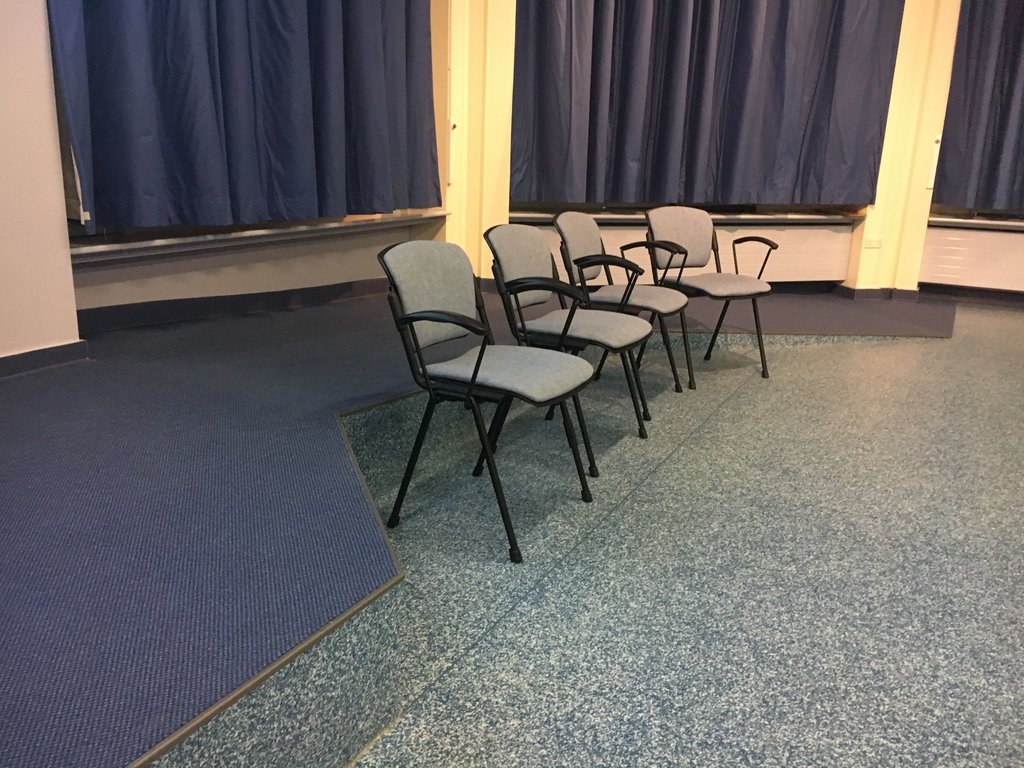
I'm on a panel today and am very impressed to find there is a ramp up to the podium!  Well done NHS Lanarkshire.


Thursday, 30 June 2016

Almost but not quite...

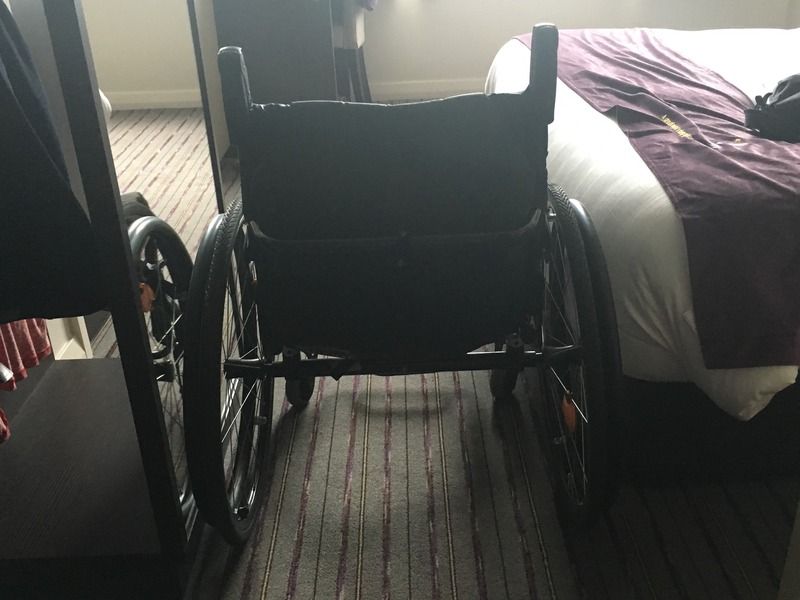
I'm at the Nottingham Human Rights Law Centre Summer School this week and we are staying in a Premier Inn in the centre of Nottingham.  I've been given an accessible room, which usually I don't bother with as I can walk the short distances in a hotel room.

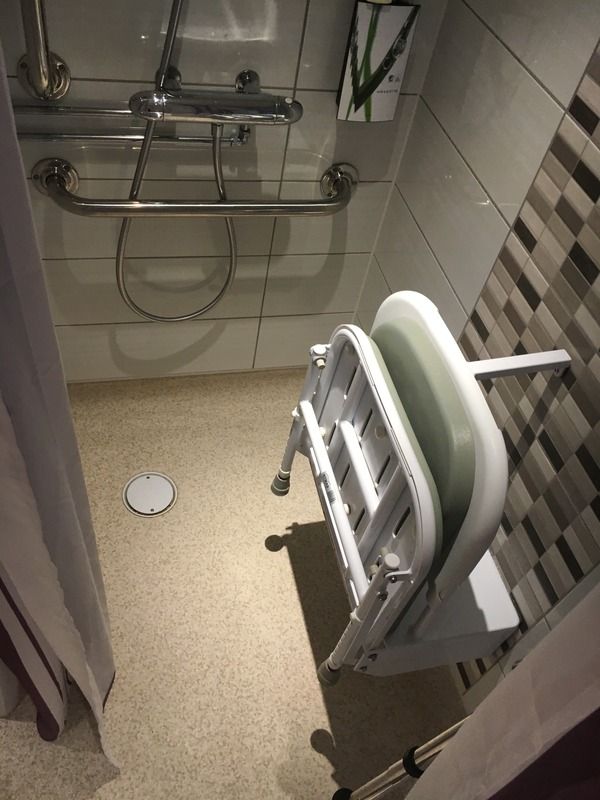
The hotel is almost brand new and very comfortable.  It has a wet room with plenty of hand rails.  The basin is a decent size and there is counter space for toiletries and make up.  There's plenty of space to move around.  All in all the architect designed an accessible room that meets all the right standards but doesn't feel like a public toilet.

And then, I suspect, someone with a bit less knowledge came along to fit it out.


There's a shelf unit (with wheelchair height hanging rail) that sticks out into the room making it very difficult to squeeze a wheelchair through.  They should have put hooks on the wall.  


There's a very bulky shower seat in a small but otherwise workable shower area.  It makes it tricky to shower whether or not you're using it.  You can get much smaller ones than this, that take up less space or they could provided a freestanding chair or stool that could be moved out of the way.  

The phenomenon of a building being designed accessible but obstacles being added that reduce accessibility is not limited to hotels.  Shops are really goo at adding free standing displays that block aisles or even the tills!  

Tuesday, 7 June 2016

Where did the ramp go?

It's actually reassuring to discover that problems with ramps are not confined to this country.  A friend pointed me in the direction of this article from a local paper in Connecticut, USA, about a perfectly good ramp being moved in a way that made it barely accessible.

I wonder if they thought to move the disabled parking bays as well?

Friday, 3 June 2016

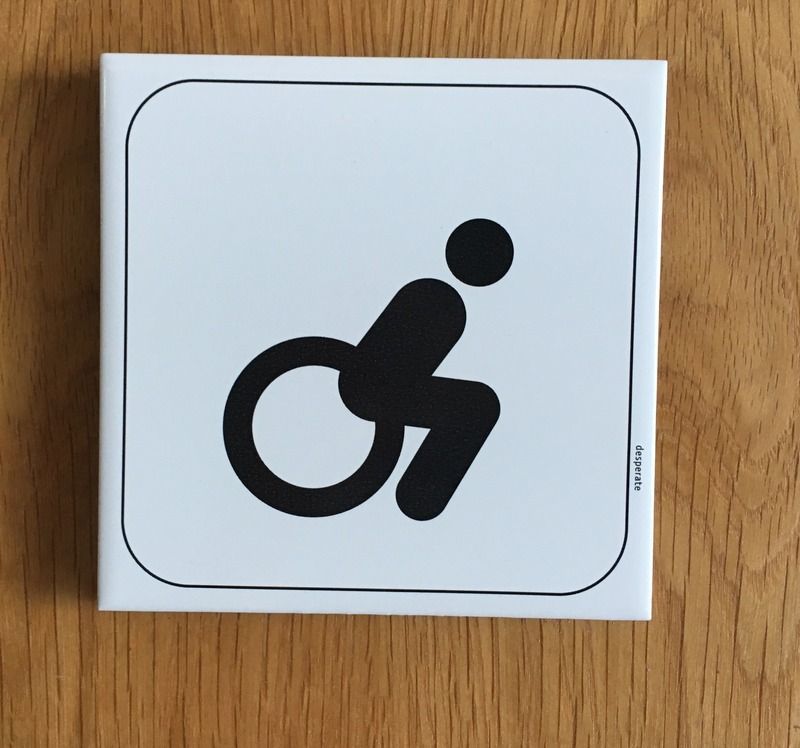
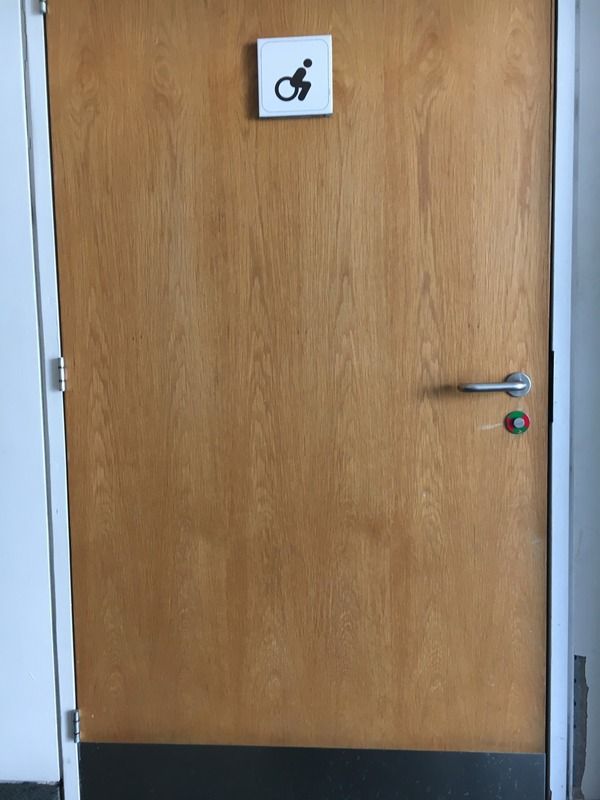
I'm at an event today at the Lighthouse in Glasgow and had to take a picture of this symbol they've used in all the signage for their disabled toilets.


I love active wheelchair logos, like the one on the Edinburgh trams I posted about a couple of years ago.  This person is clearly going up a very steep hill!

I'd suggest one small change - maybe it should be at the eye level of a wheelchair user.


Friday, 15 April 2016

Money, money money

We're off to Denmark* on our holidays, so I dug out the Danish coins in our random coins jar.

The small Scottish boy had a look through some of the others - I have lira, Deutschmark, Belgian Franc, Guilder and even some Czechoslovak and Soviet coins (bonus points for having not only currencies which no longer exist, but ones from countries which no longer exist). Also, for some unknown reason, I have about 10Fr in 10 and 20 centime coins.

Anyway, conferred with the Nationalbanken website to see if the Danish coins were still OK. They all are, except the old style 25øre and 5øre but they had been withdrawn in 1991 when I got them.

I don't have any notes, which is good, because they've been replaced twice since I lived there. The new ones have bridges (real ones, not the Euro fake ones) on one side and Viking things on the other.

I was impressed though that the last series (which I'd not really looked at - they were just coming out when I left in 1999) was gender balanced - given the debate about having just one woman (aside from the Queen) on bank notes generates here. There were five notes, so the 1000kr had Anna and Michael Ancher. Karen Blixen, Carl Nielsen, Johanne Luise Heiberg (who was played by Sidse Babett Knudsen in 1864) and Niels Bohr were on the others.

The ones before, the ones I know from living there, are the 1972 series. All but one of those have women on. Prior to that was a portrait series of all men. I do wonder if any other nation has had as many physicists on it's notes - Bohr, Ørsted and Rømer have all featured down the years.

*Yes, I know, Abba are Swedish. Three years of Scandinavian Studies at University here! Our plans also include a quick visit to Sweden one evening for dinner. I've been there just once, for a few hours one Easter Sunday in the 90s. I had no Swedish money with me, but as nothing was open, it didn't matter.

Wednesday, 13 April 2016

Copenhagen

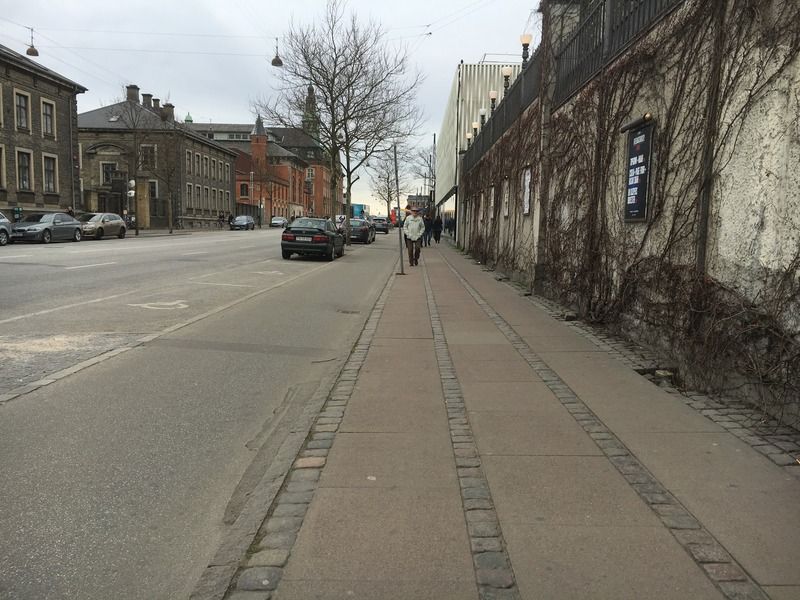
Frustratingly, though Copenhagen's streets are fantastic for cyclists, they're a bloody nightmare for wheelchair users.  It's so tempting to head up that beautiful smooth cycle path but when I briefly did, because the footpath was blocked by parked cycles, I got shouted at (and shouted back I might add!).


So I've struggled along with those rows of cobbles which are almost exactly the width of my chair apart.  Even with the freewheel, the least worst option is to follow the cobbles with it.  This is pretty good path.  Most are half the width and very uneven.

Also, when everyone cycles, there are as many arseholes cyclists as arsehole drivers.

Saturday, 2 April 2016

Belfast

Going through my photographs is a good way of remembering the blog posts I've written in my head but which I've not managed to actually write on screen yet.  This picture was the prompt for my first solo business trip in my new job.


A conference on children's right to play took me to Belfast, by plane.  It was the first time I've travelled completely alone by plane since I got the wheelchair but after last year's Paris trip I wasn't too worried.  It was also great that no one at my work hesitated about me going for a second.  The assumption was that if I thought I could manage, that was fine.  The cup in the picture is from the dinner the night before, which was held at the Titanic Belfast.

I flew across on FlyBe .  Work booked the flight and indicated I need assistance and then the airline contacted us and asked me to complete an information form with the dimensions of my wheelchair (assembled and broken down) and my assistance needs.  It was the first time I've needed to provide so much detail - but it's a pretty small plane.  At both airports (Edinburgh and Belfast City/George Best) I made myself known to the assistance team, confirmed I needed the ambulift as there wouldn't be an airbridge, but wouldn't need the aisle chair (I'm learning the routine!), then said I would meet them at the gate at the agreed time.  They were both fine with this - an improvement from a few years ago when they didn't seem to like you getting out of their control.  

I'd booked late and wasn't able to get into the same hotel as the rest of the conference delegates and with the Premier Inn right by the Titanic Belfast fully booked, picked the Hilton as being the nearest to the airport, Titanic and the right side of the city for the conference venue.  It was slightly dearer than the Premier Inn but not much.  Really spacious hotel room and really accessible while still being comfortable and fully furnished (I once stayed in a room where all the furniture had been removed to make it accessible!)

The conference itself was at Cultra Manor, which is within the grounds of the Ulster Folk and Transport Museum (which is a massive site - mostly wooded and very beautiful on a sunny spring day).  It's a lovely venue with good access - nice ramp and a proper lift.  Lovely view across Belfast Lough.


The only disappointment of the trip was the taxis.  I'm used to cities, certainly in Britain, having plenty of London taxis.  It's pretty easy to just lift the chair in.  Private Hire cars are usually hatchbacks or estates, with plenty of room.  However in Belfast most of the taxis were very large, mostly upmarket saloon cars - Audis, Mercedes. VWs.  I discovered that my wheelchair would not fit in an Audi A6's boot, even with the wheels off and the back folded.  There was also a real scarcity of wheelchair accessible taxis.  As a result, I was advised by both the main taxi companies that I would need to request an estate car (station wagon) - at an extra cost of £5.  The Northern Irish contingent at the conference were horrified but it seems there are some ongoing issues with taxi companies treatment of disabled people in Northern Ireland.

Thursday, 31 March 2016

A good idea this, but first, toilets.

Disabled toilets are actually quite interesting in their variety.  And also in the ways that they can be done badly.  I'm lucky - I can stand and walk so transferring isn't a problem, so my interest is mostly theoretical, but for those who have to transfer horizontally (i.e. slide from wheelchair to toilet and then back again) it must be a nightmare. It doesn't surprise me at all that there is a whole blog on the subject.

The basics are pretty easy.  Lots of space, some handrails and a big door.  Easy?  That first criteria, it turns out, is the biggest problem.  Disabled toilets have loads of space.  And space is often at a premium in restaurants and shops.  You can see the thought process - lovely big space, we'll just store the high chairs/bulk pack of toilet roll/cleaning equipment in there.  The other thing is that they see the lovely space, realise they also need to provide a baby change area, so in goes a changing table and a really bulky bio-waste bin for nappies.   The problem is, if the toilet is the minimum size and you add those in, suddenly there's not enough room for a wheelchair user to get in, turn around, maneuver alongside the toilet (from either side) and then transfer across.  Add in a helper and it's pretty crowded in there.  Now I've nothing against baby change areas (I've used them enough myself) but if the disabled toilet is going to do double duty, it needs to be bigger.

Then there's the sinks.  Often they're tiny, probably because it's in some guideline somewhere and because the room is probably too small to start with.  But if the water pressure is too high, you end up with a very wet lap.  And the tiny ones don't feel like they're any easy to use than a bigger one, with clearance underneath would be.  They usually require a lot of leaning at an odd angle.

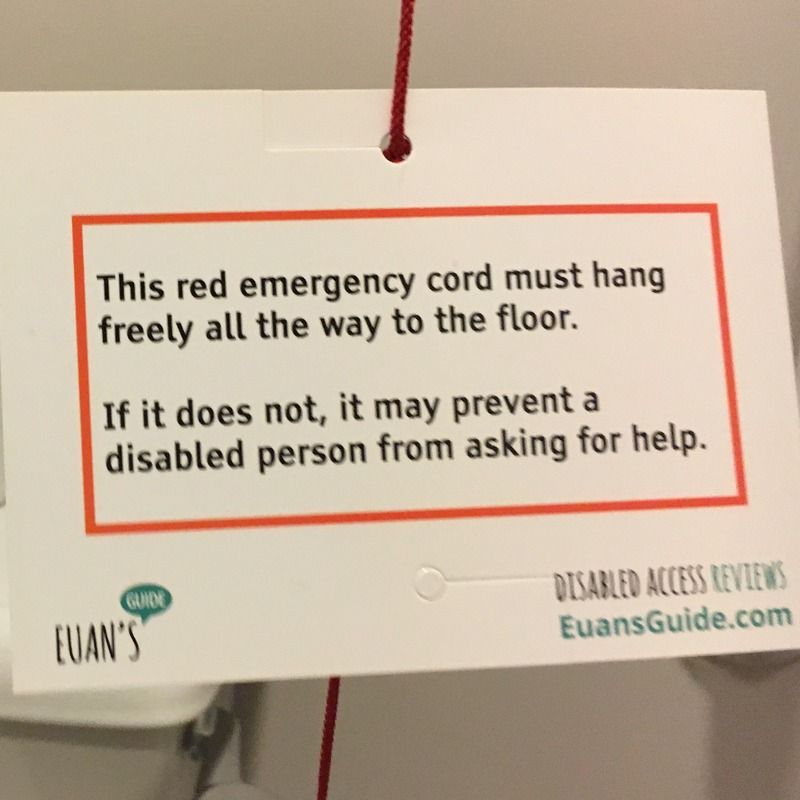
Finally, that red emergency pull cord.  It's not something I'm likely to use, but it's there for a reason.  A very good reason.  If a disabled person falls, for example because they're trying to transfer at a strange angle, they need to be able to grab it to get help.  Easily.  Without standing up (because perhaps they can't).  But cleaners clearly find the cord extremely annoying.  I've seen all sorts of efforts to tidy it "out of the way" - in one extreme case a hook had been installed, a foot below the ceiling, for it to be wound round!  One of the most annoying being to wrap it round the fold down handrails.  Thing is, they're there for a reason as well and it's pretty embarrassing to fold down the handrail (which I do need) and set it off.  Even if you can reach the reset button in a hurry (they're usually clear across the room), even if someone knocks rather than barging straight in while your knickers are down, you're going to do a walk (or wheel) of shame back to your table when that happens in a busy restaurant.

It seems like I'm not the only one who has been silently fuming about the safety cords.  The great Euan's Guide, who run a Scottish version of the J'accede app I used in France last year, have started a campaign and produced A5 cards to raise awareness of the cords.  Here's one I snapped at the Dovecot Studios in Edinburgh a couple of weeks ago.


I've ordered a supply and have already deployed my first - in an Asda store which had the cord very firmly wrapped around the hand rail (and yes, I did set it off when I untangled it!)

Saturday, 23 January 2016

Wheelchair fashion

A friend pointed me in the direction of IZ Collection, an American company who specialise in clothing for wheelchair users.  It hadn't occurred to me that such a thing existing but I can definitely see the point.

One of the things they don't tell you when you get a wheelchair is that you'll end up replacing most of your clothes.  All my trousers were too short because when you're sitting down the whole time, it pulls the hems up and your ankles get cold - I've gone from wearing a short to a regular length.  And you don't want a lot of bulk round your middle (and mine perhaps has enough built in!) so I'm afraid treggings and jeggings, much as I hate the words, are the answer.   Cardigans and jackets have to be fastened or they catch in the wheels (and get filthy!).  And the bits of you that feel the cold change. My lovely down jacket, bought last winter, is too warm on all but the coldest days, if I'm moving about much, but at the same time my legs are often freezing.  I have a couple of men's ski jackets, in dark colours because otherwise they'd be turned grey, quickly, by the muck from the wheels.  This hybrid jacket does a good job of not cooking my arms but keeping the bits that get cold warm.  They're far lighter than any coat I'd normally wear.  Finally, none of my tailored jackets fit anymore because I've developed arm muscles.  Just as well the dress code is fairly casual at my new job.

A lot of the clothes on the IZ website, particularly in the sale, are along the lines of things I've figured out already.  Tunics were already part of my wardrobe.  I've added cropped, fastening cardigans - some bought, some hand knitted.  I hate ironing, so jersey is a great fabric - it also doesn't crease when you're sitting all day.  The thing that interested me most - and what I am most likely to order - is their trousers.  I'd not anticipated the draughts down the back of my trousers, even when wearing a longer top and a vest (US - undershirt) tucked in underneath.  I've bought a couple of pairs of elastic waisted trousers from M&S which are comfortable and fit round the waist but IZ's look really interesting.  That slanted waistline looks like it could be very useful at stopping what my Grandma used to call "a chill in your kidneys".


The other conundrum I've been mulling over is how to cover my legs to keep them warm and dry without feeling like a granny.  I quite like a couple of the options on the IZ website, but I do wonder whether I couldn't make them myself.   On the other hand, a friend suggested one of these:


Wednesday, 13 January 2016

New job

I started a new job last week.  So far it has involved a lot of reading - more than I have done since I finished my MA - but I think I am going to enjoy it.  It's getting back to doing policy work, whereas my old job, with a local Council, had moved away from that.

Inevitably, a new job is a source of anxiety but this is the first time I've been "properly" disabled and changing job.  When I started my last job, back in 2008, I already had back and leg problems and had been using a stick, but I didn't have a disabled parking badge and could mostly get about OK.  A few months after I started, I seriously injured my right SI joint, which resulted in the transition to using crutches.  2 years later I broke my tailbone causing even more problems and a year ago I started using a wheelchair.  I've more than once had to fight to get adjustments made or had to work around accessibility issues.

So, I found myself dealing with the practicalities of disability with a new employer.  I have to say I am incredibly lucky in that everything has gone very smoothly with my employer.  A parking space was made available for me without me having to ask and they're happy to do whatever I need.  This is just as well, as Access to Work, the government scheme I first used for adaptations (a specialist office chair and some other equipment) about 10 years ago, has been much watered down in the meantime.

When I attended the Unison Disabled Members Conference back in October there was a lot of discussion about the effect changes to the scheme have had on disabled workers.  It's particularly affecting workers with hearing and visual impairments, but it is also having an impact on those with a physical disability who require adjustments in the workplace .  Increasingly, employers are expected to make these, in line with their obligations under the Equality Act.  But while I now have the luxury of an employer who will do what is necessary and would not dream of discriminating, I don't doubt this is providing a barrier to employment to some disabled people - and it seems like very little is being done to challenge that.

When I first used the scheme, you could apply within the first six weeks at a new job and they would provide any equipment needed at no cost to your employer.  This reduced the risk that an employer would reject a disabled candidate because of the potential cost of adjustments.  When I changed jobs, because my chair had been provided by Access to Work, it was mine to take with me to my new job.  This support was subsequently restricted to smaller employers and latterly it seems the expectations on employers have increased.  I'm still not sure what support will be available this time round.

The cuts to Access to Work make me particularly angry as this is a scheme which is supposed to remove barriers to disabled people working.  We still don't know what effect the scale of the cuts.    Reducing and restricting what it covers means that it is harder for a disabled person to find work, it adds another potential cost to employing a disabled person which serves as a disincentive for all but the very best employers.  And for some people, the cuts may mean work is no longer a viable option.  Surely that's the opposite of what should be happening.